gamesbriefs
9:01in productionCh. 1 · You Place With Your Eyes/ 9:01 · ceiling 15 min
Puzzle · Game design

Superliminal

Perspective isn’t just a trick here—it’s the only rule, and the only tool.

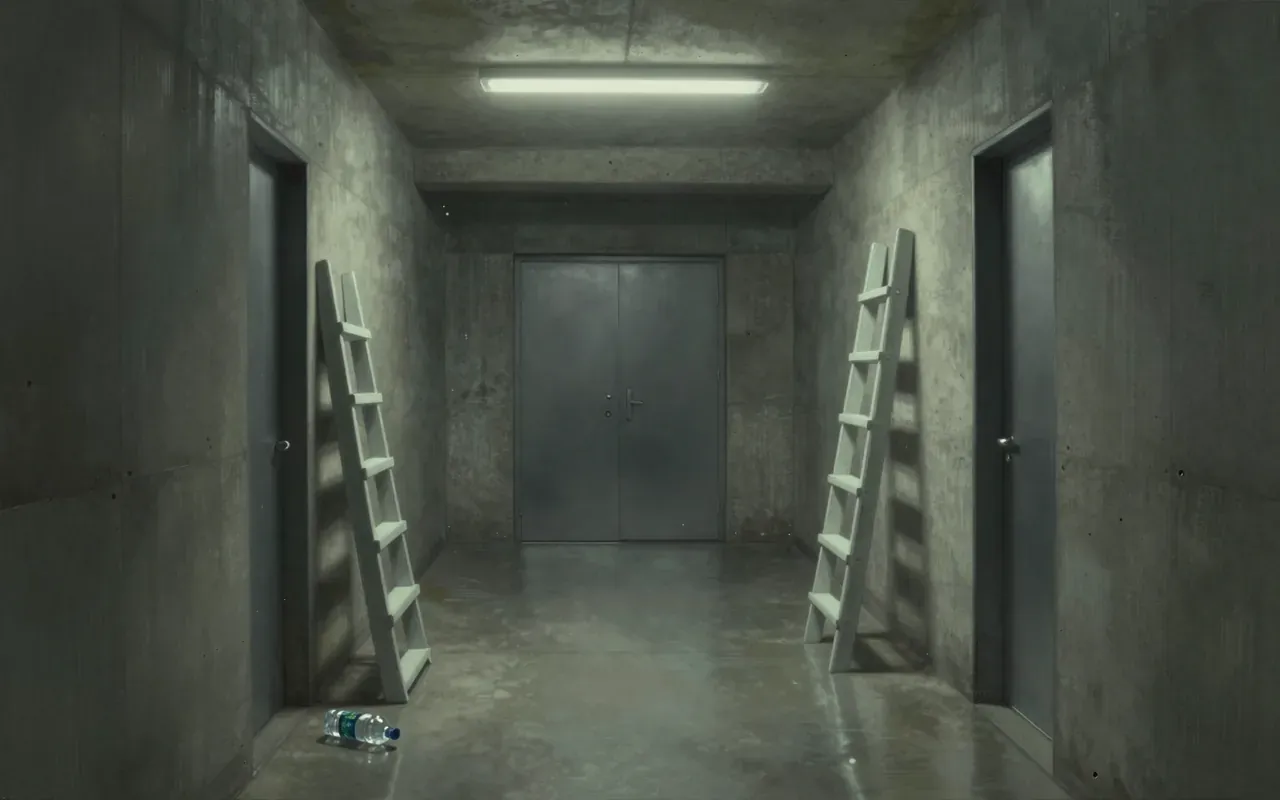
Superliminal is a first-person puzzle game built entirely around forced perspective. Players manipulate objects by moving them while holding them, then dropping them at new apparent distances to scale them up or down. This enables climbing, bridging, and unlocking. Trompe-l'œil elements require precise alignment to become interactive. Puzzles involve navigating rooms to reach exits that are closed, elevated, or hidden. The game establishes a single, elegant perceptual rule—and sticks to it rigidly.

Chapters & takeaways5
  1. 1:04
    You Place With Your Eyes

    Objects scale where you *think* you placed them—not where you actually did.

  2. 2:12
    Angle Dictates Scale

    Looking up or down while dropping changes size predictably—and permanently.

  3. 3:16
    Infinite Stacking, One Rule

    One scaled object becomes a step, then a platform, then a bridge—repeatedly.

  4. 4:28
    Illusions Demand Alignment

    Some objects exist only as flat fragments—until you find the exact spot where they snap into 3D.

  5. 5:34
    Exits Are Hidden in Plain Sight

    Every room is a locked box. The exit is always there—but never where your instincts say it should be.

Worth your time?

Yes. Play the whole thing.

3.5/ 5
What works
  • immediate legibility of the scaling loop
  • precise cause-and-effect between gaze and object size
  • trompe-l'œil segments resolving cleanly on alignment
What does not
  • narrative depth
  • mechanical expansion
  • feedback clarity
Play it if
  • players who enjoy spatial logic puzzles
  • those who value clean, self-contained rulesets
Skip it if
  • players seeking story-driven progression
  • those who tire of single-mechanic iteration
The written brief1 min read

What the game is

Superliminal is a 2019 surreal puzzle video game released by Pillow Castle Games. It uses forced perspective as its sole structural principle: objects scale based on where the player appears to place them, not where they physically are.

How it actually plays

The player picks up a cube, holds it while rotating their view, then drops it at a new apparent distance to scale it up or down. Looking up while dropping makes it grow; looking down shrinks it. This loop repeats to build platforms or clear obstacles. Trompe-l’œil objects appear only from precise angles before becoming grabbable. Most puzzles require navigating rooms to reach exits that are closed, elevated, or hidden.

What works

The scaling loop is immediate, legible, and physically intuitive once internalised. Dropping a cube while looking up to grow it into a platform—or down to shrink it into a key—feels like discovering a law of the game’s physics. Trompe-l’œil segments cohere cleanly when aligned, making perception itself the interface.

What does not

It offers no meaningful variation on its central scaling mechanic. Later puzzles layer trompe-l’œil illusions but do not recombine them with scaling in novel ways. The design withholds feedback on failed attempts, leaving players guessing whether they misjudged perspective or misapplied the rule.

Who it is for, and who it is not

It is for players who enjoy discrete, logic-driven spatial experiments and tolerate repetition as part of mastery. It is not for players who require escalating complexity, narrative scaffolding, or tactile or kinetic variety.

Is it worth your time

Yes—if you want a tight, self-contained optical illusion puzzle loop that demands spatial recalibration and rewards precise viewing. No—if you need narrative weight, mechanical variety, or sustained challenge beyond the core scaling rule.
Same shelf · Puzzle4 of 11
Up next in Games

Tactics Ogre

Quest · 1995 · 10:26

Tactics Ogre forces you to weigh every action twice: once for its effect, once for when it steals your next turn.

10:26