gamesbriefs
9:45in productionCh. 1 · Voxel Grid/ 9:45 · ceiling 15 min
Game design · Simulation

Minecraft

Minecraft gives you infinite terrain and zero direction—freedom as architecture, not narrative.

Minecraft is a sandbox and survival game developed by Mojang Studios. Its first alpha version was released on 17 May 2009. It began as a clone of Infiniminer.

Chapters & takeaways4
  1. 1:14
    Voxel Grid

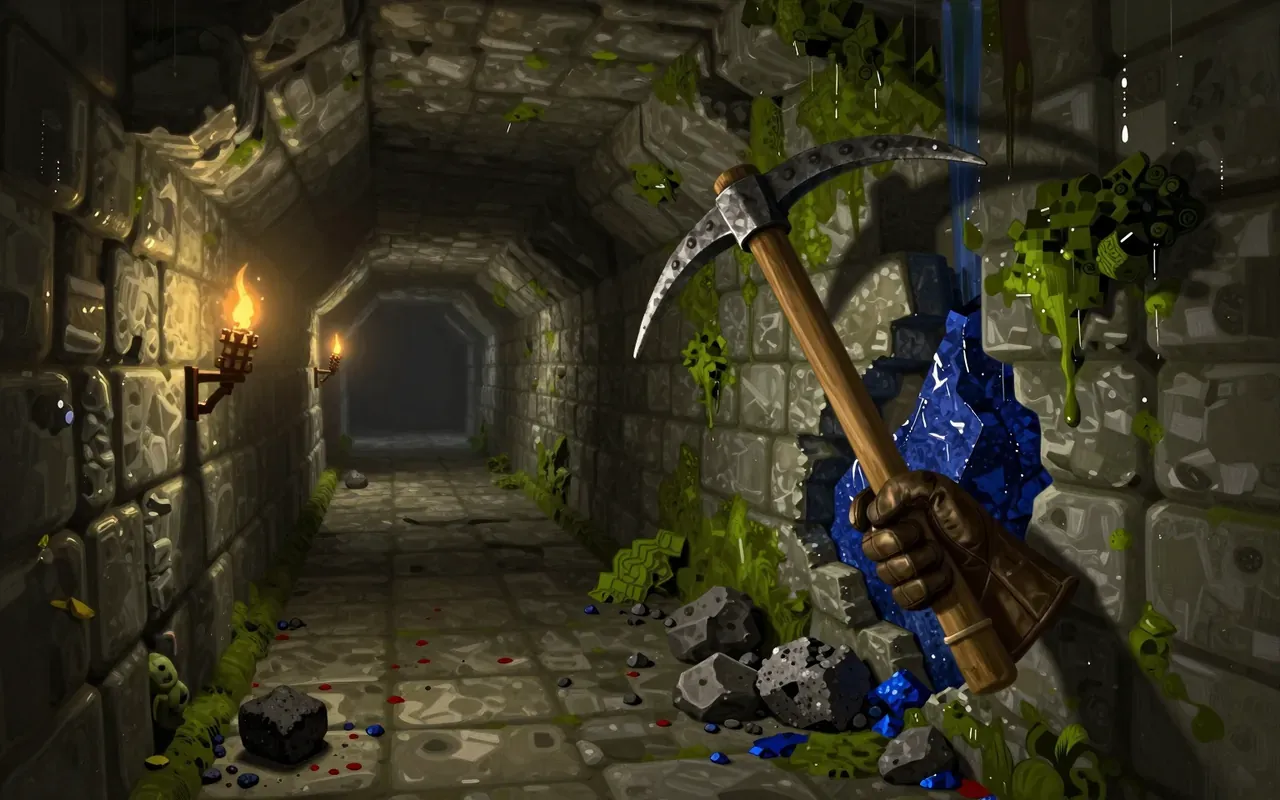
    Every world is a unique, infinite grid of cubes—dirt, stone, water, lava—each occupying fixed 3D space.

  2. 3:12
    Mine and Float

    You break blocks to gather, then place them anywhere—even mid-air—because most ignore gravity.

  3. 4:32
    No Goals, Only Loops

    There are no required goals. Survival and sandbox modes coexist, but neither forces a path.

  4. 6:11
    Persistent Play

    Each world persists. You cooperate or compete, fight mobs, craft tools—but only if you choose to.

Worth your time?

Yes. Play the whole thing.

4.5/ 5
What works
  • self-sustaining mine-craft-build-survive loop
  • gravity-defying placement enabling radical architecture
  • procedural generation delivering infinite terrain
  • voxel grid making material properties legible
What does not
  • establish pacing
  • provide authored meaning
  • deliver mechanical consequence beyond block placement
Play it if
  • players who enjoy spatial reasoning
  • players who prefer self-directed systems
Skip it if
  • players who rely on external validation
  • players who need escalating stakes
The written brief1 min read

What the game is

A sandbox and survival game where players mine and place voxel-based blocks in persistent, procedurally generated worlds.

How it actually plays

Players move freely in a first-person perspective, mining blocks and placing them elsewhere to build. Worlds are persistent, voxel-based, and procedurally generated. Most blocks ignore gravity. There are no required goals. Players extract raw materials, craft tools, build structures, fight hostile mobs, and interact in multiplayer.

What works

The loop—mine, craft, build, survive—is self-sustaining. Gravity-defying placement enables radical architectural freedom. Procedural generation delivers infinite terrain without repetition. The voxel grid makes material properties legible and predictable.

What does not

It does not establish pacing, escalation, or closure. It withholds authored meaning, curated sequence, or mechanical consequence beyond immediate block interaction. The optional achievement system does not shape play—it annotates it.

Who it is for, and who it is not

It is for players who enjoy spatial reasoning, iterative experimentation, and self-directed systems. It is not for players who rely on external validation, escalating stakes, or authored story beats.

Is it worth your time

Yes—if you want open-ended construction, exploration, and emergent problem-solving with no narrative pressure. No—if you need clear objectives, tight feedback loops, or authored progression.
Same shelf · Game design4 of 35
Up next in Games

Nights into Dreams

Sega · 1996 · 10:20

Nights into Dreams is not about flying freely—it’s about flying exactly where the game tells you to, exactly when it says you must.

10:20