Saved
Simulation · Racing & sports

Wreckfest

Wreckfest isn’t about crashing—it’s about calculating how much crash your chassis can take before it stops obeying you.

Worth your time?3.5/5Yes.Play the whole thing.What works, what does not, who it is for ↓
9:22in productionCh. 1 · Tactics Over Thrills/ 9:22 · ceiling 15 min
4 chapters · 9:22Ceiling 15:00

The brief is written and checked. The video joins this page when it is cut.4 chapters · 1 min read · 9:22 planned

Read the brief

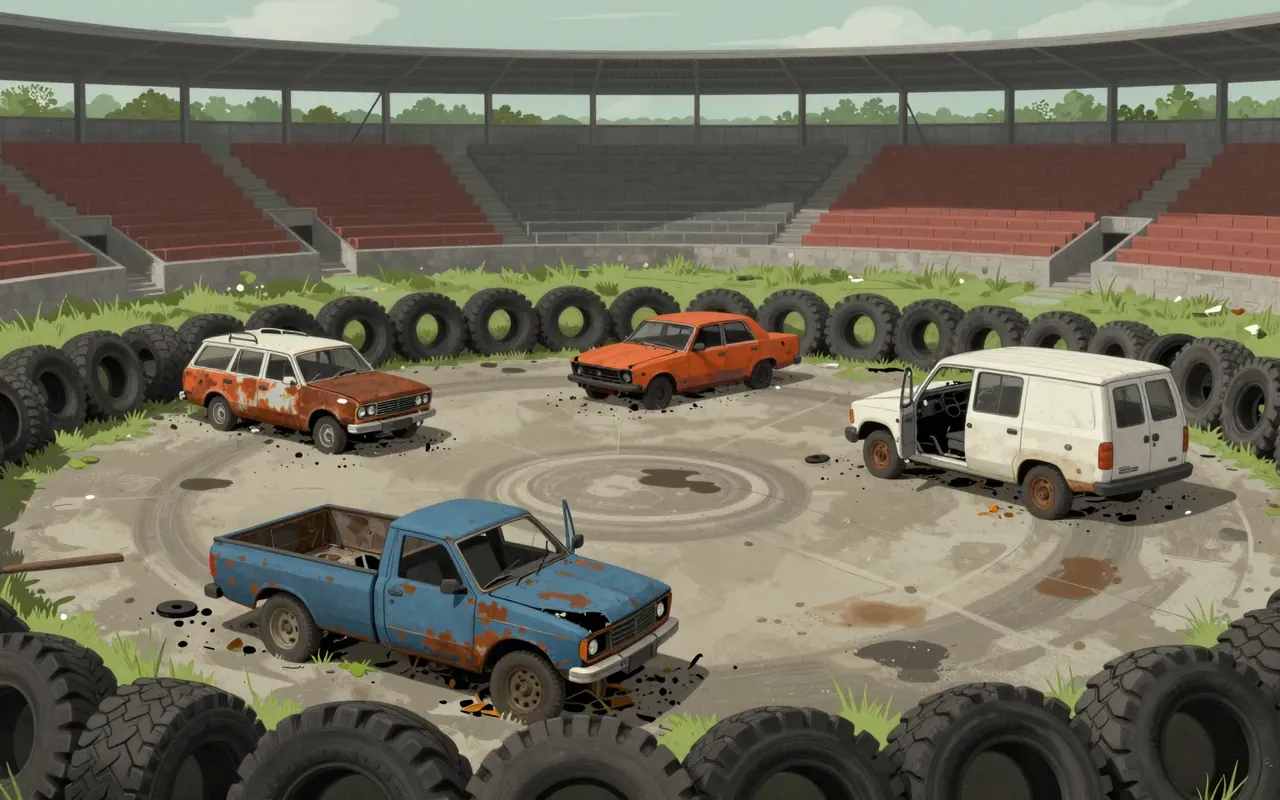
Wreckfest is a car simulator released on June 14, 2018 by Bugbear Entertainment using their ROMU engine. It features banger racing and demolition derby, with physics-driven soft-body damage that alters vehicle dynamics based on impact location. Players configure assists, buy and upgrade vehicles, and compete in career, multiplayer, and custom events. Its slower, more strategic pacing distinguishes it from faster destruction racers like Burnout.

Chapters & takeaways4
  1. 1:02
    Tactics Over Thrills

    Winning means balancing aggression and survival—ramming opponents costs control, and every hit changes how your car drives.

  2. 2:41
    Damage That Drives

    Soft-body damage isn’t cosmetic—it bends axles, tears suspension, and rewrites handling mid-race.

  3. 4:30
    Configurable Combat

    You choose your car, your transmission, your ABS, and your upgrades—every setting shapes your approach to collision.

  4. 5:58
    Three Modes, One Machine

    Career, multiplayer, and custom events all exist inside the same car-simulator framework—no mode escapes the physics.

1 more chapterFewer chapters
Worth your time?

Yes. Play the whole thing.

3.5/ 5
What works
  • soft-body damage affecting driving dynamics
  • tactical balance between aggression and vehicle preservation
  • configurable assists shaping session intent
  • vehicle upgrades with tangible performance effects
What does not
  • narrative
  • social features
  • visual fidelity
  • arcade responsiveness
Play it if
  • players who treat cars as mechanical systems
  • players who value cause-and-effect over spectacle
Skip it if
  • players seeking story or character
  • players expecting fast-paced chaos
Who should play it, and who should skipHide who it is for
The written brief1 min read

What the game is

Wreckfest is a car simulator built on the ROMU engine. It launched on June 14, 2018. Its core is banger racing and demolition derby, grounded in physics-driven soft-body damage modelling.

How it actually plays

Players control a car to win races or be the sole survivor in demolition derbies. Before each event, they choose a vehicle and configure assists including transmission type, ABS, and AI difficulty. Races demand constant tactical balancing: ramming and shunting opponents into barriers earns points but risks damage that degrades handling. Damage is location-based and physics-driven, using soft-body modelling to alter steering, suspension, and acceleration in real time.

What works

The soft-body damage model works. Location-based hits meaningfully degrade handling—front-left suspension failure pulls the car right; bent rear axle induces oversteer. Vehicle customisation and upgrades directly affect durability and combat effectiveness. The three modes—career, multiplayer, and custom events—each serve distinct player intents without overlap.

What does not

It does not deliver high-speed spectacle or emergent chaos. Its slower, more strategic pacing undercuts the visceral immediacy of demolition-focused rivals. Custom events lack robust tooling for sharing or discovery. Career mode offers no story, no characters, and no world-building beyond vehicle acquisition.

Who it is for, and who it is not

It is for players who treat cars as systems to understand and exploit—not as skins to collect or avatars to embody. It is not for players seeking narrative, social scaffolding, visual polish, or arcade responsiveness.

Is it worth your time

Yes—if you want a car simulator where damage changes how your vehicle behaves, not just how it looks. It asks for patience with slower pacing and tolerance for repetition across career events. It does not ask for reflexes, precision, or narrative investment.
Same strand · Simulation4 of 53
12:05
BeamNG.driveBeamNG · 2015BeamNG.drive is a sandbox vehicle simulation game built around soft-body physics. It features career mode, campaigns, time trials, and free roam. Campaigns consist of small scenarios themed around races, chases, and stunts. In time trials, players compete against their own best time using selected vehicles, maps, and routes. In free roam, players can operate, place, and manipulate objects and vehicles within maps. They can also change environmental properties such as time, gravity and wind. Players can utilize various objects ranging from road barriers to weapons such as cannons in order to inflict damage on other vehicles.
9:03
Session: Skate Simcrea-ture Studios · 2019Session: Skate Sim is an open-ended sports video game that simulates skateboarding with strict adherence to physics, presented through a fish-eye lens mimicking mini DV format.
11:06
Universe SandboxGiant Army · 2008Universe Sandbox (2008) is a physics simulation tool masquerading as a game. It lets players load real solar system data or invent new stars, planets, and black holes — then adjust mass, density, velocity, and time to watch gravity do its work. There is no score, no story, no failure state — only observation, iteration, and consequence. Its strength is fidelity to astrophysical cause-and-effect; its limit is the absence of any design layer between the user and the equations.
10:31
Elite DangerousFrontier Developments · 2014Elite Dangerous is a persistent-galaxy space sim built on scale, synchronicity, and player-driven consequence. It offers unparalleled scope but minimal scaffolding. Its ambition is structural, not narrative. Its cost is time, not money.
Up next in Games

Yoshi's Island

Nintendo · 1995 · 9:01

Yoshi's Island trades platforming precision for tactile puzzle logic—and it never asks you to jump faster, only smarter.

9:01