gamesbriefs
10:24in productionCh. 1 · What It Is/ 10:24 · ceiling 15 min
Racing & sports · Sound & music

Beat Saber

Beat Saber is not music made visual — it is music made muscular.

Beat Saber is a virtual reality rhythm game developed by Beat Games in 2018.

Chapters & takeaways4
  1. 1:12
    What It Is

    It is a VR rhythm game — not a port, not a hybrid, not a simulation.

  2. 2:30
    How You Move

    You relocate sabers in space to cut blocks in specific directions — or dots — on a fixed grid synced to beats.

  3. 3:56
    How You Score (and Fail)

    Score depends on swing geometry and timing. Failure is binary: the energy bar empties, and the song stops.

  4. 5:40
    What Punishes You

    Bombs punish reflexes. Walls punish stillness. Both enforce full-body engagement.

Worth your time?

Yes. Play the whole thing.

4.5/ 5
What works
  • spatial-rhythm-feedback
  • immediate-consequence-loop
  • directional-grid-discipline
  • energy-bar-stakes
What does not
  • narrative
  • progression
  • adaptivity
  • world-building
Play it if
  • vr-owners
  • rhythmic-learners
  • physical-gamers
Skip it if
  • seated-players
  • narrative-seekers
  • low-mobility-players
The written brief1 min read

What the game is

Beat Saber is a virtual reality rhythm game developed by Beat Games in 2018.

How it actually plays

Players stand in place and swing VR controllers to slice blocks approaching on a 4x3 grid. Each block has an arrow pointing in one of eight directions — or a dot, allowing side cuts only. Bombs must be avoided. Walls advance toward the player’s head. An energy bar starts at half and drains on errors: wrong direction, wrong saber, missed block, bomb hit, or wall collision. Empty bar ends the song.

What works

The 4x3 grid forces spatial awareness. Directional arrows lock timing to musical phrasing. Scoring rewards swing length, angle, and precision — not just timing. The energy bar creates real stakes without artificial lives or menus. Blocks, bombs, and walls combine into a single, coherent threat model.

What does not

It offers no story, no character, no world-building. There is no campaign, no unlockable lore, no adaptive difficulty. The energy bar resets per song; failure teaches nothing beyond muscle memory. It asks for exertion but gives no context for why.

Who it is for, and who it is not

It is for VR owners who treat games as exercise, musicians who feel rhythm kinesthetically, and players who value clean cause-and-effect over exposition. It is not for seated players, those with limited mobility, or anyone who needs meaning beyond motion.

Is it worth your time

Yes — if you own VR hardware and want immediate physical feedback from rhythm. No — if you lack space, stamina, or tolerance for repetition without narrative or progression.
Same strand · Racing & sports4 of 74
10:30
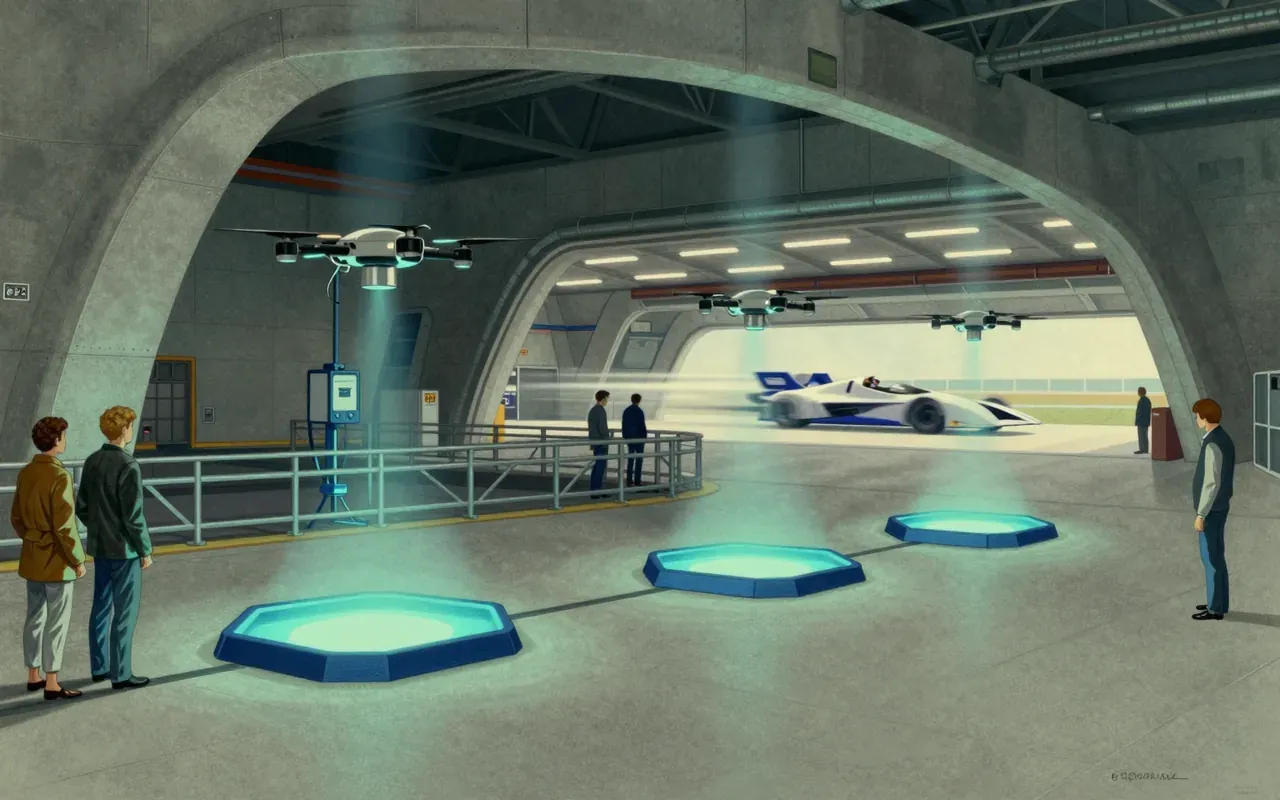
Wipeout 2097Psygnosis · 1996Wipeout 2097 is a PlayStation-era anti-gravity racing game developed by Psygnosis using the console as primary reference hardware in preparation for its September 1995 Western launch. Players race against AI opponents, aiming to finish in the highest position possible. Vehicles travel at high speeds and require air-brakes for cornering. A weapons system lets players eliminate opponents mid-race. Each vehicle has a shield energy quota; depletion from weapons or impacts destroys the craft. Destroyed ships can be recharged at pit stops at the cost of race time. The Quake Disruptor creates a wave effect that launches opponents into the air. Difficulty escalates across three classes — Vector, Venom, Rapier — each with higher speeds and more complex tracks.
10:55
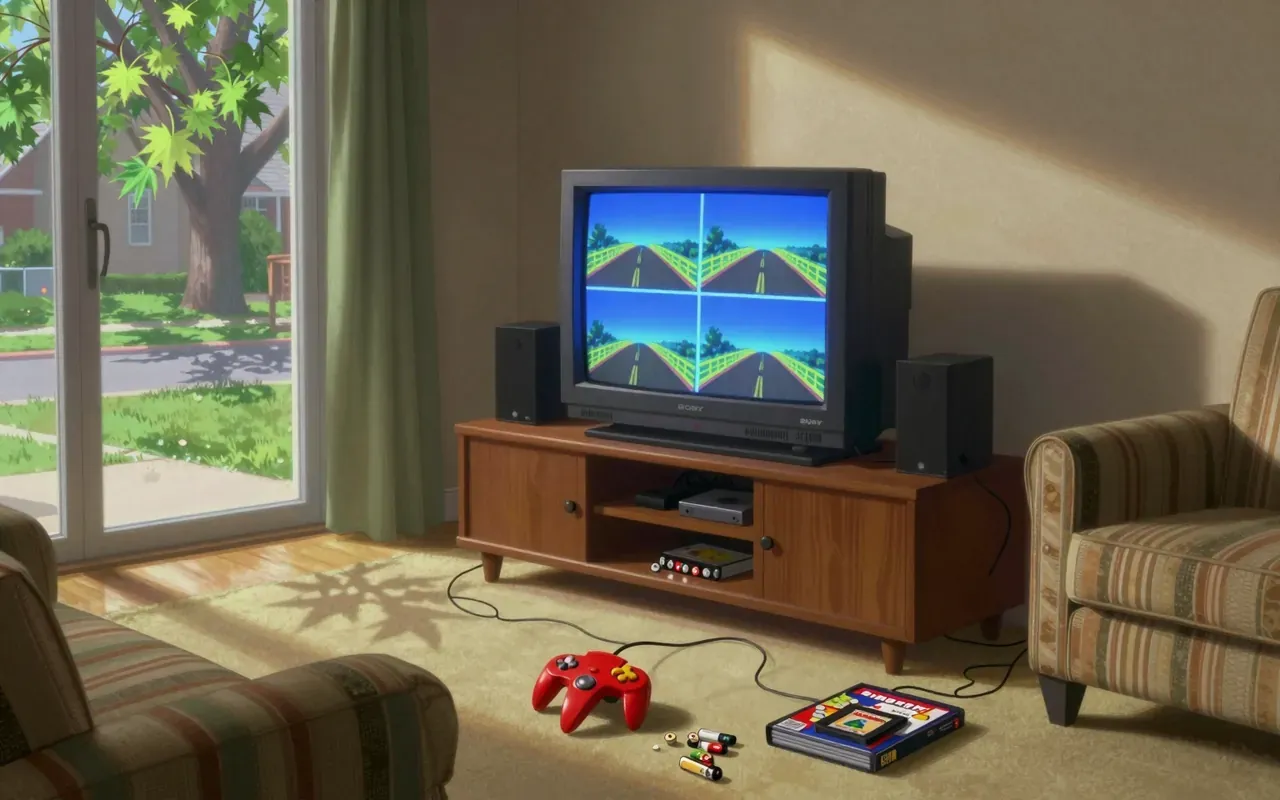
Mario Kart 64Nintendo · 1997Mario Kart 64 is a foundational local multiplayer racing game built around item-driven chaos, weight-class trade-offs, and split-screen immediacy. It asks players to react faster than they think—and to forgive the game when luck overrides skill. Its hardware constraints shaped its clarity: no HUD clutter, no camera tricks, no persistence beyond the next race.
12:05
BeamNG.driveBeamNG · 2015BeamNG.drive is a sandbox vehicle simulation game built around soft-body physics. It features career mode, campaigns, time trials, and free roam. Campaigns consist of small scenarios themed around races, chases, and stunts. In time trials, players compete against their own best time using selected vehicles, maps, and routes. In free roam, players can operate, place, and manipulate objects and vehicles within maps. They can also change environmental properties such as time, gravity and wind. Players can utilize various objects ranging from road barriers to weapons such as cannons in order to inflict damage on other vehicles.
11:16
TrackManiaNadeo · 2003TrackMania (2003) by Nadeo is a racing game built around player-authored tracks, checkpoint-driven time trials, and non-interactive concurrent multiplayer. It prioritises iterative lap refinement over narrative, shared space over shared stakes, and file-based exchange (.gbx) over centralised distribution. Its design assumes a player who wants to build, break, and rebuild a single corner until it yields perfection—and who finds satisfaction in that loop alone.
Up next in Games

Bejeweled Blitz

PopCap Games · 2010 · 9:42

Bejeweled Blitz replaces patience with panic — and makes you love it.

9:42