What the game is
A PlayStation 2 rhythm game built around a custom guitar-shaped controller. It translates recorded rock tracks into scrolling note lanes. Players match timing and colour to trigger audio feedback. It was published by RedOctane and developed by Harmonix, drawing directly from Frequency and Amplitude.
How it actually plays
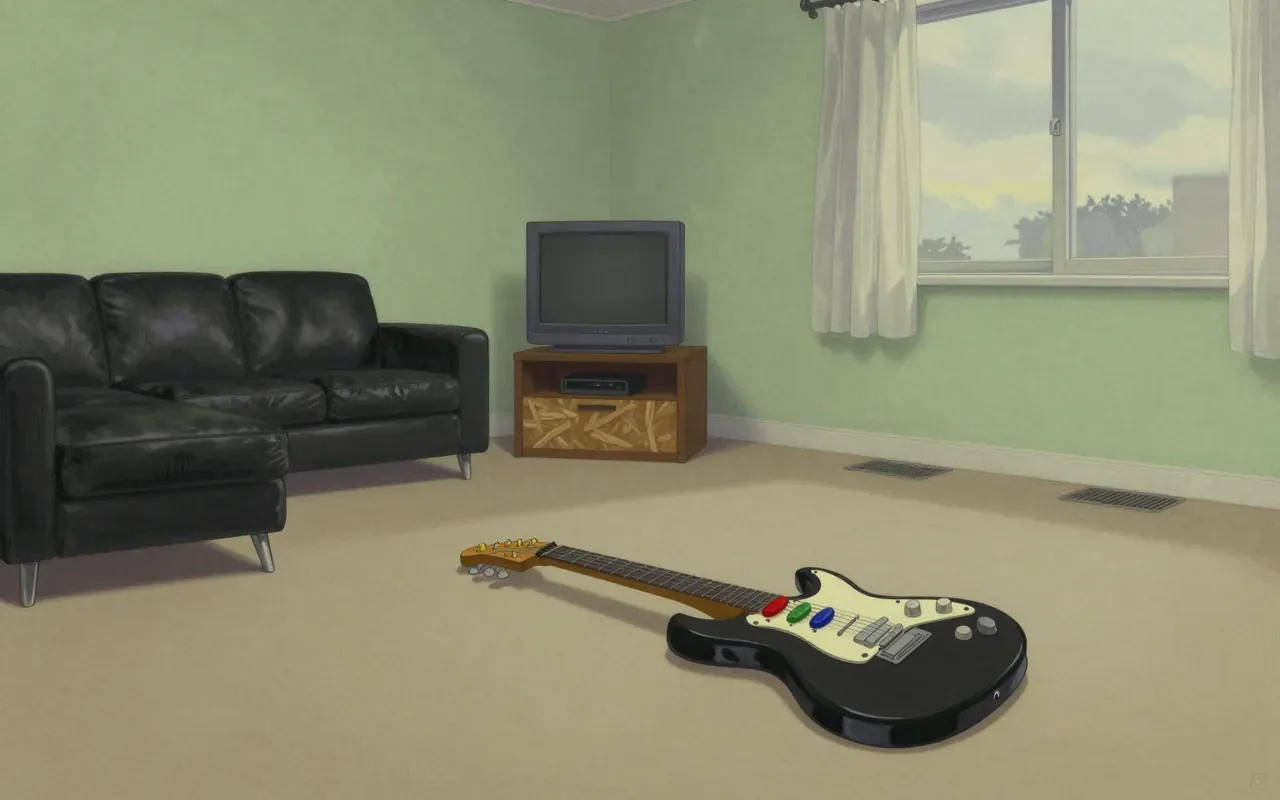
The player holds a coloured fret button and toggles the strum bar as each note passes a fixed marker on screen. Faster passages use hammer-on and pull-off techniques—no strumming required. A Rock Meter depletes with missed notes; drop it too low and the song ends early. Points come from hitting notes, chords and sustains. A score multiplier rises with consecutive hits. The guitar controller has five colour-coded frets and a strum bar. Left- or right-handed configurations are toggleable. A standard controller maps notes to face buttons.
What works
The Rock Meter creates immediate stakes: miss too many notes and the song stops—not just the score, but the music. Star Power, activated by tilting or using the whammy bar, doubles points and refills the Rock Meter, rewarding expressive risk. Hammer-ons and pull-offs let players chain notes without strumming—this opens up physical fluency. The five-fret layout is simple enough to learn, deep enough to master. Toggleable handedness removes a barrier before play even begins.
What does not
It does not simulate guitar playing. There is no string tension, no pitch bending beyond Star Power’s whammy bar, no fretboard geography. It does not teach music theory, chord structure or timing outside its own scroll speed. It offers no narrative, no character, no world beyond the stage backdrop and song list. It does not scale difficulty meaningfully across songs—only by note density and pattern complexity.
Who it is for, and who it is not
It is for people who want to move to music, not just listen. It is for players who enjoy clear cause-and-effect loops and tangible feedback. It is not for those who need story, exploration, progression systems or social mechanics. It is not for players who dislike repetition, physical mimicry or performance-as-feedback.
Is it worth your time
Yes—if you want to feel rhythm physically, not just hear it. It asks for coordination, repetition and tolerance for early failure. It does not ask for musical training, reading ability or long sessions. It rewards muscle memory over analysis. It is worth your time if you have a PS2, a space to swing a plastic guitar, and thirty minutes to lose yourself in one song.