What the game is
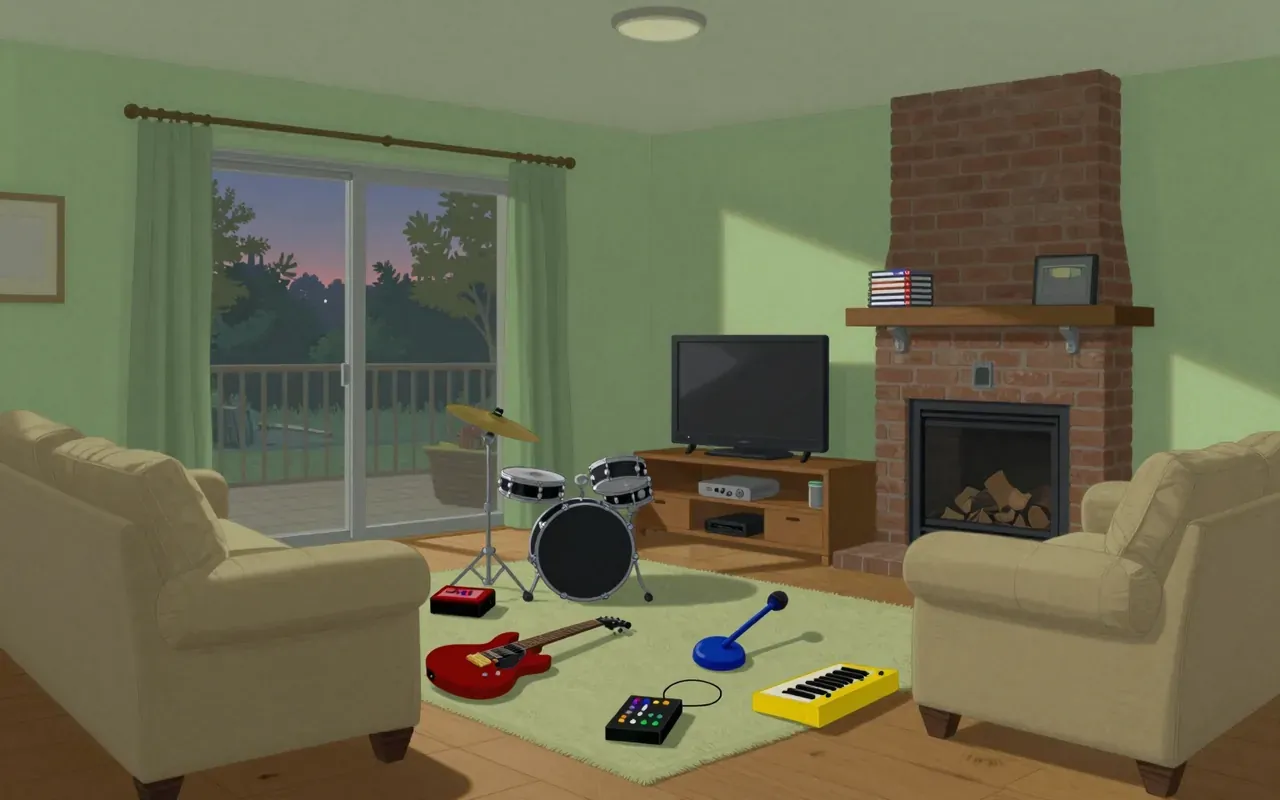
A cooperative rhythm game for up to four players using instrument-shaped controllers and a USB microphone. It simulates live rock performance through timed input matching. It expands Guitar Hero’s design by adding drums and vocals as first-class inputs. It launched in November 2007 with weekly downloadable songs for PlayStation 3 and Xbox 360.
How it actually plays
Players hold coloured fret buttons and strum for guitar and bass. They strike matching coloured drumheads or step on a pedal for bass drum notes. Vocals scroll horizontally at the top of the screen, with lyrics under green pitch bars; players must sing in relative pitch to the original, guided by a real-time pitch indicator. Up to three vertical note tracks — lead guitar, bass, drums — scroll simultaneously. The vocals display is separate and pitch-aligned.
What works
The shared band score creates immediate interdependence. Overdrive can be deployed cooperatively to rescue failing players. Each instrument maps cleanly to its controller: fret + strum, drumhead + pedal, pitch + voice. The vertical note lanes are legible. The horizontal vocal display separates pitch from rhythm cleanly. Weekly DLC sustains engagement without requiring new mechanics.
What does not
It does not work as a solo experience. The Tour mode is a thin wrapper. Overdrive is a band-saving mechanic, not a creative tool. Vocal scoring gives no feedback on tone, timbre, or expression — only pitch proximity. Difficulty scaling per instrument creates imbalance in mixed-skill bands.
Who it is for, and who it is not
It is for groups who want low-stakes, high-energy social play with physical props. It is not for solo players, competitive players, or anyone seeking musical instruction, narrative, or expressive freedom. It assumes access to peripherals, space, and tolerance for loud group singing.
Is it worth your time
Only if you have four people, instrument controllers, and a room where noise does not matter. It asks for physical coordination, shared attention, and tolerance for repetition. There is no solo depth. No progression outside the band score. No narrative. No stakes beyond hitting the next note.