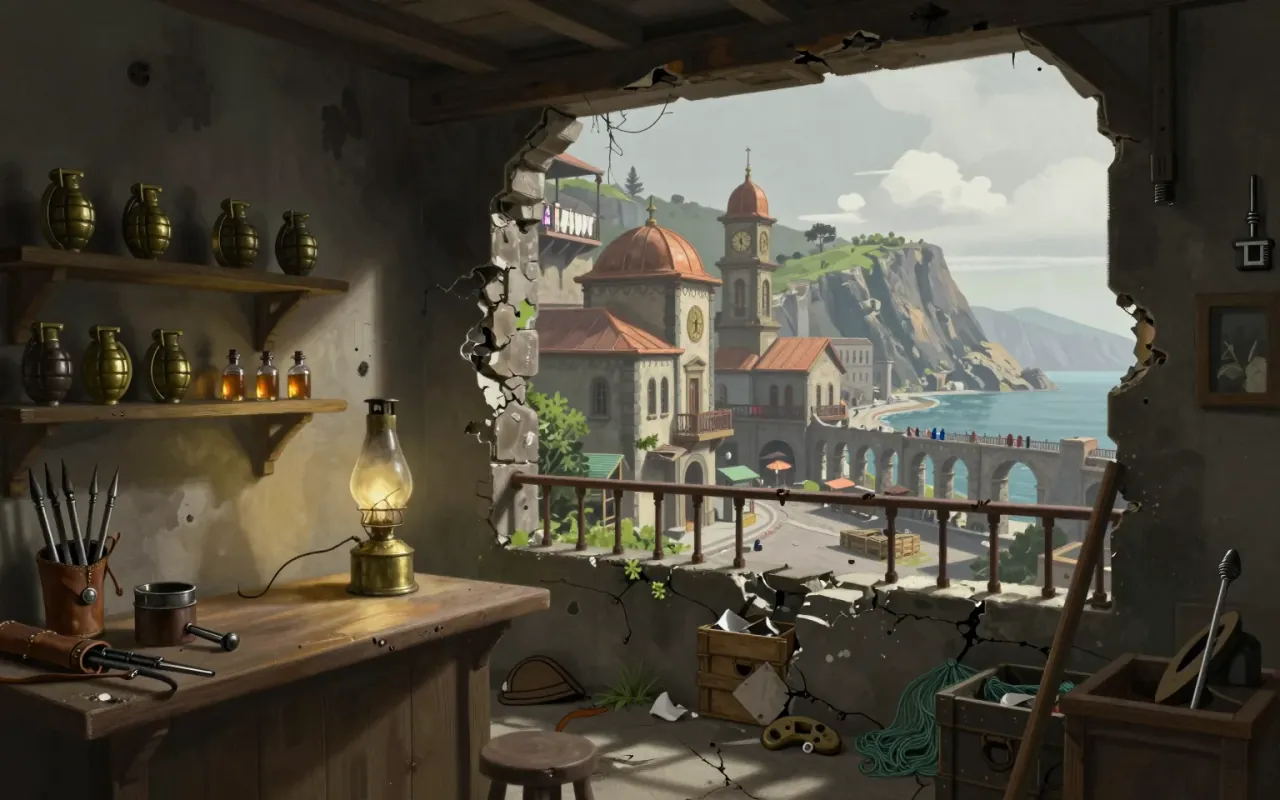
What the game is
Hitman 3 is a 2021 stealth game. IO Interactive developed and published it. It is the final entry in the World of Assassination trilogy. It runs on the Glacier engine. It is played in third-person as Agent 47.
How it actually plays
You play as Agent 47 in third-person. You enter large sandbox levels — except Romania — and hunt multiple targets. Instinct vision highlights all relevant items and targets. You infiltrate by stealing disguises: knock out NPCs or find them in the map. Stealth is mandatory. No combat loop. No fail state for detection — just consequence: guards become hostile, routes close, opportunities vanish.
What works
Disguise-based infiltration creates constant low-stakes risk calculus. Persistent shortcuts reward repeat play. Instinct vision turns observation into actionable input. Each sandbox level — except Romania — supports layered experimentation: poison a drink, rig a chandelier, impersonate staff, wait for a private moment. The loop is tight: observe, plan, infiltrate, adapt, eliminate.
What does not
The Romania level breaks the sandbox rule: it is not large or freely explorable. The Berlin level assigns only one target, removing multi-target deduction and sequencing. The trilogy’s conclusion offers no narrative closure beyond what the prior games established. Ray tracing is a technical feature with no gameplay consequence.
Who it is for, and who it is not
It is for players who enjoy methodical environmental reading, pattern recognition, and self-imposed constraints. It is not for players who require story momentum, character agency beyond mechanics, or variety in core verbs. It assumes fluency with the trilogy’s systems — no onboarding for newcomers.
Is it worth your time
Yes — if you want to spend evenings solving spatial, social, and systemic puzzles in tightly authored environments. No — if you seek narrative payoff, character development, or mechanical novelty. It delivers the purest iteration of its loop, but only to those already fluent in it.