gamesbriefs
8:49in productionCh. 1 · Tricks Are Your Throttle/ 8:49 · ceiling 15 min
Racing & sports · Retro

SSX

Tricks aren’t flourishes — they’re your throttle, your brakes, and your only way to win.

SSX (2000) is a PlayStation 2 arcade snowboard racer where tricks directly fuel speed via a boost meter. Developed by EA Vancouver (then EA Canada) under the EA Sports BIG banner, it replaces simulation with rhythm, timing, and terrain-as-launchpad. Uber Tricks, rivalries, and open-world structure belong to sequels — the original delivers tight, repeatable races across discrete global courses. It works because tricks are mandatory, not decorative. It wears thin because it offers no stakes beyond the next jump.

Chapters & takeaways4
  1. 1:02
    Tricks Are Your Throttle

    Tricks are not optional extras — they’re the engine of speed and victory.

  2. 2:14
    The Boost Meter Is a Trick Counter

    Boost is earned, not given — and it’s tied directly to trick execution.

  3. 3:20
    Built by EA’s Oldest Studio, Not Its Sports Division

    EA Vancouver — EA’s oldest and largest studio — built SSX as an EA Sports BIG title, not a simulation but a branded arcade spectacle.

  4. 4:40
    What SSX 2000 Does *Not* Have

    Uber Tricks, rivalries, and the open mountain came later — the 2000 original has none of them.

Worth your time?

Yes. Play the whole thing.

3.5/ 5
What works
  • tight trick-to-boost loop
  • intuitive yet deep control scheme
  • terrain designed explicitly for aerial flow
What does not
  • open mountain
  • rivalries
  • Uber Tricks
  • unlimited boost
Play it if
  • players who value immediate mechanical feedback
  • players who enjoy chaining tricks for rhythm and flow
Skip it if
  • players seeking narrative or simulation
  • players expecting long-term progression systems
The written brief1 min read

What the game is

SSX is an arcade snowboarding racer developed by EA Vancouver (then EA Canada) and published by EA Sports BIG for PlayStation 2 in 2000. It is built around a loop of racing + trick-performing, with tricks directly enabling speed advantages.

How it actually plays

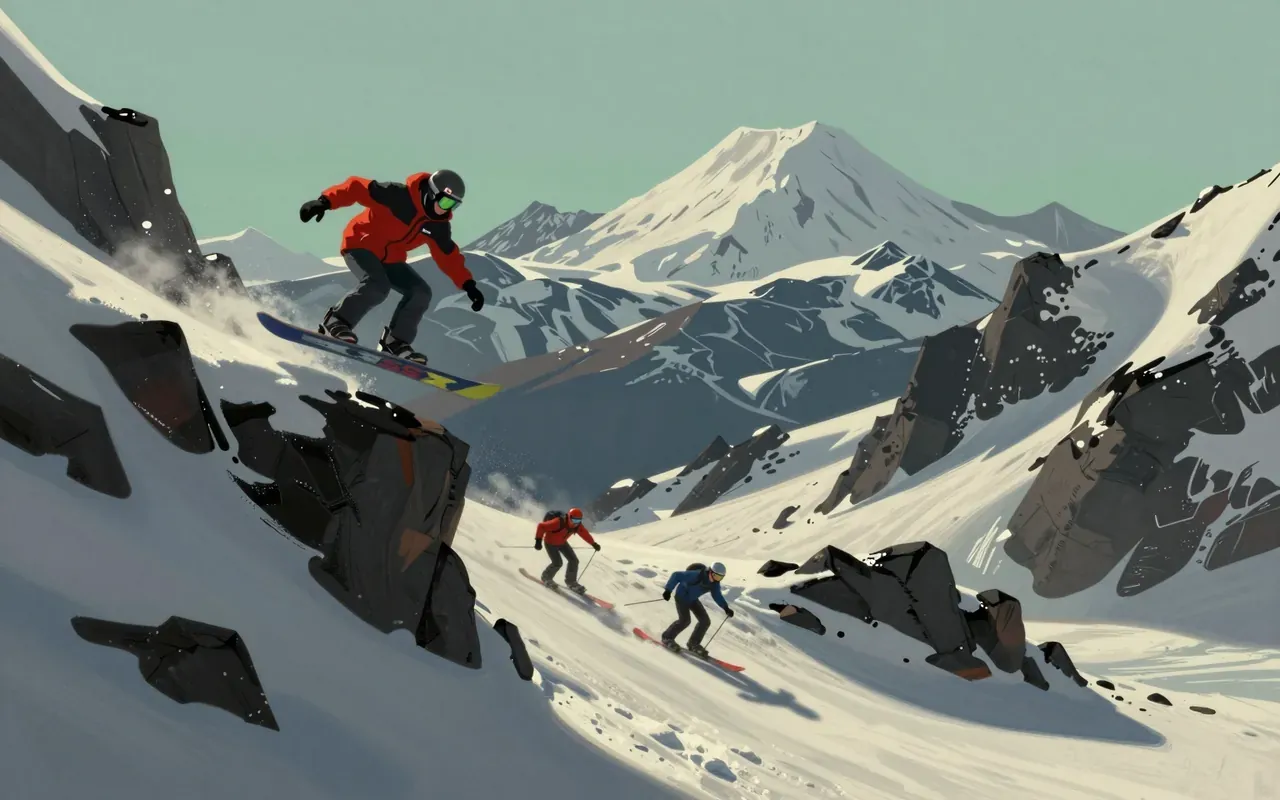
Players race down snow-covered mountains while performing tricks to fill a boost meter. Tricks generate speed boosts. Performing tricks is required to gain speed and win races. The boost meter enables acceleration. A session consists of chaining tricks mid-air and on terrain to sustain momentum, manage adrenaline, and trigger Uber Tricks — which involve detaching the board — to unlock unlimited boost.

What works

The core loop tightly binds trick execution to forward momentum. Controls are intuitive but reward precise timing and combo fluency. Terrain is designed for aerial flow — jumps, rails, and half-pipes exist to launch tricks, not simulate skiing or physics. Boost management creates moment-to-moment tension: empty meter means falling behind; full meter means committing to riskier air time.

What does not

It does not sustain long-term engagement through meaningful stakes, character development, or evolving course design. There is no open mountain structure in the 2000 original — that arrived in SSX 3. Rivalries and Uber Tricks were introduced in SSX Tricky, not the first game. The 2000 version offers discrete global courses, not systemic consequences from opponent interaction.

Who it is for, and who it is not

It is for players who enjoy immediate feedback, rhythmic input patterns, and mechanical mastery over realism or story. It is not for players seeking simulation, slow-burn progression, or narrative context — there is none.

Is it worth your time

Yes — if you want fast, tactile, rhythm-driven snowboarding that rewards timing and spatial awareness over realism or narrative. No — if you expect simulation, progression depth beyond trick combos, or sustained challenge without repetition.

Same shelf · Racing & sports4 of 22
Up next in Games

SSX Tricky

EA Canada · 2001 · 10:57

SSX Tricky trades realism for rhythm—and wins by making every jump feel like a dare you can’t refuse.

10:57