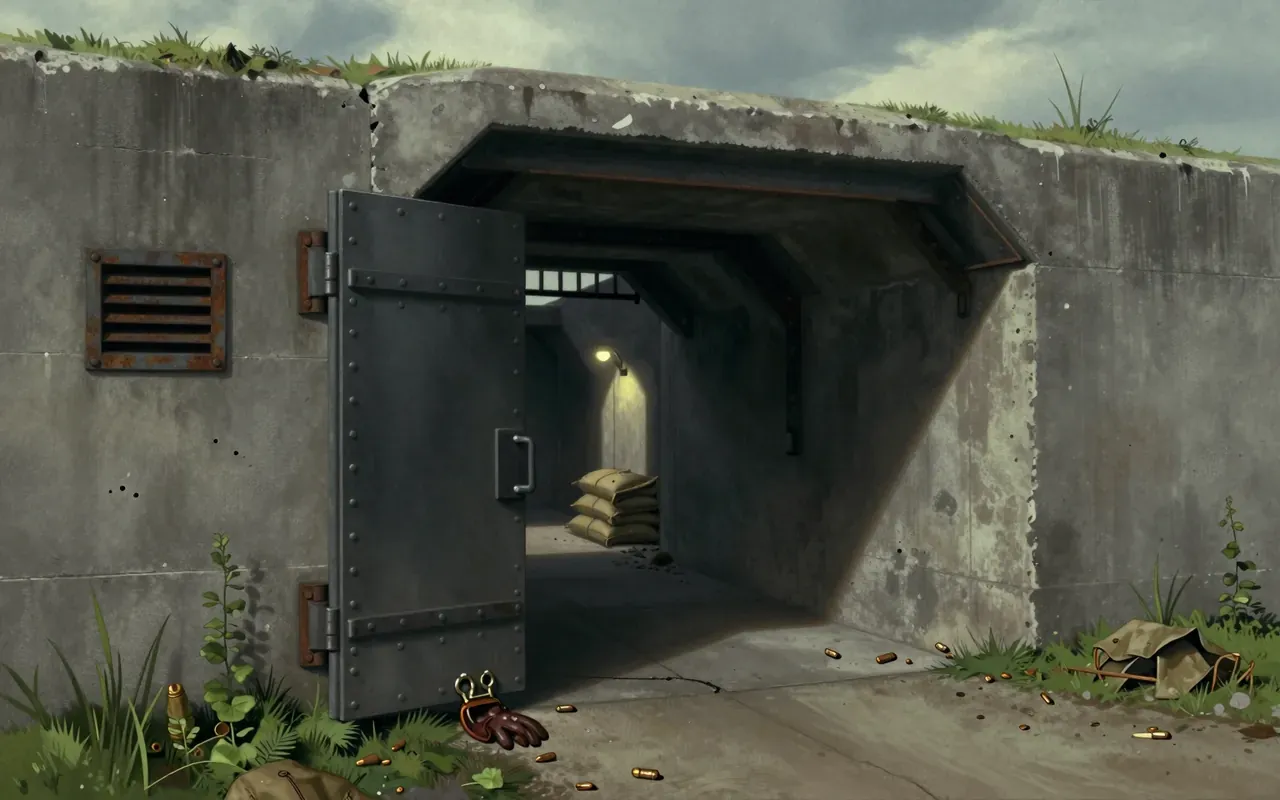
What the game is
Wolfenstein 3D is a first-person shooter released by id Software in 1992. The player assumes the role of Allied spy B.J. Blazkowicz during World War II. The game presents rudimentary 3D graphics and violent gameplay. Levels are grouped into named episodes. Nazi symbols—including swastikas and the Horst-Wessel-Lied—are used throughout the PC version.
How it actually plays
The player moves across a flat, grid-based plane of uniform-height walls and doors. Each level is a maze of rooms and corridors. The player must find an elevator to advance—or kill a boss on the final level of each episode. Combat is immediate and binary: point, shoot, reload, repeat. Enemies appear instantly at fixed points or behind doors. Health and ammo are scarce. There is no cover, no crouch, no jumping, no inventory management beyond picking up items on the floor.
What works
The grid-based level design creates tight, readable combat spaces. Enemy placement forces constant spatial awareness. The elevator-as-exit rule gives every room purpose. The weapon escalation—from knife to chain gun—creates clear power milestones. The flat-plane constraint makes navigation legible at speed. The violence is unambiguous and immediate, reinforcing the loop of threat and response.
What does not
It does not simulate space convincingly. Walls are texture-mapped planes with no depth or perspective beyond height. It does not support exploration for its own sake—rooms exist only as chokepoints or ammo caches. It does not adapt: enemies follow fixed patrol paths or spawn identically every time. It does not accommodate failure gracefully—death resets the entire level.
Who it is for, and who it is not
It is for players who want to understand how the FPS genre’s core loop was built from hardware limits and design discipline. It is not for players who need story, character, moral ambiguity, or systems that respond to choice. It is not for those who mistake historical significance for present-day playability.
Is it worth your time
Yes—if you want to feel the raw architecture of the FPS: how movement, sightlines, and enemy placement create tension in real time. No—if you expect narrative, progression, or mechanical nuance beyond the loop of finding the exit while surviving waves of identical foes.