gamesbriefs
8:22in productionCh. 1 · Not More Street Fighter. Different Street Fighter./ 8:22 · ceiling 15 min
Fighting · Game design

Street Fighter III

Street Fighter III replaces safety with precision — and dares you to parry or perish.

Street Fighter III discards familiarity to enforce precision. Its parry system removes all passive defence. Every dash, leap, or super jump exists only as long as your timing holds. It is not generous. It is not nostalgic. It is calibrated.

Chapters & takeaways4
  1. 1:04
    Not More Street Fighter. Different Street Fighter.

    It is a one-on-one fighter defined by new movement and defensive rules — not just more characters or flashier effects.

  2. 2:28
    Parry Is Not Block

    Parrying isn’t blocking with flair — it’s a binary, frame-perfect input that removes damage, chip, and recovery cost.

  3. 3:44
    Movement With Consequences

    Dash, retreat, super jump, and leap attacks reposition combat vertically and horizontally — but only if you survive long enough to use them.

  4. 5:20
    Super Arts Demand Super Timing

    Defending against Super Arts without chip damage makes parrying essential — not optional — at high level.

Worth your time?

Yes. Play the whole thing.

4.5/ 5
What works
  • parry timing as core rhythm
  • movement tied to vulnerability windows
  • Super Art cancelling as combo grammar
What does not
  • nostalgia
  • accessibility
  • character continuity
Play it if
  • players who train inputs like scales
  • players who value consequence over spectacle
Skip it if
  • players who rely on aerial guard as a crutch
  • players seeking narrative or world-building
The written brief1 min read

What the game is

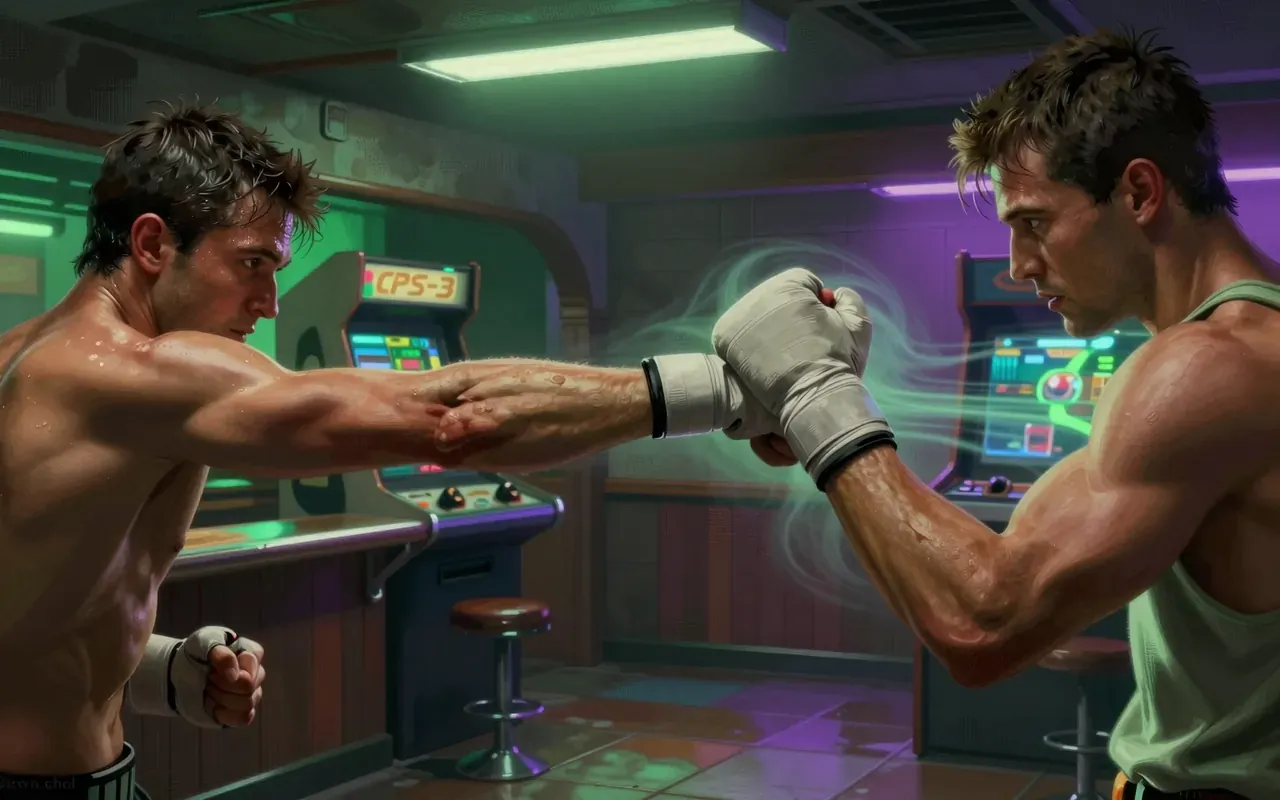
A one-on-one 2D fighting game built for Capcom’s CPS-3 arcade hardware. It introduces parrying as the central defensive mechanic and restructures movement, hit reactions, and combo flow around it.

How it actually plays

Players dash, retreat, super jump, and quick stand after knockdown. Leap attacks hit crouching opponents. Aerial guarding is gone. Parrying replaces it: input toward or down at the exact moment an attack lands to deflect it cleanly — no damage, no block stun, full counter opportunity. Special Moves and Super Arts can be parried without the minor chip damage blocking inflicts.

What works

Parrying creates asymmetric risk: a successful parry opens long, safe counter windows; a mistimed input leaves the player fully vulnerable. Super Arts cancel directly from special moves, enabling tight, high-damage sequences. The turned-around state enables guaranteed grabs after certain hits — a new layer of spatial control.

What does not

It does not accommodate casual players. The parry timing is unforgiving. The roster discards most prior characters, offering no nostalgia anchor. It offers no aerial defence, removing a safety net present in earlier Street Fighter titles.

Who it is for, and who it is not

It is for players who treat inputs like musical notation — who study frame data, rehearse timings, and seek mastery through repetition. It is not for players who prefer forgiving inputs, narrative context, or gradual skill ramping.

Is it worth your time

Yes — if you want a precise, high-stakes 2D fighter that demands timing over reflexes and rewards deep pattern recognition. No — if you expect accessible combos, generous recovery windows, or familiar characters beyond Ryu and Ken.
Same shelf · Fighting4 of 20
Up next in Games

Street Fighter V

Capcom · 2016 · 10:20

A fighting game that demands mastery but shipped without the basics required to practise it.

10:20