gamesbriefs
11:30in productionCh. 1 · The First 3D Mario/ 11:30 · ceiling 15 min
Game design · Retro

Super Mario 64

It invented 3D platforming by making the camera a character—and never letting you forget it.

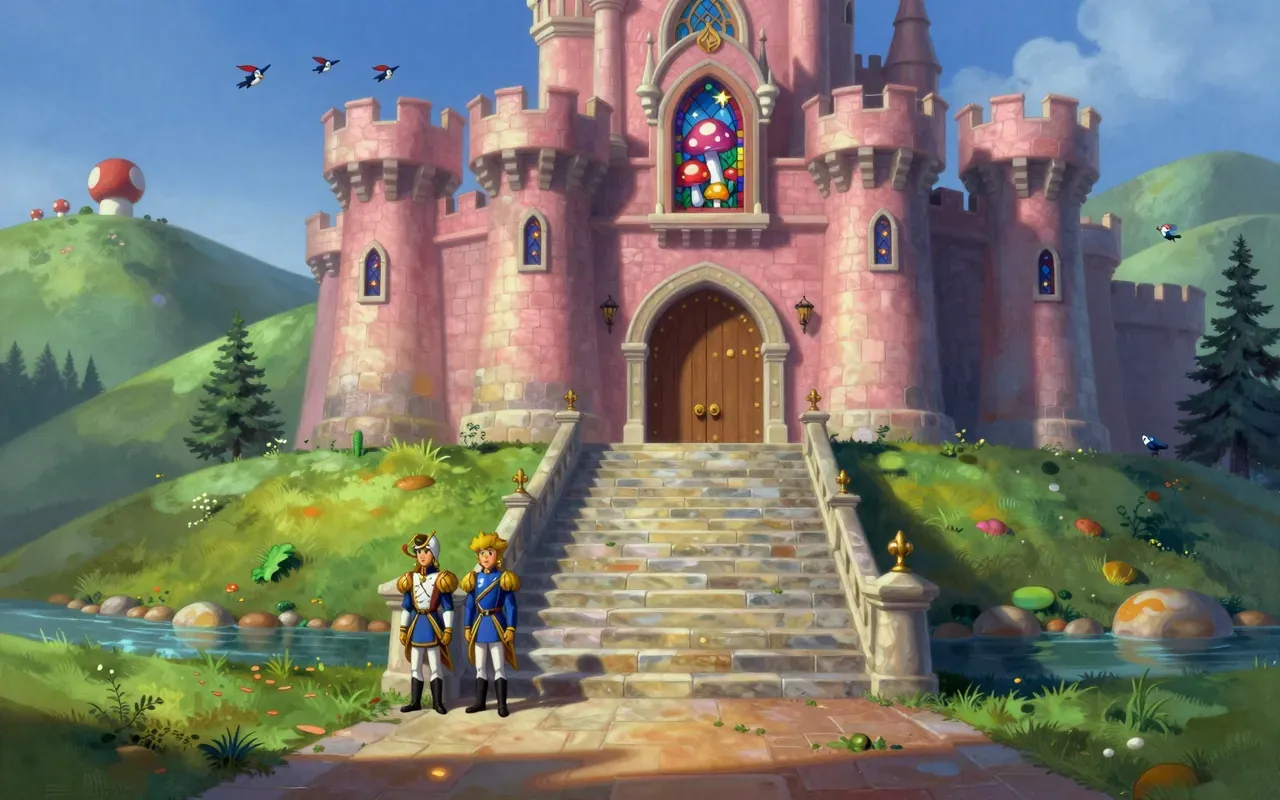
Super Mario 64 is a 1996 Nintendo 64 platform game and action-adventure title. It is the first Super Mario game with 3D graphics and a large open world. Bowser invades Princess Peach’s castle, kidnaps her, and hides Power Stars in magical paintings. As Mario, the player traverses levels and collects Power Stars to unlock areas of the castle, reach Bowser and rescue Peach. Mario’s abilities are far more diverse than in previous games. He can walk, run, jump, crouch, crawl, climb, swim, kick, grab objects, and punch using the game controller's analog stick and buttons. He can execute special jumps by combining a regular jump with other actions, including the double and triple jumps, long jump, backflip, and wall jump. The player can adjust the camera—operated by a Lakitu broadcasting Mario—and toggle between first-person and third-person view.

Chapters & takeaways6
  1. 1:00
    The First 3D Mario

    It is the first Super Mario game with 3D graphics and a large open world.

  2. 2:15
    Movement as Language

    Mario’s movement set—walk, run, jump, crawl, climb, swim, plus double/triple/long/backflip/wall jumps—is defined by analog input and button combos.

  3. 3:29
    Camera as Co-Pilot

    The player adjusts a Lakitu-operated camera and toggles between first- and third-person views.

  4. 4:53
    Paintings as Portals

    Bowser invades Peach’s castle, kidnaps her, and hides Power Stars in magical paintings—each accessed via portals.

  5. 5:50
    Genre Codified

    It is a 3D platformer and action-adventure game where the player controls Mario through diverse courses.

  6. 7:15
    Hardware’s First Test

    It launched with the Nintendo 64—a console marketed on its 64-bit architecture.

Worth your time?

Yes. Play the whole thing.

3.5/ 5
What works
  • The analog stick enables unprecedented 360-degree mobility for its time.
  • Jumping is expressive and layered: each variant changes momentum, height, and landing state.
  • The castle hub creates tangible progression—every star unlocks a new door, stairway, or room.
  • Power Star objectives force varied engagement: race, collect, survive, solve, explore.
What does not
  • The camera often fights the player instead of serving them.
  • Movement feels imprecise on flat surfaces.
  • Objectives lack clear visual cues.
  • Secrets rely on frame-perfect inputs or undocumented geometry, not discovery.
Play it if
  • Players curious about foundational 3D design.
  • People who enjoy tactile, physics-led movement systems.
  • Those willing to accept jank as part of the era’s hardware negotiation.
Skip it if
  • Players who prioritise intuitive camera control.
  • Players who expect consistent hit detection.
  • Players who require explicit feedback.
The written brief1 min read

What the game is

A 1996 Nintendo 64 platform game and action-adventure title. It is the first Super Mario game with 3D graphics and a large open world. Bowser invades Princess Peach’s castle, kidnaps her, and hides Power Stars inside magical paintings.

How it actually plays

The player moves Mario with an analog stick to walk, run, jump, crouch, crawl, climb, swim, kick, grab, and punch. Special jumps—double, triple, long, backflip, wall—require precise timing and button-analog combinations. The camera is controlled by a Lakitu; the player can adjust it or switch to first-person view. Each course contains six named objectives and a 100-coin star. Progress depends on collecting Power Stars to unlock new castle areas and reach Bowser.

What works

The analog stick enables unprecedented 360-degree mobility for its time. Jumping is expressive and layered: each variant changes momentum, height, and landing state. The castle hub creates tangible progression—every star unlocks a new door, stairway, or room. Power Star objectives force varied engagement: race, collect, survive, solve, explore.

What does not

The camera often fights the player instead of serving them. Movement feels imprecise on flat surfaces. Objectives lack clear visual cues. The 100-coin star offers no narrative or mechanical reward beyond repetition. Secrets rely on frame-perfect inputs or undocumented geometry, not discovery.

Who it is for, and who it is not

Players curious about foundational 3D design. People who enjoy tactile, physics-led movement systems. Those willing to accept jank as part of the era’s hardware negotiation. It is not for players who prioritise intuitive camera control, consistent hit detection, or explicit feedback.

Is it worth your time

Yes—if you want to experience how 3D movement, camera agency, and mission-based exploration were first codified in a home console platformer. No—if you expect tight feedback, consistent physics, or modern accessibility. It demands patience with its camera, trial-and-error jumps, and opaque spatial logic.
Same shelf · Game design4 of 35
Up next in Games

Super Mario Bros.

Nintendo · 1985 · 9:51

Super Mario Bros. is not about saving a princess—it’s about learning to read space, time, and consequence in real time.

9:51