What the game is
A side-scrolling platformer released in 1985 alongside the Nintendo Entertainment System. Players control Mario—or Luigi in two-player mode—to traverse the Mushroom Kingdom and rescue Princess Toadstool from Bowser.
How it actually plays
The player moves right through side-scrolling stages. Jumping defeats enemies in one hit, but only if landed on directly. Mario shrinks when hit while small and dies instantly if hit while small or if he falls off-screen. Collecting a Super Mushroom makes him grow, grants one instance of damage immunity, and lets him break bricks above him. Coins are collected from the ground or by hitting ?-bricks from below. Extra lives come from 1-Up Mushrooms, 100 coins, chaining enemy bounces, or defeating multiple enemies with a Koopa shell. Time limits force constant forward motion.
What works
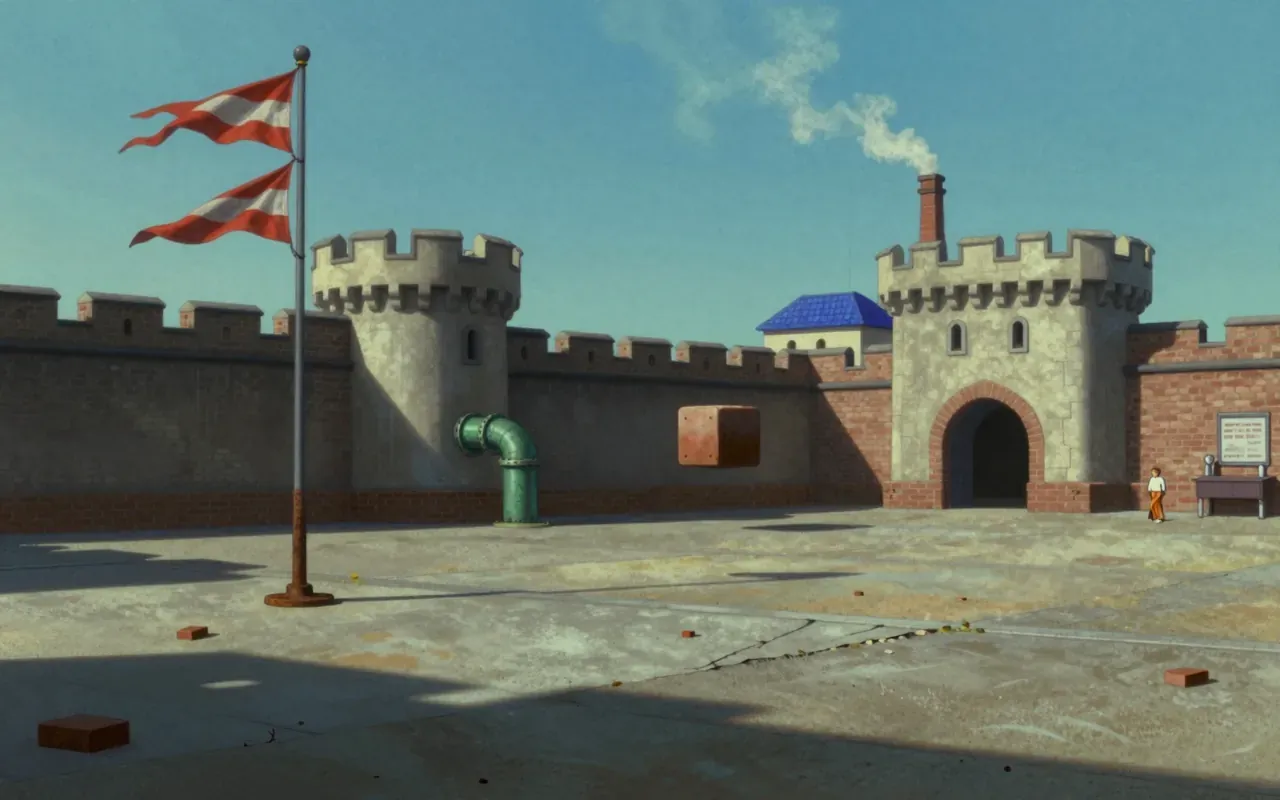
World 1-1 teaches core mechanics through embedded repetition: pipes introduce verticality, Goombas teach jump timing, ?-bricks teach interaction, and the flagpole teaches goal orientation—all without text or instruction. Hardware constraints bred elegance: flipped Goomba sprites, reused cloud/bush tiles, and algorithmically generated backgrounds keep the world dense without bloating memory. The scrolling engine enables acceleration from walk to run—a tactile, responsive shift absent in earlier platformers.
What does not
It does not sustain engagement through story, character, or thematic resonance. There is no dialogue, no cutscenes, no lore beyond the rescue premise. The flagpole mechanic offers no variation: it always ends the level, always rewards height, never changes function. Lives reset entirely on death—no checkpoints, no saves, no partial progress. Falling off-screen is always fatal, regardless of context or player intent.
Who it is for, and who it is not
It is for players who value precision, clarity, and cause-and-effect transparency. It is not for players who need narrative scaffolding, systemic depth, or adaptive difficulty. It assumes no prior knowledge—but demands active observation and rapid iteration. It is built for short, focused sessions where each attempt yields immediate, unambiguous feedback.
Is it worth your time
Yes—if you want to feel how tightly a game’s physics, feedback, and progression can lock together. It asks for attention to timing, spatial memory, and pattern recognition. It gives immediate cause-and-effect: every jump, hit, and dodge has a clear, consistent result. It does not ask for patience with ambiguity, narrative depth, or mechanical complexity. It is worth your time as a functional blueprint—not as nostalgia bait.