gamesbriefs
9:44in productionCh. 1 · Hardware First/ 9:44 · ceiling 15 min
Racing & sports · Simulation

Wii Sports

Wii Sports isn’t a sports game—it’s a motion sensor with rules stapled on.

Wii Sports is a hardware demo disguised as a game. It reduces sport to arm motion. It asks nothing of the player but gesture—and gives back only confirmation. It worked because it was the first thing many people ever did with motion control. It does not work as a game today.

Chapters & takeaways4
  1. 0:56
    Hardware First

    Five sports. One purpose: show off the Wii Remote.

  2. 2:16
    Gesture Is Input

    You don’t press buttons—you swing, roll, and jab.

  3. 3:58
    No Rules, No Depth

    Simplified rules mean no learning curve—but also no mastery.

  4. 5:15
    Arm Control Only

    Motion sensing is literal: arm movement maps directly to on-screen action.

Worth your time?

Yes. Play the whole thing.

3/ 5
What works
  • makes motion control instantly legible
  • requires zero prior knowledge
  • enables immediate shared play
  • maps gesture to outcome with no latency
What does not
  • simulate sport
  • require or reward precision
  • build skill over time
  • support solo long-term engagement
Play it if
  • non-gamers
  • families
  • parties
Skip it if
  • players seeking challenge
  • sports fans expecting simulation
  • anyone wanting mechanical depth
The written brief1 min read

What the game is

A launch-title collection of five simplified sports simulations built to demonstrate the Wii Remote’s motion-sensing capabilities. It is not a sports game in the traditional sense. It is a hardware showcase packaged as accessible play.

How it actually plays

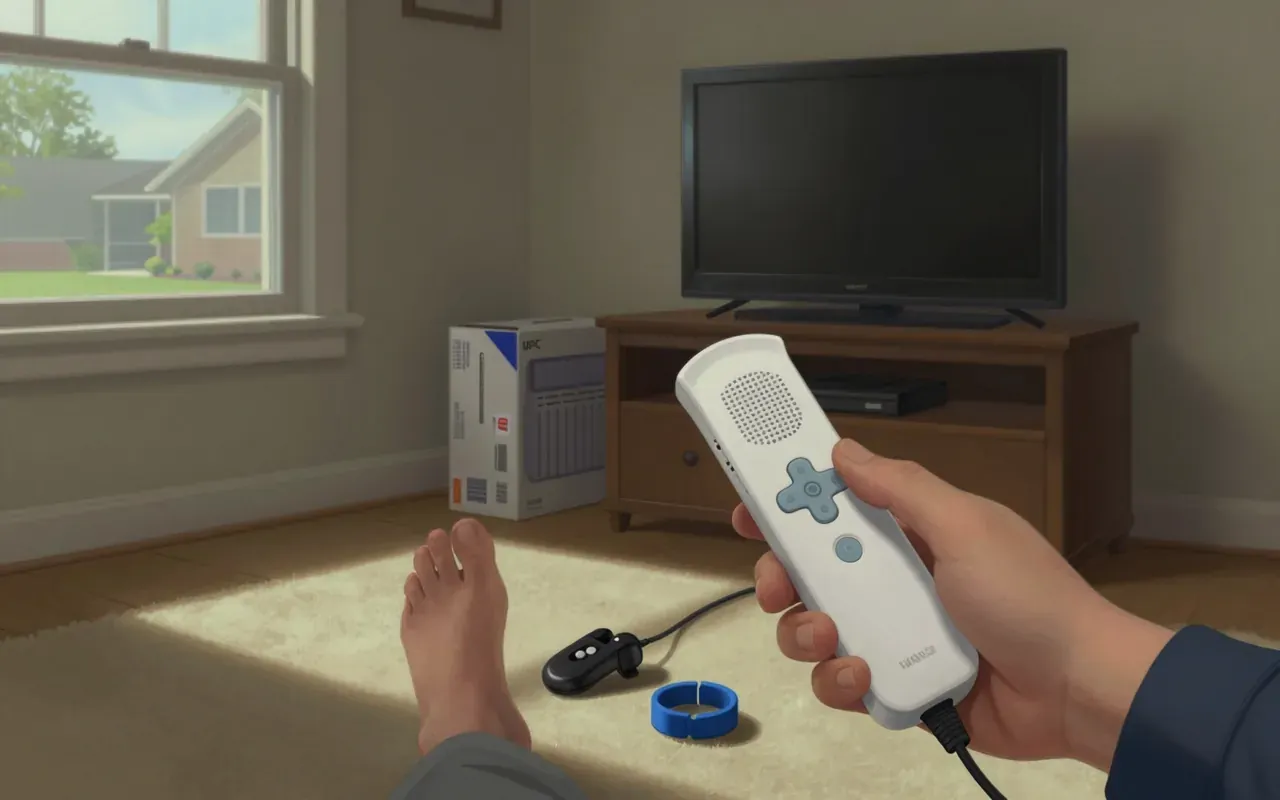
Players hold and swing the Wii Remote like real sports equipment: a tennis racket, baseball bat, golf club, or bowling ball. In boxing, they use both the Wii Remote and Nunchuk to control each arm. Tennis delegates movement to AI while the player controls only the swing. Each sport runs in short, self-contained sessions. Bowling and golf use turn-based shared hardware. All five games rely entirely on motion input from the Wii Remote’s accelerometer and infrared sensors.

What works

It makes motion control legible in one gesture. Swinging the remote like a tennis racket immediately produces a swing. Rolling it like a bowling ball releases a ball. The simplification works because it removes everything except the core physical action—and ties that action directly to a visual outcome without delay or interpretation.

What does not

It does not simulate sport. It omits footwork, positioning, stamina, tactics, or timing windows beyond gross gesture recognition. It offers no player agency beyond the dominant arm’s swing or jab. There is no feedback loop that tightens skill—only binary success or failure based on amplitude and direction of motion.

Who it is for, and who it is not

It is for non-gamers, families, and parties. It is not for players who expect responsiveness, consistency, or mechanical nuance. It assumes no prior knowledge of controllers, sports rules, or video game conventions—and delivers nothing beyond that assumption.

Is it worth your time

Yes—if you want to test motion control with zero friction, or host a low-stakes physical party game. It has no progression, no depth, and no replay structure beyond immediate social play. It is not worth your time if you seek challenge, narrative, strategy, or sustained engagement.
Same strand · Racing & sports4 of 74
10:24
Wii FitNintendo · 2007Wii Fit is a simulation of physical discipline built around a single hardware input: the Wii Balance Board. It measures weight and centre of balance in real time. It offers over 40 activities — yoga, strength training, aerobics, balance games — all calibrated to that input. It supports up to eight user profiles, each tied to date of birth, height, and a Mii. It logs external activity manually. It uses an on-screen trainer in yoga and strength modes. It does not simulate athletic development. It simulates accountability.
9:24
Tony Hawk's Pro Skater 2Neversoft · 2000Tony Hawk's Pro Skater 2 is a tightly wound trick-chaining machine — built for repetition, reward, and escalating absurdity. Its fixed camera and autonomous skater create a distinct physical language. Its loose physics serve the loop, not realism. It offers no story, no stakes beyond your own score — and that’s exactly why it holds up.
11:06
1080° SnowboardingNintendo · 19981080° Snowboarding is a Nintendo 64 snowboarding game released in 1998. Players control one of five snowboarders in third-person across eight levels. Core gameplay splits between racing (Race, Time Attack, 2 Players, Match Race) and trick-based scoring (Trick Attack, Contest). Tricks — 24 standard and 5 secret — fall into grab or spin categories and require circular stick motions plus R, Z, and B inputs. Scoring rewards complexity, combos, and timing. Characters and boards have distinct stats affecting technique, speed, weight, balance, and edge control. The game emphasises realistic physics and responsive controls.
10:40
Skate 3EA Black Box · 2010Skate 3 is a third-person open-world skateboarding game developed by EA Black Box in 2010. It tasks players with selling one million skateboards by completing challenges, after failing Jump The Shark. It introduces Easy and Hardcore difficulty modes, an optional tutorial (Skate School), and a park builder (Skate.Park). Online-only multiplayer at launch required DLC for offline party play.
Up next in Games

Zaxxon

Sega · 1982 · 9:39

Zaxxon doesn’t simulate flying—it simulates failing until your muscle memory learns the wall’s height.

9:39