What the game is
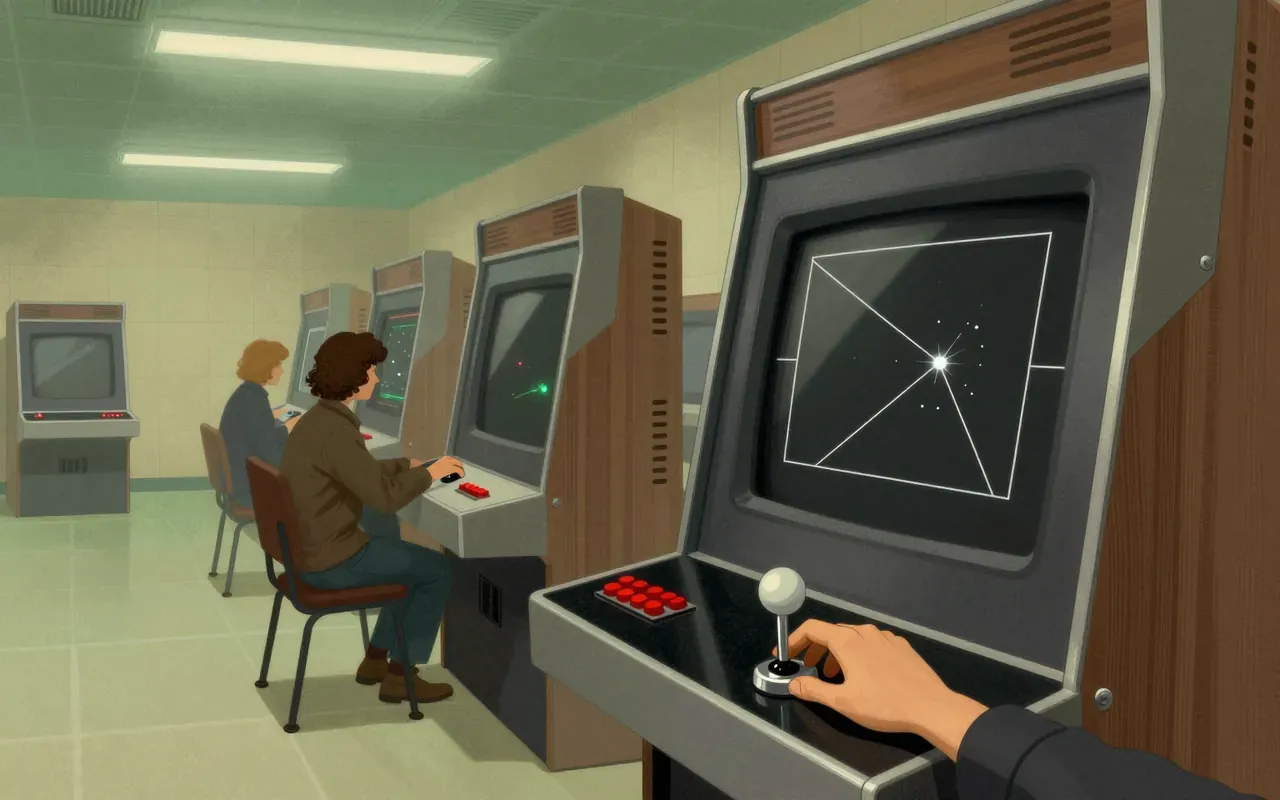
A vector-display arcade shooter where the player navigates an asteroid field crossed by hostile flying saucers, using rotation, thrust, and forward fire to survive and score points.
How it actually plays
The player rotates, thrusts, and fires a triangular ship with inertia-based movement. Momentum persists until thrust changes direction or friction stops it. Asteroids split into faster fragments when shot. Flying saucers cross the field and fire back. Screen edges wrap horizontally and vertically. Hyperspace teleports the ship randomly — often into danger.
What works
The inertia-based movement creates real physics tension. Wrapping edges turn the screen into a continuous arena, not a bounded box. Asteroid fragmentation forces adaptation: each hit raises speed and difficulty. The high-score table with initials makes competition tangible and immediate.
What does not
It does not scale gracefully for modern attention spans. There is no pause, no save, no tutorial, no explanation. The saucers’ aim exploits screen-edge ‘lurking’, making evasion feel cheap rather than earned. Hyperspace is a panic button, not a tactic.
Who it is for, and who it is not
It is for players who value tight, deterministic feedback loops and can tolerate repetition without reward beyond mastery. It is not for players who need context, pacing, narrative scaffolding, or accessible entry.
Is it worth your time
Yes — if you want a pure, unforgiving test of spatial reasoning and reflex under escalating pressure. It asks for constant attention, rewards pattern recognition, and offers no narrative, no progression beyond score, and no mercy.