gamesbriefs
8:39in productionCh. 1 · Eat/ 8:39 · ceiling 15 min
Retro · Game design

Pac-Man

Pac-Man is not about eating dots—it’s about learning when to run, when to wait, and when to turn the hunters into the hunted.

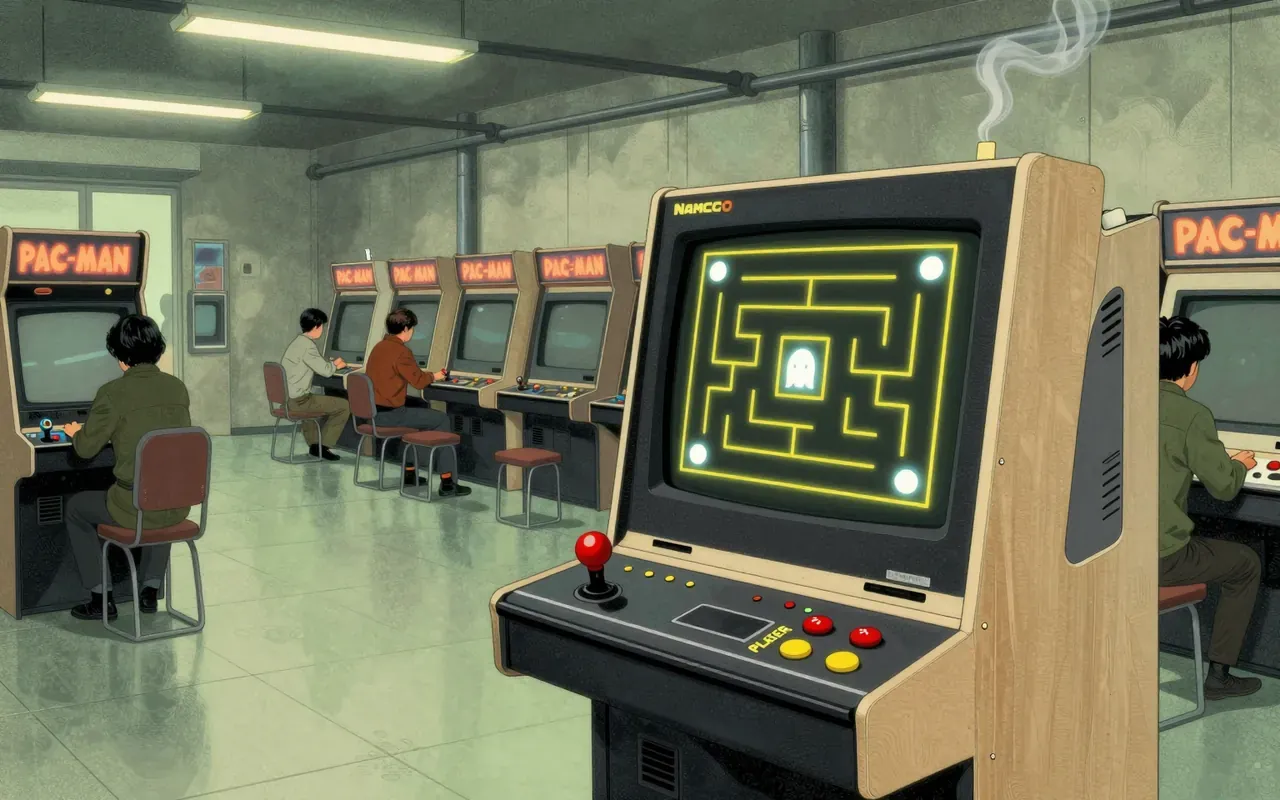
Pac-Man is a foundational arcade game released by Namco in Japan in 1980 (test-marketed 22 May, wide release July) and North America in November 1980. Its design centres on eating dots in a fixed maze while evading four ghosts—Blinky, Pinky, Inky, and Clyde—each governed by a distinct AI rule. Power pellets temporarily reverse ghost behaviour and enable Pac-Man to consume them. Completion of each level requires clearing all dots; contact with a ghost costs a life. The game ends when all lives are lost.

Chapters & takeaways4
  1. 0:56
    Eat

    Pac-Man is a maze chase defined by a single verb: eat.

  2. 2:14
    Four Rules, Not Four Characters

    Each ghost behaves like a rule—not a person—making pursuit predictable, then exploitable.

  3. 3:36
    Blue Is Not Just Colour

    Power pellets don’t just change colour—they reverse direction, invert roles, and reset threat.

  4. 4:54
    All Or Nothing

    Progress is binary: all dots cleared, or life lost. No partial credit. No save.

Worth your time?

Yes. Play the whole thing.

4.5/ 5
What works
  • tight-loop-design
  • predictable-yet-dynamic-pressure
  • role-inversion-mechanic
  • learnable-maze-symmetry
What does not
  • narrative
  • customisation
  • systemic-depth
  • error-recovery
Play it if
  • players-who-value-clean-cause-and-effect
  • players-who-enjoy-rapid-feedback
  • players-seeking-mastery-through-repetition
Skip it if
  • players-seeking-story
  • players-seeking-character
  • players-who-dislike-binary-outcomes
The written brief1 min read

What the game is

An arcade maze chase game developed by Namco. The player controls Pac-Man to eat all dots in an enclosed maze while avoiding four coloured ghosts with distinct AI behaviours.

How it actually plays

The player steers Pac-Man through a symmetrical maze, eating dots one by one. Four ghosts pursue with fixed AI rules: Blinky chases directly, Pinky and Inky try to cut Pac-Man off, Clyde alternates between chase and retreat. Eating a power pellet turns ghosts blue, reverses their direction, and makes them vulnerable. Pac-Man eats them for points. Ghosts regenerate from the center box after being eaten. Clear all dots to advance. Touch a ghost and lose a life. Lose all lives and the game ends.

What works

The loop is tight: navigate, evade, exploit openings, trigger power pellets, reverse roles, repeat. Each ghost’s AI creates predictable yet dynamic pressure. The power pellet mechanic flips tension into triumph in under two seconds. The maze’s symmetry and corner placement of energizers make evasion legible and learnable.

What does not

It offers no narrative, no progression beyond dot-counting, no adaptation to player skill beyond ghost speed increases. The maze is static. The rules do not evolve. There is no recovery from error—only reset or restart.

Who it is for, and who it is not

Players who value clean cause-and-effect, rapid feedback, and mastery through repetition. Not for those seeking story, character, customisation, or systemic depth. Not for players who dislike binary outcomes—success or death—with no middle ground.

Is it worth your time

Yes—if you want a pure, immediate test of spatial memory, timing, and pattern recognition under escalating pressure. It asks for nothing but attention and repetition. It gives back rhythm, clarity, and the thrill of turning pursuit into prey.
Same strand · Retro4 of 73
10:00
Diddy Kong RacingRare · 1997Diddy Kong Racing is a 1997 Nintendo 64 kart racer developed and published by Rare. Players select from ten characters and race across five worlds—each containing four tracks—using cars, hovercraft, or aeroplanes. Victory over antagonist Wizpig comes solely through winning races. Vehicle types impose clear trade-offs: the car is all-round but slowest on sand and water; the hovercraft handles those surfaces but suffers poor acceleration and manoeuvrability; the aeroplane accesses aerial zones and turns sharply but has the lowest speed. All characters can use all vehicles. The design asks players to match vehicle to terrain—and learn why the match fails as often as it succeeds.
8:25
NBA StreetEA Sports · 2001NBA Street is a deliberate departure from EA Sports’ simulation ethos. It trades authenticity for attitude, structure for swagger, and time limits for point thresholds. Its design insists on expression before execution—and rewards repetition, not mastery.
8:50
Need for Speed: Underground 2Black Box · 2004Need for Speed: Underground 2 is a racing game where tuning, driving, and discovery are inseparable. It asks you to treat Bayview as terrain—not backdrop—and rewards persistence over precision. Its constraints are deliberate: no fast travel, no race menus, no hand-holding for hidden events. It works because those constraints shape a specific kind of attention: one tuned to corners, shortcuts, and the hum of a modified engine echoing off concrete.
9:20
Shogun: Total WarCreative Assembly · 2000Shogun: Total War is a foundational strategy game that fused turn-based empire management with real-time battlefield tactics. Its ambition—to simulate feudal Japanese unification—was matched only by its structural compromises. The campaign map was added late. Systems coexist but rarely converse. Yet its combat loop remains legible, its faction asymmetry functional, and its provincial logic direct. It rewards patience, pattern recognition, and tolerance for abstraction.
Up next in Games

Path of Exile

Grinding Gear Games · 2013 · 11:08

Path of Exile replaces narrative with system — and rewards only those willing to speak its language of gems, mods, and barter.

11:08