gamesbriefs
Topic

Artificial intelligence

The field that has been five years away for seventy years, and then was not.

9
in games
9:55
average
89 min
in total
78
across the network
Artificial intelligence across the network →
All briefs9
10:22

F.E.A.R. (video game)

Monolith Productions · 2005

F.E.A.R. is a first-person shooter psychological horror game developed by Monolith Productions in Kirkland, Washington. It uses the studio’s LithTech engine and centres on reflex time, adaptive AI, and melee as a core combat pillar.

9:28

Metal Gear Solid 2: Sons of Liberty

Hideo Kojima / Konami · 2001

Metal Gear Solid 2: Sons of Liberty is a PlayStation 2 stealth-action game released in 2001 by Konami. It features two narrative chapters—the 'Tanker' prologue with Solid Snake and the 'Plant' main section with Raiden—set near New York City in an alternate-history timeline. Its stealth loop relies on observation, environmental interaction, and squad-based enemy AI. It explores memetics, information control, and freedom of thought through a postmodern, fourth-wall-breaking structure.

8:40

Tom Clancy's Splinter Cell: Chaos Theory

Ubisoft Montreal · 2005

Tom Clancy's Splinter Cell: Chaos Theory is a 2005 stealth action game developed by Ubisoft Montreal. It refines the series' core stealth loop around two interdependent detection systems: light exposure and relative noise. Guards react intelligently to environmental changes and coordinate tactically. Alarms trigger only on discovery—not on being seen—and no longer cause automatic failure. It expands close-quarters options and introduces equipment loadouts tied to lethality constraints.

10:58

Thief: The Dark Project

Looking Glass Studios · 1998

Thief: The Dark Project is a 1998 stealth game by Looking Glass Studios. It uses light and sound as core mechanics. Players assume the role of Garrett in a first-person, unscripted 3D world. Objectives are discrete—like stealing a specific object—and must be completed to advance. A visibility gem on the HUD indicates detectability. NPCs react to environmental cues. Eidos Interactive published it.

9:52

The Sims (video game)

Will Wright / Maxis · 2000

The Sims is a social simulation video game developed by Maxis and published by Electronic Arts in 2000. Designed by Will Wright, it allows players to create and control virtual people called Sims, build and furnish homes, and manage Sims' needs, relationships, careers, and household finances. Its open-ended gameplay has no fixed win condition. The Sims is an artificial life game built around simulated characters who respond to needs, objects, and other Sims. Although Sims can act autonomously when free will is enabled, the player usually directs their actions, manages their household, and decides how they develop relationships, skills, careers, and homes. Because the game has no fixed win condition, it can be played indefinitely and has been described as more like a toy than a traditional game. Sims are influenced by the player to interact with objects or other Sims. If enabled in the game's options, Sims have a certain amount of free will, allowing them to autonomously interact with their world; however, the player can override most of these autonomous actions by canceling them in the action queue at the top of the screen.


10:21

AI: The Somnium Files

Spike Chunsoft · 2019

AI: The Somnium Files is a branching adventure game developed by Spike Chunsoft in 2019. It alternates between first-person investigation and timed third-person dream exploration ('Somnium'). Players use an AI assistant named Aiba to analyse scenes and augment vision. Progress requires completing multiple routes via a flowchart, with each route withholding key narrative information until all are finished.

10:54

Left 4 Dead

Valve · 2008

Left 4 Dead is a cooperative first-person shooter released in 2008 by Valve. Players control one of four survivors navigating zombie-infested environments to reach safe areas. Its defining feature is the AI Director, which dynamically adjusts enemy spawns and item placements to ensure varied, tension-filled experiences across playthroughs. Cooperation is structurally enforced via mechanics like wall-visible teammate outlines, shared healing, mandatory revival from incapacitation, and lethal consequences for repeated failure to recover. Campaign mode includes safehouse checkpoints, crescendo events, and defensive finales, while multiple modes (Versus, Survival, Single-Player) extend replayability. The game uses the Source engine and emphasizes cinematic, film-inspired presentation and communication systems — including voice callouts and visual cues — to sustain coordinated group action.

8:39

Pac-Man

Namco · 1980

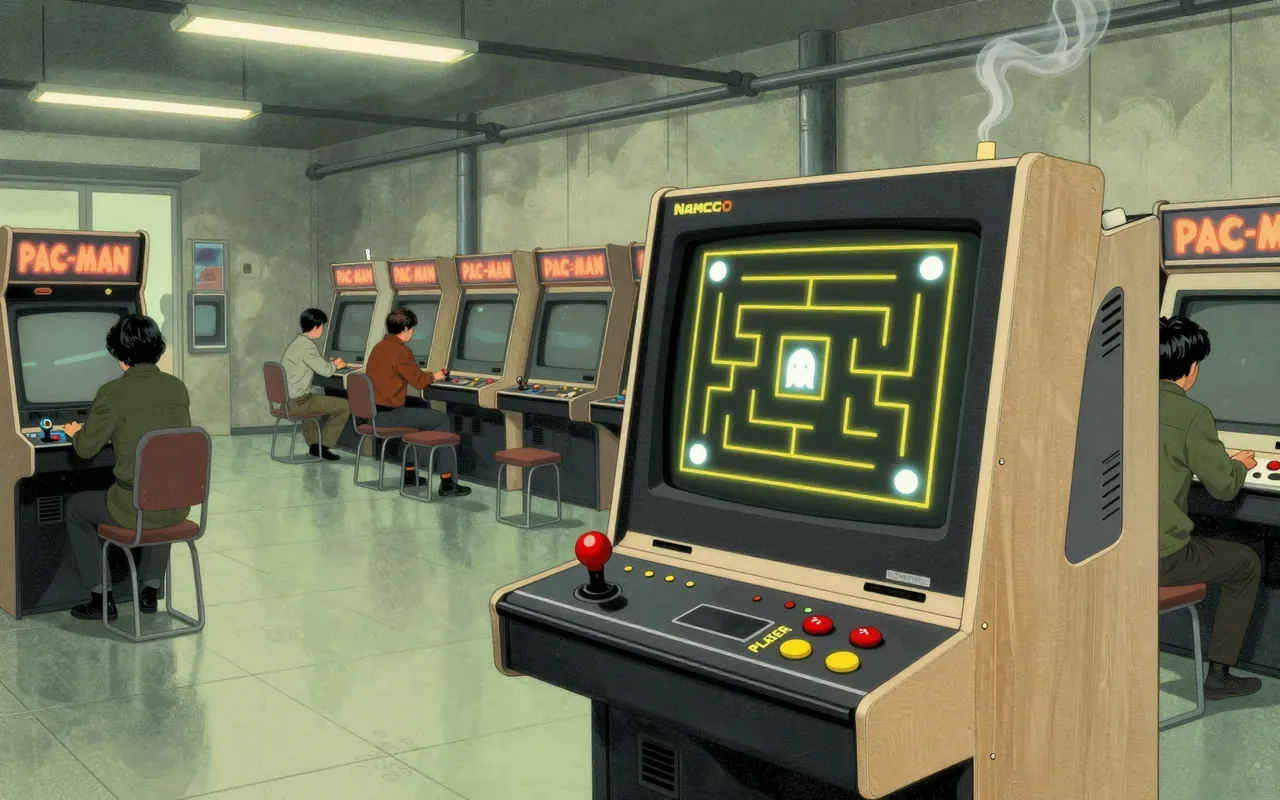
Pac-Man is a foundational arcade game released by Namco in Japan in 1980 (test-marketed 22 May, wide release July) and North America in November 1980. Its design centres on eating dots in a fixed maze while evading four ghosts—Blinky, Pinky, Inky, and Clyde—each governed by a distinct AI rule. Power pellets temporarily reverse ghost behaviour and enable Pac-Man to consume them. Completion of each level requires clearing all dots; contact with a ghost costs a life. The game ends when all lives are lost.

10:05

RimWorld

Ludeon Studios · 2016

RimWorld is a construction and management simulation game developed and published by Ludeon Studios for Windows, macOS, and Linux. It functions as a story generator driven by procedural 'storyteller' algorithms that select events to shape narrative experiences. Players oversee stranded colonists on a procedurally generated planet, forming and sustaining a colony while managing survival needs, mental stability, and external threats. Colonists are task-driven rather than directly controlled, and the game ends via spaceship construction, AI-assisted ship recovery, or DLC-specific endings. Events scale in difficulty and are influenced by configurable storyteller modes and difficulty presets.