gamesbriefs
10:18in productionCh. 1 · Not a penguin. A tool./ 10:18 · ceiling 15 min
Puzzle · Retro

Pengo (video game)

Pengo is not about being a penguin — it’s about turning ice into weapons, one precise shove at a time.

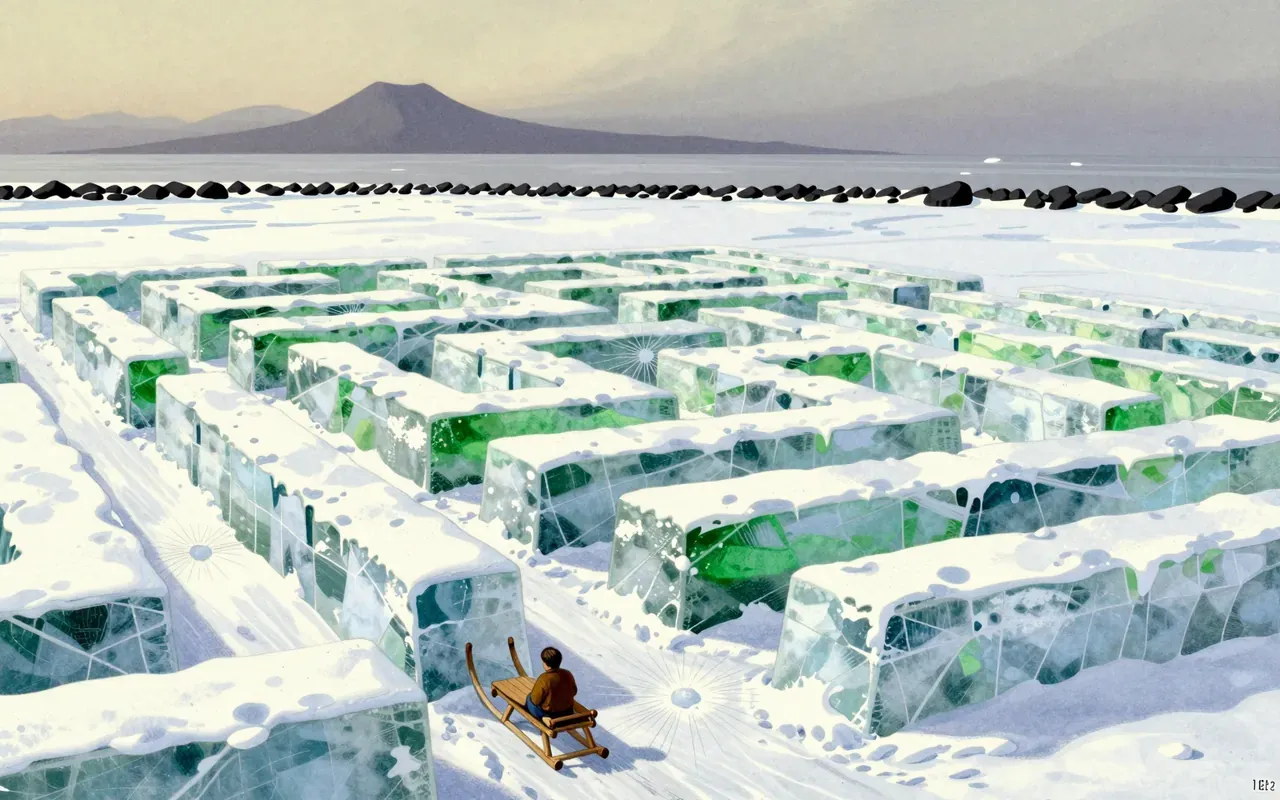
Pengo is a 1982 arcade maze game developed by Coreland and published by Sega Enterprises, Inc. The player controls Pengo — a red penguin in the Antarctic — using a four-position joystick and one button to slide or crush ice blocks in an overhead maze. The goal is to eliminate all Sno-Bees and Sno-Bee eggs each round, optionally aligning three diamond blocks for bonus points. Rounds end when all enemies and eggs are destroyed; doing so in under 60 seconds awards time-based bonus points. The game features 16 rounds with intermissions.

Chapters & takeaways4
  1. 1:02
    Not a penguin. A tool.

    You are not playing as a character — you are operating a red penguin in an Antarctic ice maze to crush enemies with sliding blocks.

  2. 2:33
    Two actions. One rule.

    One button and four directions define every action: slide empty paths, crush occupied ones — no exceptions, no modifiers.

  3. 3:43
    Three ways to win. One way to score high.

    Clear all Sno-Bees and eggs to advance — but bonus points demand speed, alignment, or precision, not just survival.

  4. 5:42
    Enemies are terrain problems.

    Sno-Bees are not fought — they are outmanoeuvred, pinned, stunned, and crushed under ice.

Worth your time?

Yes. Play the whole thing.

3.5/ 5
What works
  • The sliding-crushing duality is instantly legible and deeply replayable.
  • Every round forces new evaluation of block placement and enemy positioning.
  • Diamond-block alignment adds meaningful optional depth without clutter.
What does not
  • It does not explain its own mechanics.
  • It does not adapt to player skill.
  • It does not sustain engagement beyond pattern recognition.
Play it if
  • Players who value clean cause-and-effect over narrative.
  • Players who enjoy solving spatial threats in real time.
  • Players who accept repetition as rhythm, not monotony.
Skip it if
  • Players who expect guidance or contextual feedback.
  • Players who dislike fixed inputs and irreversible consequences.
  • Players who require emotional or thematic investment beyond mechanics.
The written brief1 min read

What the game is

A 1982 arcade maze game developed by Coreland and published by Sega Enterprises, Inc., in which the player controls Pengo — a red penguin in the Antarctic — navigating an overhead ice-block maze to eliminate Sno-Bees and their eggs.

How it actually plays

Pengo slides ice blocks with a four-position joystick and one button. Press the button while pushing against a block to slide it — if the space ahead is empty. If occupied, the block crushes instead. Crush Sno-Bees directly, crush egg-containing blocks, or stun Sno-Bees by pinning them against walls then running over them. Align three diamond blocks for bonus points. Eliminate all Sno-Bees and eggs to clear each round.

What works

The sliding-crushing duality creates immediate tactile clarity. Every input has a visible, irreversible effect. The overhead view gives full board awareness. Diamond-block alignment adds optional risk-reward depth. Time-based bonuses reward speed without punishing patience.

What does not

It does not scale well for modern attention spans. No tutorial. No explanation of wall-stunning or Blob transformation. The time-pressure mechanic forces rushed decisions without teaching consequence. Intermissions break momentum without adding meaning.

Who it is for, and who it is not

It is for players who enjoy deterministic physics puzzles with enemy patterns to learn and exploit. It is not for players who need narrative scaffolding, adaptive difficulty, or feedback beyond score and round progression.

Is it worth your time

Yes — if you want tight, physical puzzle-action that rewards spatial anticipation and timing. It asks for constant re-evaluation of block positions, threat vectors, and escape routes. No filler. No padding. Just 16 rounds of escalating pressure.
Same strand · Puzzle4 of 22
8:49
Bejeweled (video game)PopCap Games · 2001Bejeweled is a browser-based match-three puzzle game developed by PopCap Games and first released in 2000. Players swap adjacent gems to form lines of three or more identical gems, clearing them and triggering cascading falls. Swaps that fail to produce a match revert automatically. It features untimed and timed modes — the former ending when no moves remain, the latter requiring point accumulation to stall a depleting timer — and later introduced competitive multiplayer with special gems.
10:15
Braid (video game)Jonathan Blow · 2008Braid is a 2D puzzle-platform game developed by Thekla Inc., published by Microsoft, released on XBLA in 2008. Its art was created by David Hellman. It uses time manipulation as its central design pillar, delivered through six sequentially unlocked worlds, each governed by a distinct temporal rule. Narrative is conveyed through text between worlds, environmental art, and gameplay itself.
9:32
Candy Crush SagaKing · 2012Candy Crush Saga is a match-three puzzle game where players swap adjacent candies to make lines or columns of three or more identical colours. Matches remove candies, trigger cascading falls, and generate points — with bigger matches producing special candies that clear larger board sections. Each level imposes a specific goal — like collecting a number of candies or clearing jelly-covered tiles — within a fixed move limit. Lives are lost on failure and regenerate over time or via purchase. The game introduced saga-based progression and cross-platform sync, with mobile versions built for touch and offline play.
8:44
Cooking Mama (video game)Office Create · 2006Cooking Mama is a sequence of brief, touch-driven minigames representing kitchen tasks. Each lasts under 10 seconds. Players follow instructions on the top screen and act on the bottom screen using the stylus. Failure occurs on serious error or time expiry. It offers crisp, immediate feedback but no cumulative learning or systemic logic. Office Create developed it and enforced strict quality standards over feel and content — but not over depth or coherence.
Up next in Games

Phantasy Star (video game)

Sega · 1987 · 8:38

A game that demands paper, not pixels — where every dungeon is a test of memory, not reflex.

8:38