gamesbriefs
8:42in productionCh. 1 · No Pilot, Just Steel/ 8:42 · ceiling 15 min
Shooter · Action & adventure

Armored Core (video game)

Armored Core makes you pay to learn — every miss, every misfire, every failed mission costs credits before you even understand the terrain.

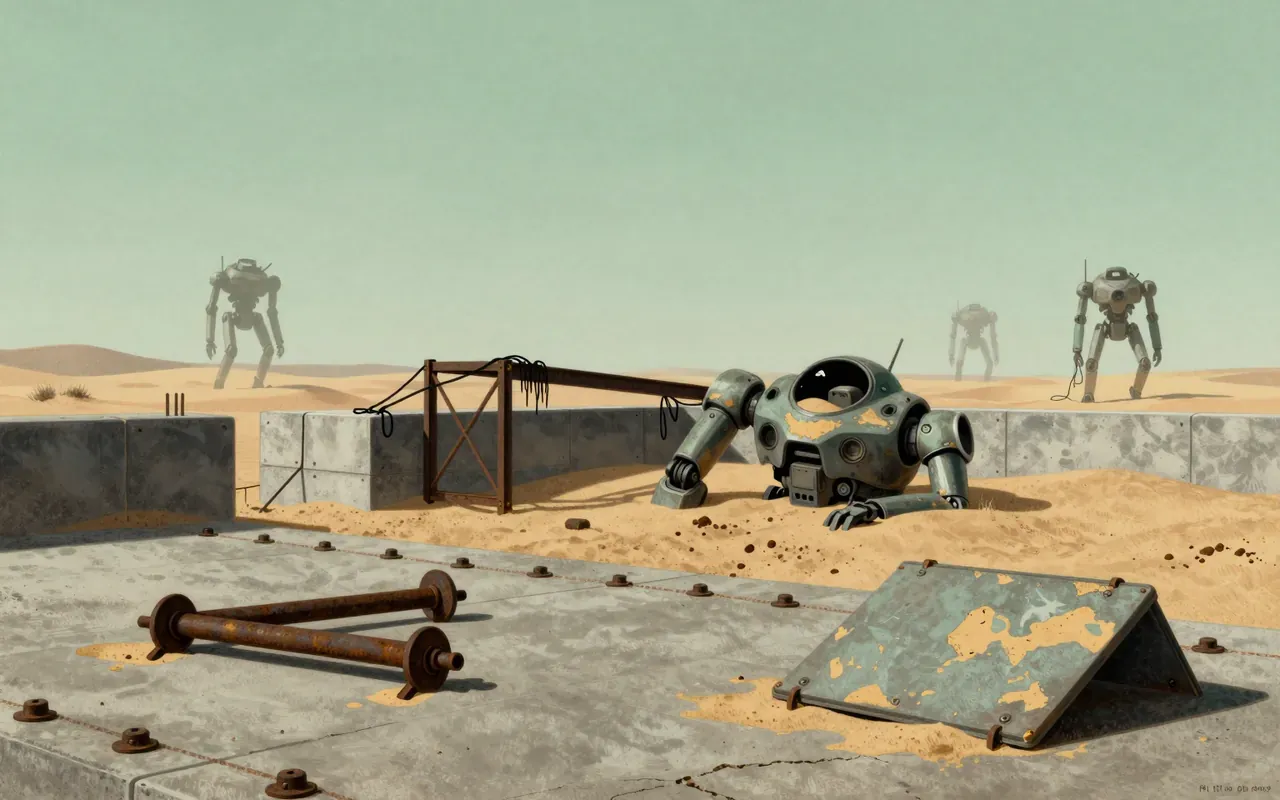
Armored Core (1997) is FromSoftware’s first mecha combat game. Players pilot highly modular Armored Cores across open desert bases and space stations, engaging enemies that appear from all directions. Customisation is functional: swapping leg units changes mobility; weapon choices define combat range. Credits earned from missions fund upgrades, but ammunition and repair costs are deducted even on failure. There is no hand-holding — no map, no waypoints, no enemy indicators. The loop is austere, spatial, and penalised.

Chapters & takeaways4
  1. 1:08
    No Pilot, Just Steel

    This is mecha combat stripped to its chassis: no lore preamble, no cutscenes — just your Core, an enemy, and terrain.

  2. 2:07
    Modularity With Consequence

    Customisation is functional, not cosmetic: leg swaps change movement physics; weapon purchases define your combat envelope.

  3. 3:28
    Terrain as Teacher

    Missions are open arenas — desert bases, space stations — where enemies emerge unpredictably and navigation is pure spatial reading.

  4. 5:06
    Costs Before Credit

    Credits fuel progression, but are also the game’s only measure of failure: lose a mission, and you still pay for bullets and repairs.

Worth your time?

Yes. Play the whole thing.

3.5/ 5
What works
  • tight credit-for-customisation loop
  • open terrain demanding spatial vigilance
  • modular parts with immediate physical consequences
What does not
  • narrative
  • accessibility
  • guidance
Play it if
  • players who value mechanical clarity over exposition
  • players who treat failure as data, not punishment
Skip it if
  • players who need orientation or contextual feedback
  • players seeking thematic or emotional payoff
The written brief1 min read

What the game is

Armored Core is a 1997 third-person mecha combat game by FromSoftware. It is the first entry in its flagship Armored Core series. Players pilot customisable Armored Cores in open terrain against other Cores and vehicles.

How it actually plays

Players choose missions and navigate open levels — desert bases, space stations — searching for enemies that appear from all directions. They control a highly modular Armored Core, swapping leg units for speed or weapons for damage. Primary weapons include guns, rocket launchers, lasers, missiles, and swords. Ammunition and repair costs are deducted from rewards even on mission failure.

What works

The modular Core system delivers tangible mechanical consequence: swapping legs changes movement; weapon choice dictates engagement range and reload rhythm. Credits earned from missions directly fund upgrades, creating a tight loop of risk, reward, and recalibration. Open levels force constant spatial scanning and situational adaptation.

What does not

The game withholds guidance. Levels offer no waypoints, no enemy indicators, no map. Mission failure still drains resources, making early sessions punishing without feedback. Branching paths exist but are not signposted, and story progression remains opaque.

Who it is for, and who it is not

It is for players who enjoy systems-first design, resource austerity, and learning through repetition and penalty. It is not for players who rely on narrative scaffolding, directional cues, or incremental difficulty curves.

Is it worth your time

Yes — if you want a lean, punishing mecha loop built on scarcity, spatial awareness, and iterative hardware tuning. No — if you expect narrative cohesion, hand-holding, or forgiving progression.

Same strand · Shooter4 of 77
11:39
Borderlands (video game)Gearbox Software · 2009Borderlands (2009) is a role-playing shooter developed by Gearbox Software. It combines first-person shooter action with RPG systems—including four distinct Vault Hunters, branching skill trees, mission-driven progression, and a procedural loot engine generating over 15 million weapon and gear variations. Its cell-shaded-like art style gives Pandora a comic-book appearance. Players fight hostile wildlife and human forces on the fictional planet while seeking a fabled Vault.
11:13
Crysis (video game)Crytek · 2007Crysis is a first-person shooter developed by Crytek and published by Electronic Arts. It was released on PC in November 2007. It casts the player as Delta Force soldier Nomad on a hostile tropical island. Its core design premise is 'adaptive tactics'—requiring players to shift between stealth, aggression, lethality and mobility based on terrain, enemy placement and Nanosuit energy state.
8:27
Destiny (video game)Bungie · 2014Destiny is a server-dependent first-person shooter that structures player time around repeated group activities — strikes, raids, patrols, and PvP matches — all governed by Light-level gating and tied to Bungie.net infrastructure. Its strength lies in rhythmic, communal combat execution. Its weakness is systemic opacity and narrative detachment. It asks for consistency, not curiosity.
10:12
Far Cry (video game)Crytek · 2004Far Cry (2004) is a first-person shooter set in a dynamic tropical archipelago. It uses environmental cover, sound, and optical tools to create a sensor-driven combat loop. Enemies react, coordinate, and communicate. Its open maps contrast with linear missions. It is Crytek’s debut AAA title, built on CryEngine, and the first Far Cry game.
Up next in Games

Asteroids (video game)

Atari · 1979 · 8:50

Asteroids doesn’t simulate space — it simulates the cost of every decision in real time.

8:50