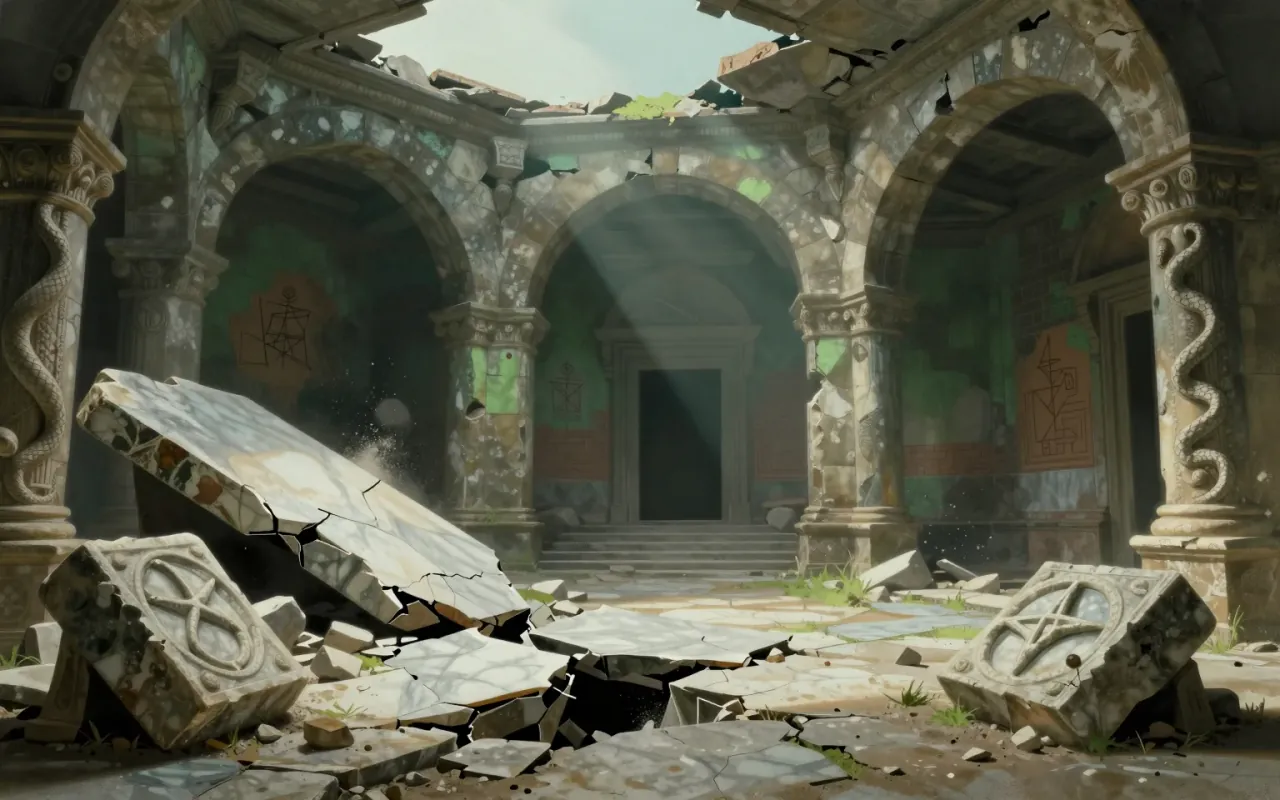
Hexen II doesn’t blend genres—it bolts RPG stats onto an FPS chassis and makes you feel the rivets.
Hexen II is a 1997 first-person shooter built on a modified Quake engine. It is the second sequel in the 'Serpent Riders' trilogy. It features action-adventure and action role-playing elements.
It is a first-person shooter first, with RPG and adventure elements grafted on—not woven in.
2:20
Four Classes, Four Loops
Class isn’t flavour—it’s weapon loadout, spell set, and movement weight, all baked into the core loop.
3:42
Levels That Talk To Each Other
Hubs aren’t just maps—they’re cause-and-effect machines where breaking a wall here opens a door there.
4:55
RPG Without Agency
Experience grows HP and mana only—no skill trees, no choices, no deviation from the curve.
5:44
What the Engine Lets You Do (and Doesn’t)
The Quake engine gives it speed and fragility—but also locks out vertical aiming and real-time inventory switching.
Worth your time?
Yes. Play the whole thing.
3.5/ 5
What works
Four distinct classes—Paladin, Crusader, Necromancer, Assassin—each with unique weapons, spells, and play styles, create immediate, tangible variety.
Destructible environments reward aggression.
Mounted weapons add tactical anchoring points.
The Tome of Power returns from Heretic as a functional, repeatable power-up.
What does not
The hub system creates backtracking without clear signposting.
Role-playing elements are shallow: stat growth is automatic and uncustomisable.
Multiplayer is unsupported today.
The Quake engine’s limitations—no true verticality, fixed FOV, no sprint—constrain movement more than they define it.
Play it if
players who value mechanical specificity over polish
players who enjoy reading level architecture as a puzzle
players who accept 1997’s technical constraints as part of the design language
Skip it if
players who need consistent feedback
players who need explicit goals
players who need systems that explain themselves
The written brief1 min read
What the game is
Hexen II is a 1997 first-person shooter built on a modified Quake engine. It is the second sequel in the ‘Serpent Riders’ trilogy. It features action-adventure and action role-playing elements.
How it actually plays
You move through hub-connected levels, solving environmental puzzles by triggering changes in one area that unlock paths or alter enemies elsewhere. Combat revolves around class-specific weapons and spells, with mana and HP scaling as you gain experience. You look up and down. You break walls and activate mounted guns. You manage inventory. You do not level up mid-fight. You do not pause to rest. You do not respec stats.
What works
Four distinct classes—Paladin, Crusader, Necromancer, Assassin—each with unique weapons, spells, and play styles, create immediate, tangible variety. Destructible environments reward aggression. Mounted weapons add tactical anchoring points. The Tome of Power returns from Heretic as a functional, repeatable power-up.
What does not
The hub system creates backtracking without clear signposting. Role-playing elements are shallow: stat growth is automatic and uncustomisable. Multiplayer is unsupported today. The Quake engine’s limitations—no true verticality, fixed FOV, no sprint—constrain movement more than they define it.
Who it is for, and who it is not
It is for players who value mechanical specificity over polish, who enjoy reading level architecture as a puzzle, and who accept 1997’s technical constraints as part of the design language. It is not for players who need consistent feedback, explicit goals, or systems that explain themselves.
Is it worth your time
Yes—if you want a 1997 FPS that treats class choice as mechanical identity, not cosmetic, and uses its hub structure to make exploration feel consequential. No—if you expect modern pacing, accessibility, or narrative cohesion.