gamesbriefs
10:44in productionCh. 1 · Two Games, One Box/ 10:44 · ceiling 15 min
Puzzle · Genres

Puyo Puyo Tetris

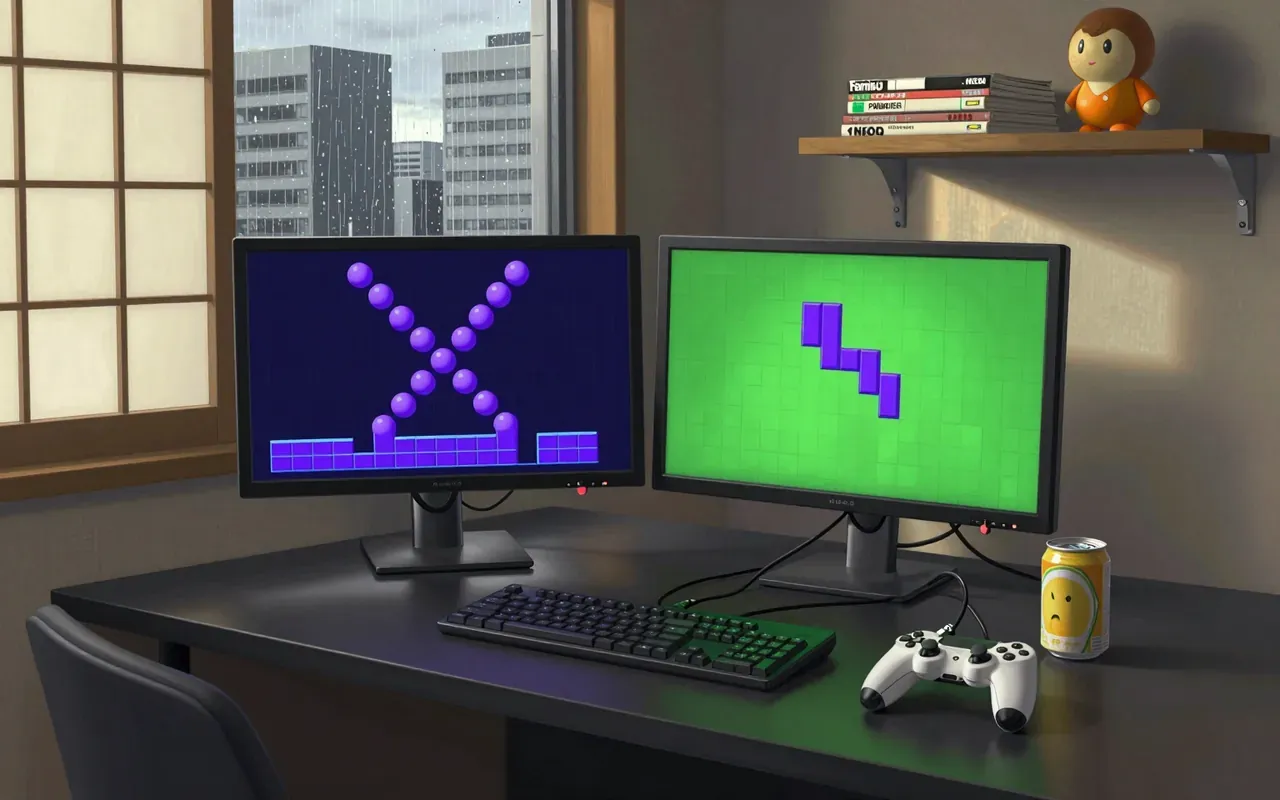
Two puzzle games bolted together—not fused, not reimagined, but run in parallel like trains on separate tracks.

Puyo Puyo Tetris is a deliberate, unapologetic juxtaposition—not an integration—of two established puzzle systems. Its strength lies in clarity, consistency, and competitive rigour. Its limitation is structural separation: no rule, constraint, or feedback bridges Puyo and Tetris beyond shared menus and scoring.

Chapters & takeaways4
  1. 1:10
    Two Games, One Box

    Puyo Puyo Tetris is not a remix—it’s a dual-system container with no shared rules.

  2. 2:36
    How Each System Plays

    Puyo relies on adjacency-based colour chains; Tetris on line-completion geometry—both demand precision placement, but nothing connects them.

  3. 4:17
    Where Both Systems Break

    Failure is binary and visible: a Puyo crossing the X mark ends it; Tetrominos breaching the top ends it.

  4. 6:25
    The Illusion of Fusion

    Modes like Swap and Fusion require switching between systems mid-match—but the switch is administrative, not mechanical.

Worth your time?

Yes. Play the whole thing.

3.5/ 5
What works
  • garbage-sending under pressure
  • clear failure states
  • multiplayer mode variety
  • consistent input-response timing
What does not
  • unify mechanics
  • introduce new input methods
  • feature narrative or character arcs
Play it if
  • players who value deterministic outcomes
  • fans of competitive puzzle combat
  • those comfortable with rigid mode-switching
Skip it if
  • players seeking systemic innovation
  • those drawn to emergent or expressive play
  • casual players unfamiliar with either Puyo or Tetris fundamentals
The written brief1 min read

What the game is

A 2014 puzzle game developed by Sonic Team that combines Puyo Puyo and Tetris as coexisting but independent gameplay systems within shared multiplayer and single-player modes.

How it actually plays

Players rotate and place falling Puyos or Tetrominos. In Puyo, four or more same-colour adjacent Puyos pop, triggering chain reactions if falling Puyos land into new matches. In Tetris, horizontal lines of filled cells disappear when complete; clearing multiple lines at once yields more points. Both modes end when pieces overflow past a marked boundary: the X mark in Puyo, the top of the field in Tetris.

What works

The garbage-sending mechanic works tightly: successful clears in either system send nuisance blocks to opponents. Versus, Swap, and Fusion modes force players to adapt between Puyo and Tetris under pressure. The board boundaries and failure states are clear, immediate, and consistent.

What does not

It does not unify the two systems into one coherent mechanic. Puyo and Tetris remain separate rule sets with parallel win/loss conditions. There is no hybrid gameplay where Tetrominos affect Puyo chains or vice versa. The fusion is structural, not systemic.

Who it is for, and who it is not

It is for players who enjoy high-stakes, deterministic puzzle combat with strict inputs and visible cause-and-effect. It is not for players seeking emergent storytelling, open-ended experimentation, or hardware-defying innovation.

Is it worth your time

Yes—if you want structured, rule-driven puzzle competition that demands rapid mode-switching and garbage management across seven distinct modes. No—if you expect narrative, progression, or mechanical novelty beyond the core loop.
Same shelf · Puzzle4 of 11
Up next in Games

Quake 4

Raven Software · 2005 · 11:25

Quake 4 is the last Quake game that moves like Quake — and the first that forgets how to stand alone.

11:25