What the game is
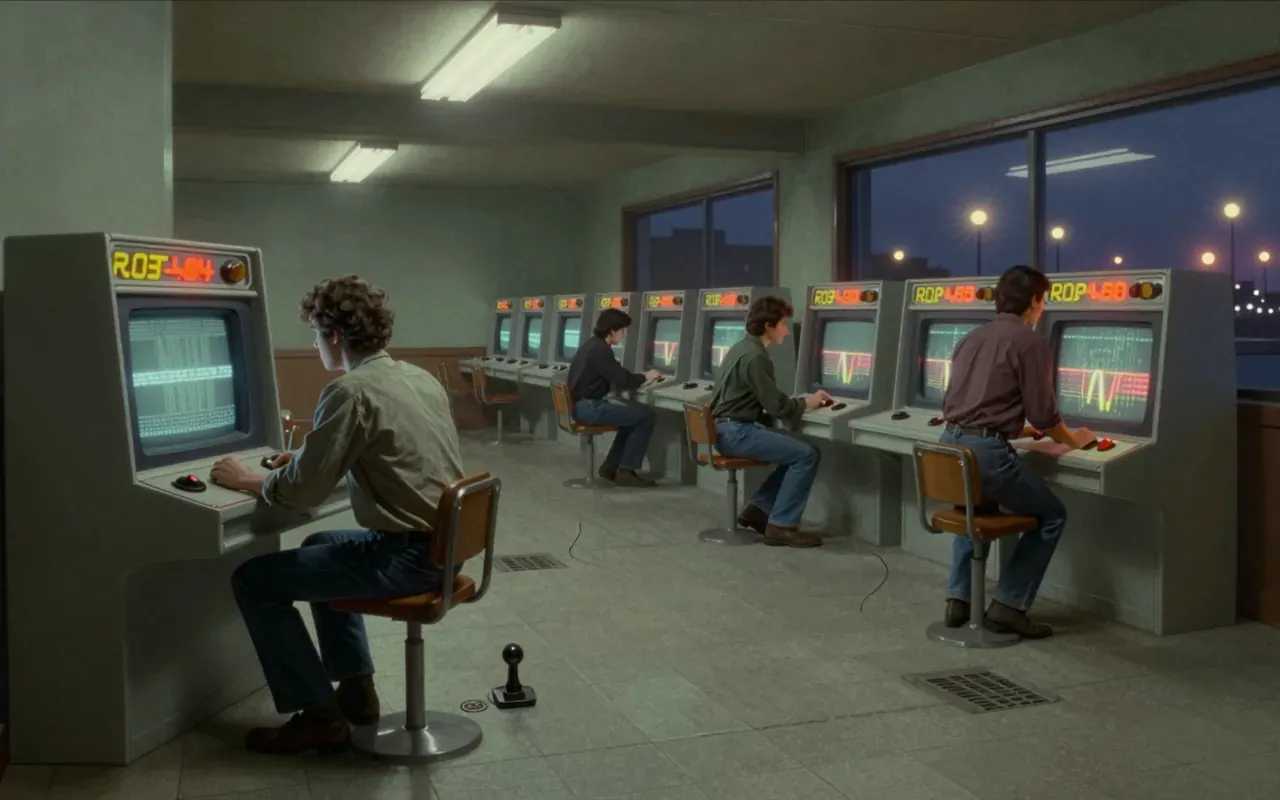
A top-down twin-stick shooter arcade game by Vid Kidz, published by Williams Electronics in 1982. It is defined by its dual-joystick control scheme, single-screen waves, multi-directional threat generation, and human-rescue scoring layer.
How it actually plays
The player starts centred on a single screen. Left joystick moves in eight directions. Right joystick fires in eight directions. Enemies swarm from all sides. Contact with any enemy, projectile or obstacle ends the life instantly. Progress requires killing every vulnerable robot on the wave. Humans appear as secondary targets — rescuing them earns points and forces split attention between survival and score.
What works
The twin-stick separation creates precise directional agency: movement and aim are independent and simultaneous. The central starting position forces immediate spatial awareness. Eliminating all vulnerable robots per wave establishes clear, unambiguous progression. Human rescue adds tactical risk-reward without breaking the core loop.
What does not
It offers no recovery window after death. It gives no visual or audio warning before new threats spawn. It does not scale difficulty gradually — each wave resets into full assault. It makes no allowance for learning curves beyond repetition.
Who it is for, and who it is not
It is for players who enjoy high-intensity motor-cognitive coupling and tolerate relentless feedback loops. It is not for players who prefer incremental mastery, narrative scaffolding, or forgiving failure states.
Is it worth your time
Yes — if you want to feel spatial pressure, test reflex coordination under chaos, and experience a design that demands constant reorientation. No — if you seek narrative, pacing variety, or respite between waves.