gamesbriefs
10:07in productionCh. 1 · Solo Time Attack/ 10:07 · ceiling 15 min
Racing & sports · Game design

TrackMania Nations

No collisions, no choices, no compromises — just you, a keyboard, and the same jump over and over until it’s perfect.

TrackMania Nations is a deliberately constrained 2006 arcade racer. It removes collision, car choice, and environmental variety to focus entirely on solo time-attack precision. Its loop is simple: run, fail, restart, refine. It asks for repetition, spatial memory, and fine motor control — nothing more, nothing less.

Chapters & takeaways4
  1. 1:00
    Solo Time Attack

    Racing is solitary, third-person, and checkpoint-gated — not about beating others, but beating your own time.

  2. 3:04
    No Collisions, No Contact

    Cars pass through each other like ghosts — multiplayer is parallel, not interactive.

  3. 5:01
    Radical Minimalism

    One car, one track, four driving keys — every variable is locked down to sharpen focus.

  4. 6:13
    Air Is a Control Surface

    Braking mid-air changes trajectory — jumps are physics puzzles, not spectacle.

Worth your time?

Yes. Play the whole thing.

4.5/ 5
What works
  • checkpoint-based-timing-loop
  • collision-free-movement
  • keyboard-accessible-controls
  • aerial-trajectory-control
What does not
  • simulation
  • narrative
  • social-interaction
  • progression
Play it if
  • players-who-enjoy-iterative-self-improvement
  • players-who-enjoy-time-attack
  • players-who-enjoy-keyboard-accessibility
Skip it if
  • players-who-need-narrative
  • players-who-need-progression-systems
  • players-who-need-social-interaction
The written brief1 min read

What the game is

TrackMania Nations is a free, 2006 arcade racing game by Nadeo. It strips racing to its timing-and-trajectory core: solo checkpoint-based runs on a fixed track, with collision-free movement and keyboard-only controls.

How it actually plays

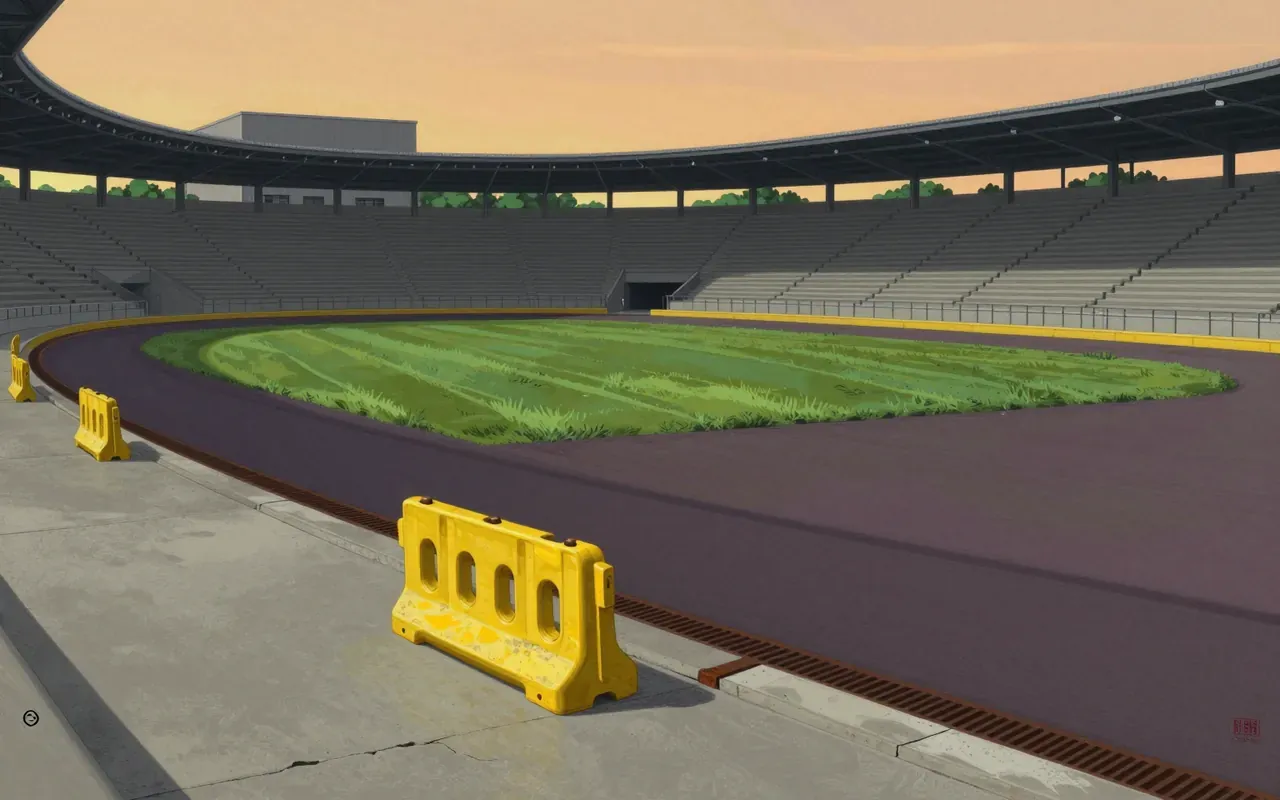
You race alone in third-person view on the Stadium environment. You steer, accelerate, brake, and restart using only keyboard inputs. Mid-air braking or accelerating alters your car’s flight path. You must pass through checkpoints to complete timed runs. Cars never collide — they phase through each other. There is only one car model, with fixed handling and nation-coloured paint.

What works

The minimalist control scheme makes mastery accessible. The absence of collisions removes frustration and focuses attention on line, air control, and split-second restarts. Checkpoint-based timing creates clear feedback loops. The Stadium environment rewards memorisation and muscle memory.

What does not

It offers no car customisation, no physics-based contact, no co-operative or adversarial multiplayer mechanics, and no environmental variation beyond Stadium. The single-car, single-track constraint limits expressive range by design.

Who it is for, and who it is not

It is for players who enjoy iterative self-improvement, spatial problem-solving, and low-friction competitive time-attack. It is not for players who need narrative, progression systems, social interaction, or simulation fidelity.

Is it worth your time

Yes — if you want a tightly scoped, endlessly replayable time-attack loop that demands precision, repetition, and spatial intuition. No — if you seek progression, variety, narrative, or player interaction.

Same strand · Racing & sports4 of 47
10:21
Crash Team RacingNaughty Dog · 1999Crash Team Racing is a precise, class-driven kart racer built around a strict, multi-stage power slide mechanic. It demands rhythmic timing, not reflexes. Its hardware constraints — split-screen performance, memory limits — are visible in its design choices, not hidden behind abstraction. It is the last Crash game Naughty Dog made, and it plays like a farewell: focused, complete, and uncompromising.
10:00
Diddy Kong RacingRare · 1997Diddy Kong Racing is a 1997 Nintendo 64 kart racer developed and published by Rare. Players select from ten characters and race across five worlds—each containing four tracks—using cars, hovercraft, or aeroplanes. Victory over antagonist Wizpig comes solely through winning races. Vehicle types impose clear trade-offs: the car is all-round but slowest on sand and water; the hovercraft handles those surfaces but suffers poor acceleration and manoeuvrability; the aeroplane accesses aerial zones and turns sharply but has the lowest speed. All characters can use all vehicles. The design asks players to match vehicle to terrain—and learn why the match fails as often as it succeeds.
10:38
Forza Horizon 5Playground Games · 2021Forza Horizon 5 is a racing game set in an open world modelled on Mexico. It was developed by Playground Games and published by Xbox Game Studios for Windows, Xbox One, and Xbox Series X/S.
9:21
Forza Motorsport 4Turn 10 Studios · 2011Forza Motorsport 4 is the fourth Forza Motorsport title, developed by Turn 10 Studios for Xbox 360 and published by Microsoft Studios in 2011. It is a racing simulation emphasising realistic car handling and visual fidelity on closed-circuit tracks. It supports dual-input control: traditional controllers or wheels for driving, and Kinect for head-tracking, voice commands, or full-body steering (with auto-acceleration/braking). Its Autovista mode enables detailed exploration of select cars, and its World Tour career adapts AI difficulty based on player performance.
Up next in Games

Wipeout 2097

Psygnosis · 1996 · 10:30

Wipeout 2097 doesn’t ask you to drive — it asks you to survive acceleration.

10:30