gamesbriefs
Topic

Computing

The machine that ate every other machine.

16
in games
10:11
average
163 min
in total
309
across the network
Computing across the network →
All briefs16
12:21

The Bard's Tale II: The Destiny Knight

Interplay · 1986

The Bard's Tale II: The Destiny Knight is a 1986 Interplay dungeon crawl that expands the first game’s scope with six cities, an explorable wilderness, banks, casinos, and the Archmage class — but retains its opaque interface and unrefined pacing.

12:35

Hitman: Codename 47

IO Interactive · 2000

Hitman: Codename 47 is a foundational stealth-action hybrid built on compromise: a forced pivot from MMO to shooter, then reshaped by executive vision into something slower, tenser, and more systemic. It rewards silence with money, punishes civilian deaths with deductions, and forces players to drag bodies to avoid alerts — all while running on a bespoke engine that pioneered ragdoll physics. Its brilliance lies in how it stitches together ideas from Deus Ex and Thief, then bends them around corpse logistics. Its flaw is that it never fully sheds its run-and-gun roots — some levels abandon stealth outright, and movement remains stubbornly unrefined. It is not a polished experience. It is a working blueprint.

10:48

King's Quest I

Sierra On-Line · 1984

King's Quest I is a foundational graphic adventure that trades player freedom for architectural control — every screen is a stage, every command a test of precise positioning, and every death a reminder that the machine holds all the cards.

9:51

Lunar Lander (1979 video game)

Atari · 1979

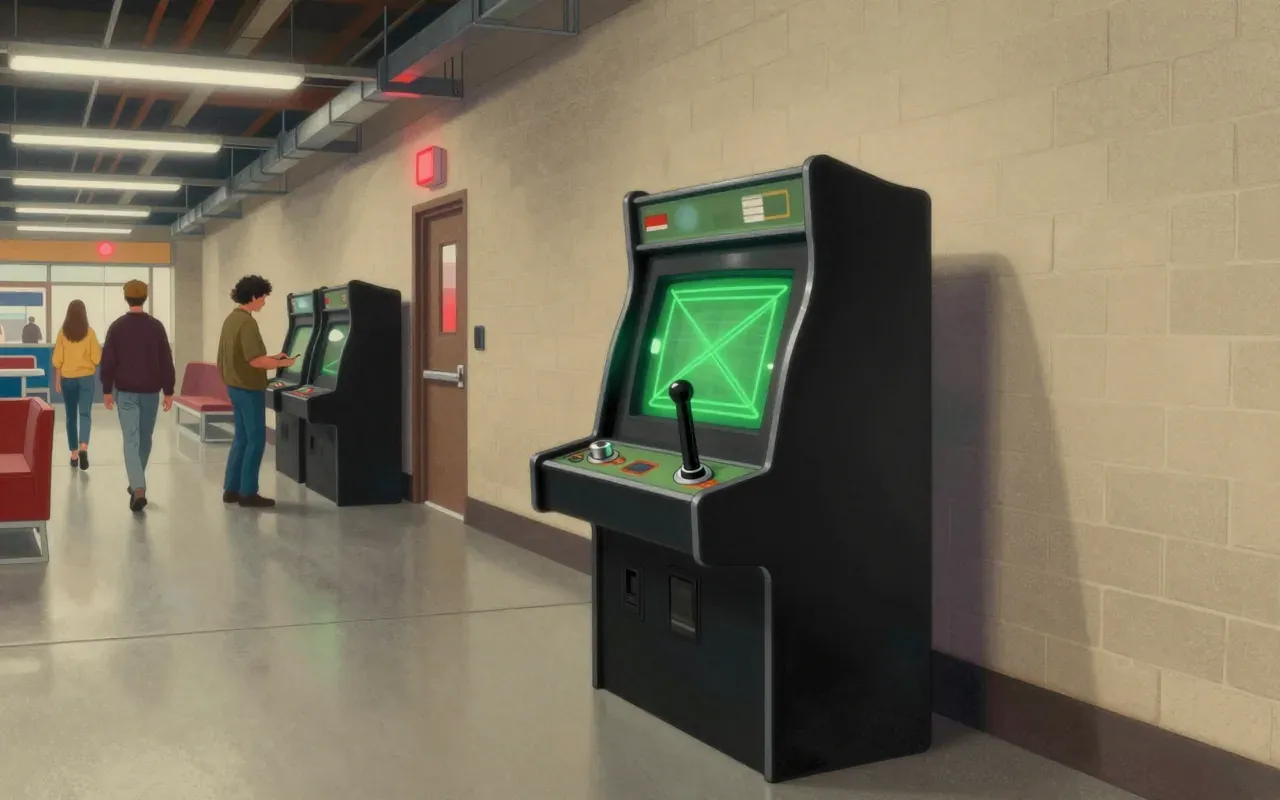
Lunar Lander (1979) is a vector-based arcade game by Atari, Inc. that reduces piloting to rotation, thrust, and fuel. It offers no story, no characters, no world—only a side-view landscape, a fragile module, and the unblinking arithmetic of descent.

9:06

Monkey Island 2: LeChuck's Revenge

LucasArts · 1991

Monkey Island 2: LeChuck's Revenge is a 1991 LucasArts SCUMM-based point-and-click adventure game that introduced iMUSE, used Puzzle Dependency Charts, and offered dual puzzle-difficulty modes.

10:14

Space Quest I

Sierra On-Line · 1986

Space Quest I is a 1986 graphic adventure built on Sierra’s AGI engine. It asks players to type commands, navigate layered 2D spaces, consult the manual constantly for copy protection, and tolerate platform-specific interface splits—including no menus on Apple II. Its humour relies on parser friction, hardware constraints, and satirical worldbuilding. It works as a design document for early Sierra adventure grammar—not as a frictionless play experience.

10:58

Thief: The Dark Project

Looking Glass Studios · 1998

Thief: The Dark Project is a 1998 stealth game by Looking Glass Studios. It uses light and sound as core mechanics. Players assume the role of Garrett in a first-person, unscripted 3D world. Objectives are discrete—like stealing a specific object—and must be completed to advance. A visibility gem on the HUD indicates detectability. NPCs react to environmental cues. Eidos Interactive published it.

9:00

Ultima I: The First Age of Darkness

Origin Systems · 1981

Ultima I: The First Age of Darkness is a foundational computer RPG where 'The Stranger'—summoned from another world—must destroy the Gem of Immortality to end Mondain's rule in Sosaria.

10:00

Wizardry: Proving Grounds of the Mad Overlord

Sir-Tech · 1981

Wizardry: Proving Grounds of the Mad Overlord is a 1981 dungeon-crawl RPG by Sirotech Software. It demands manual mapping, enforces strict party alignment rules, and offers no in-dungeon saving. Its ten-level dungeon beneath Trebor's castle exists solely to be descended — one floor at a time — until the party reaches Werdna and retrieves the amulet.

8:58

Boulder Dash (video game)

First Star Software · 1984

Boulder Dash is a deterministic puzzle game built on gravity, grids, and consequence. It gives you Rockford, dirt, boulders, time, and diamonds—and nothing else. Its rigour is its reward.

9:22

Quake (video game)

id Software · 1996

Quake is id Software’s first true 3D first-person shooter. It launched in 1996. It uses a fully 3D engine. It introduced Internet deathmatch via QuakeWorld. Its single-player campaign has four episodes. Each episode contains seven to eight levels, including one secret level. Episode one’s secret level features very low gravity. Players explore levels, face monsters, and find secret areas before reaching an exit. Switches or keys open doors. Reaching the exit advances the player to the next level. There is no dedicated "use" key — players activate objects by physically pushing against them. The player can wield up to eight weapons but always carries at least an axe and a shotgun. Four separate ammo pools — shells, nails, rockets, and cells — feed specific weapons. Power-ups include Ring of Shadows (invisibility), Pentagram of Protection (invulnerability), and Quad Damage (quadruples weapon damage). Armor has three tiers, each blocking a fixed percentage of damage regardless of durability.

8:47

Manic Miner

Bug-Byte · 1983

Manic Miner is a foundational platformer defined by constraint: fixed screens, fixed enemies, fixed timing, fixed reset. Its influence is historical. Its play is mechanical. Its value lies in how cleanly it exposes the grammar of the genre—before power-ups, before scrolling, before mercy.

9:35

SimCity 2000

Maxis / Will Wright · 1993

SimCity 2000 replaces top-down abstraction with isometric spatial logic, adds elevation and underground layers, and expands infrastructure choice—but offers no deeper explanation of how its systems connect. It rewards experimentation, not mastery.

10:36

StarCraft II

Blizzard · 2010

StarCraft II is a real-time strategy game developed and published by Blizzard Entertainment for Windows and Mac OS X. Players act as military commanders for one of three species across single-player campaigns and multiplayer modes. Versus mode supports team sizes from 1v1 up to 4v4. Player skill is ranked in regional ladders divided into bronze through grandmaster leagues. Archon mode allows multiple humans to jointly control one player's forces in a 1v1 match. Co-op mode pairs two players against AI-controlled opponents, each commanding a unique hero commander. Commanders level up across co-op matches, unlocking upgrades and abilities that alter future gameplay. Mutations are optional modifiers that alter co-op missions with increased difficulty and chaotic effects.

9:15

Ultima III: Exodus

Origin Systems · 1983

A foundational computer RPG that shifted the genre from solo brawling to party-based tactics and puzzle-driven resolution — built on Ultima’s reputation to launch Origin Systems during the 1983 crash.

11:32

Zork

Infocom · 1977

Zork is a text adventure game developed by Infocom, released in episodic form starting in 1977, where players explore the abandoned Great Underground Empire by issuing natural-language commands to a sarcastic, conversational parser.