gamesbriefs
Topic

Storytelling

The oldest technology, and the one least improved on.

21
in games
10:23
average
218 min
in total
68
across the network
Storytelling across the network →
All briefs21
10:29

Broken Sword: The Shadow of the Templars

Revolution Software · 1996

Broken Sword: The Shadow of the Templars is a 1996 point-and-click adventure game developed by Revolution Software. It stars George Stobbart and Nicole Collard in a globe-trotting investigation sparked by a bombing in Paris. Players solve puzzles using a point-and-click interface, hand-drawn environments, and dialogue-driven exposition. Death is possible — a rarity for its time — and saves are manual. It launched on PC and PlayStation in 1996, with a Game Boy Advance port in 2002.

10:18

Dragon's Lair (1983 video game)

Cinematronics · 1983

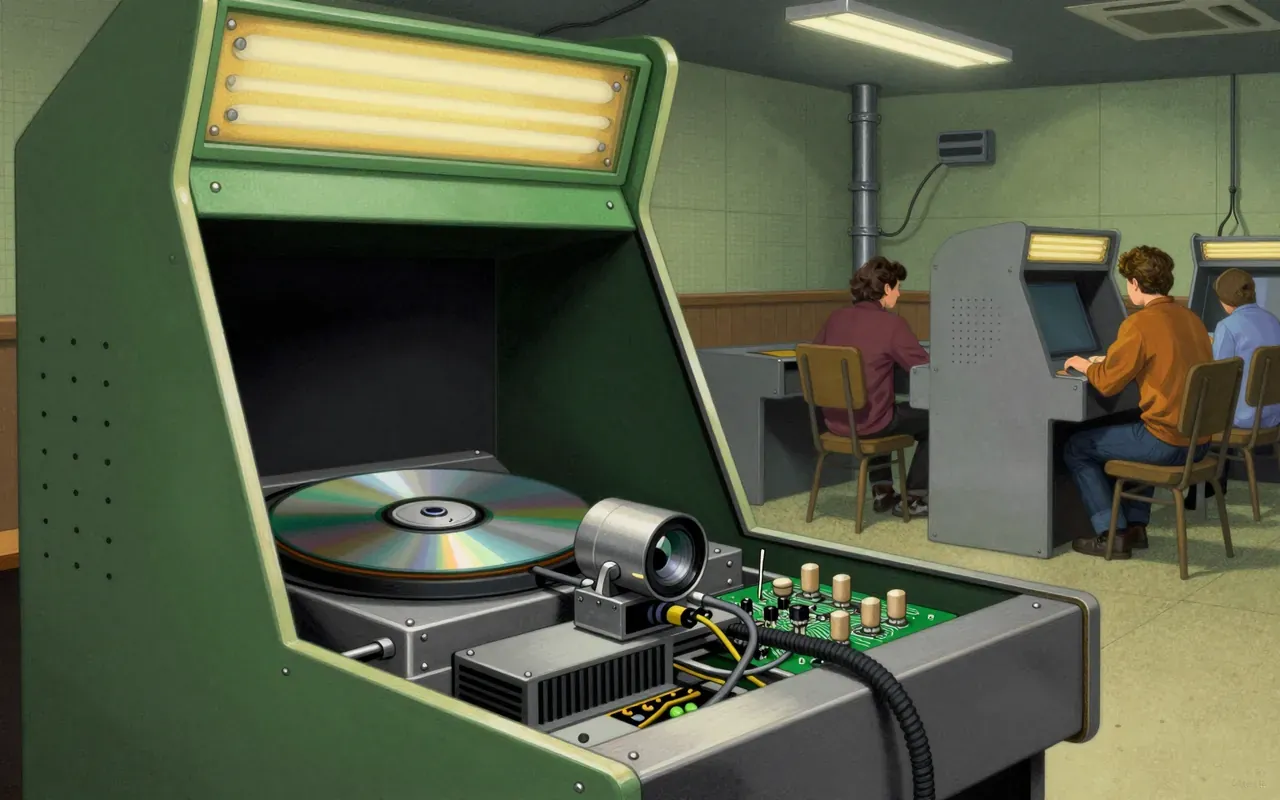
Dragon's Lair (1983) is an arcade-exclusive interactive film where players respond to quick time events during hand-animated cutscenes. It runs on LaserDisc hardware. Players control Dirk the Daring’s reflexes — not his movement or decisions. Narrative progression is predetermined. Levels are grouped into three cycles, selected dynamically. Dying moves the player forward. Failed levels must be repeated before reaching the Dragon's Lair. Some scenes repeat; some are mirrored, reversing required inputs. Operators could configure the cabinet to demand more coins mid-session. Cinematronics organised production in partnership with Advanced Microcomputer Systems and Don Bluth Productions. Starcom was formed to control rights. It was the first major LaserDisc video game.

9:47

Full Throttle (1995 video game)

LucasArts · 1995

Full Throttle is a 1995 LucasArts graphic adventure game built on SCUMM with INSANE for FMV, played from a third-person perspective using point-and-click navigation.

10:48

King's Quest I

Sierra On-Line · 1984

King's Quest I is a foundational graphic adventure that trades player freedom for architectural control — every screen is a stage, every command a test of precise positioning, and every death a reminder that the machine holds all the cards.

9:06

Monkey Island 2: LeChuck's Revenge

LucasArts · 1991

Monkey Island 2: LeChuck's Revenge is a 1991 LucasArts SCUMM-based point-and-click adventure game that introduced iMUSE, used Puzzle Dependency Charts, and offered dual puzzle-difficulty modes.

9:32

The Witcher 3: Wild Hunt

CD Projekt Red · 2015

The Witcher 3: Wild Hunt is an open-world RPG built around authored consequence, not systemic simulation. Its combat demands precision, stamina, and resource management. Its world feels lived-in because of writing—not physics. It was made at great cost, with no DRM, and shipped with free DLC. It remains worth playing if you want narrative weight over procedural noise.

12:27

Uncharted 2: Among Thieves

Naughty Dog · 2009

Uncharted 2: Among Thieves is a third-person action-adventure platformer for PlayStation 3. It is developed by Naughty Dog. It continues the studio’s first approach to realistic worlds and characters. It constrains player action through fixed weapon loadouts, scarce grenades, and environment-locked traversal. It ties puzzle-solving to journal entries. It runs on a proprietary engine built for the PlayStation 3’s Cell architecture.

10:09

Half-Life (video game)

Valve · 1998

Half-Life replaces cutscenes with continuous control, levels with chapters, and abstract challenges with environmental logic. It asks players to observe, adapt, and inhabit a world—not just shoot through it.

9:09

Mass Effect (video game)

BioWare · 2007

Mass Effect (2007) is a single-player, third-person science fiction RPG developed by BioWare using Unreal Engine 3. Players customise Commander Shepard, choose one of six classes with distinct talents and weapon proficiencies, explore a galaxy map to pursue story and optional quests, and recruit and develop six squad members. Combat is real-time and squad-based, pausable for tactical ability selection, with shield/health mechanics, overheating weapons, and cover. Dialogue uses a radial wheel tied to morality (Paragon/Renegade) that shapes relationships and unlocks narrative options. The game features vehicle-based planetary exploration via the M35 Mako, resource surveying, and talent progression through experience and leveling.

10:48

The Longest Journey (video game)

Funcom · 1999

The Longest Journey is a third-person point-and-click adventure game developed and published by Funcom in 1999. It is structured in chapters where players advance the story by completing tasks like talking to characters and solving puzzles. Dialogue is expansive and mostly non-essential to progression, serving instead to build character, location, and lore. Input differs by platform: PC uses a context-sensitive mouse cursor, iOS uses touch-screen interaction. Interaction is guided by icons: Eye for examine, Mouth for talk/consume, Hand for use/pick up. On PC, the cursor changes colour to signal interactivity: red for exits, light blue for multi-action objects. A map screen enables travel between major locations, with new destinations unlocking as the story progresses. Puzzles rely on subtle environmental and conversational clues. Items are stored in an inventory and flash when usable on a compatible object. The game was very well-received both by critics and users. The game was published in 9 languages: English, Norwegian, French, Dutch, Swedish, Italian, Polish, Russian and Spanish.

8:30

Yoshi's Story

Nintendo · 1997

Yoshi's Story is a Nintendo platform game released in 1997, built around two modes—Story and Trial—with a pop-up storybook aesthetic and pre-rendered 3D graphics.

10:08

13 Sentinels: Aegis Rim

Vanillaware · 2019

13 Sentinels: Aegis Rim is a science fiction-themed PS4 game set in the 1980s, combining mecha with a shōjo manga aesthetic. It is a genre-mixing narrative engine built around three interlocking modes—Remembrance, Destruction, and Analysis—and structured by persistent keywords, timeline-jumping, and daily rewinds.

10:06

Fate/Stay Night

Type-Moon · 2004

Fate/Stay Night is a foundational Japanese visual novel that prioritises narrative architecture over interactivity. Its design demands rereading, rewards attention to subtext, and refuses to collapse its three routes into a single coherent whole — making it a deliberate, demanding, and historically significant text-based experience.

12:01

Final Fantasy XIV: Endwalker

Square Enix · 2021

Endwalker delivers narrative closure and mechanical polish—but only to those already inside Final Fantasy XIV’s walls.

10:12

Guild Wars 2

ArenaNet · 2012

Guild Wars 2 delivers responsive storytelling, dynamic world events, and skill-based combat — all without subscription fees. But its 'living world' relied on scheduled, often temporary content. Its branching narrative lives behind instanced doors. Its ambition outpaced its persistence.

10:10

Star Wars: The Old Republic

BioWare · 2011

Star Wars: The Old Republic is BioWare’s first MMORPG. It launched in 2011. It is built around eight faction-locked classes, each with a three-act, level-gated storyline. Players choose Republic or Sith Empire but can align morally anywhere on the light/dark spectrum. Advancement comes through missions, exploration, and combat. Skills unlock automatically. Heroic missions require multi-player cooperation and reset daily. Player choices permanently alter storylines and affect NPC companions. All dialogue is fully voiced and uses a Mass Effect–style system. BioWare Austin was founded in March 2006 specifically for this project, with assistance from BioWare Edmonton. In 2023, BioWare Austin handed the game to Broadsword Online Games.

11:09

Tsukihime

Type-Moon · 2000

Tsukihime is a foundational Japanese visual novel that establishes narrative consequence as core gameplay — through death-triggered tutorials, rigid route architecture, and a completionist epilogue. Its 2000 release at Comiket 59 and immediate patching reflect its origins as an iterative, community-facing object — not a polished product. It asks for patience with prose, tolerance for adult content, and acceptance of its narrow interactivity. It gives back tightly controlled emotional arcs and structural clarity — nothing more.

8:56

Mass Effect 2

BioWare · 2010

Mass Effect 2 is a tightly authored, choice-driven action RPG that prioritises narrative consequence and squad loyalty over systemic freedom. Its strength lies in how imported choices reshape the story, how class design shapes combat, and how the galaxy map serves plot—not exploration. It asks players to commit to a single, high-stakes arc. It withholds open-ended world interaction, real-time loadout flexibility, and non-linear quest resolution.

11:02

Phantasy Star IV

Sega · 1993

Phantasy Star IV is a linear, story-driven RPG on the Sega Genesis. It uses turn-based combat, level-based progression, Technique-based magic, and combination attacks. Its manga-style panels and expanded script distinguish it within the series. Only 14 of 15 combination attacks function. Developed internally by Sega’s Consumer Development division, it belongs to Sega’s multi-million-selling Phantasy Star franchise.

10:30

Sekiro: Shadows Die Twice

FromSoftware · 2019

Sekiro: Shadows Die Twice is a 2019 action-adventure game developed by FromSoftware. Players control Wolf, a shinobi on a quest to rescue his lord Kuro. Gameplay focuses on stealth, exploration, and combat—with particular emphasis on boss battles. It is played from a third-person perspective. Compared to FromSoftware's Dark Souls series, Sekiro features fewer role-playing elements, lacks character creation and the ability to level up a variety of stats, and has no real-time multiplayer elements. It does include gear upgrading, special abilities with a prosthetic arm, a skill tree, and limited ability customization. Combat revolves around using a katana to attack enemy posture and balance, deflecting incoming attacks to create openings for a single killing blow. Stealth allows players to instantly eliminate or severely damage most enemies if they can get in range undetected. Sekiro is part of the Soulslike subgenre defined by high difficulty and environmental storytelling. Hidetaka Miyazaki directed the game.

12:48

The Secret of Monkey Island

LucasArts · 1990

A foundational point-and-click adventure that prioritised interface clarity and consequence-free exploration over challenge or realism.