gamesbriefs
Longest first

All briefs

467 briefs · 4633 min · 289–384 on page 4 of 5
9:34

Metal Gear Solid 3: Snake Eater

Hideo Kojima / Konami · 2004

Metal Gear Solid 3: Snake Eater is a PlayStation 2 stealth game set in a Soviet tropical forest in 1964. It replaces abstract health with bodily injury tracking, swaps binary detection for a dynamic camouflage index, and ties stamina to foraging and rest. Its loop is observational, adaptive, and physically grounded—not cinematic, not reflexive, not narrative-first.

9:34

Fallout (video game)

Interplay · 1997

Fallout (1997) is a foundational CRPG built on rigid arithmetic and player-driven consequence. Its design refuses abstraction: if your Luck is six, you fail 40% of critical rolls. If your Speech is 65%, you unlock one branch—not all. It does not ask you to believe. It asks you to calculate.

9:33

Pro Evolution Soccer (video game)

Konami · 2001

The verified material establishes only that Pro Evolution Soccer (2001) is Konami’s first football sports simulation in the PES series, known in Japan as World Soccer: Winning Eleven 5, with region-specific commentary, and that it sits in a lineage from International Superstar Soccer to eFootball — but says nothing about how it plays, what it asks of a player, or what it delivers in practice.

9:32

R4: Ridge Racer Type 4

Namco · 1998

R4: Ridge Racer Type 4 is a PlayStation racing game centred on powersliding — using either Drift (single brake tap) or Grip (brake/gas alternation) depending on car make — within a structured Grand Prix progression where qualifying positions determine vehicle unlocks and upgrades. It introduces team- and manufacturer-based story modes, Time Attack, two-player split-screen VS. Battle (a series first), four-player Link Cable support, car decoration, Extra Trials versus prototypes, and PocketStation integration for car trading in Japan.

9:32

The Witcher 3: Wild Hunt

CD Projekt Red · 2015

The Witcher 3: Wild Hunt is an open-world RPG built around authored consequence, not systemic simulation. Its combat demands precision, stamina, and resource management. Its world feels lived-in because of writing—not physics. It was made at great cost, with no DRM, and shipped with free DLC. It remains worth playing if you want narrative weight over procedural noise.

9:32

Candy Crush Saga

King · 2012

Candy Crush Saga is a match-three puzzle game where players swap adjacent candies to make lines or columns of three or more identical colours. Matches remove candies, trigger cascading falls, and generate points — with bigger matches producing special candies that clear larger board sections. Each level imposes a specific goal — like collecting a number of candies or clearing jelly-covered tiles — within a fixed move limit. Lives are lost on failure and regenerate over time or via purchase. The game introduced saga-based progression and cross-platform sync, with mobile versions built for touch and offline play.

9:32

The Forest (video game)

Endnight Games · 2018

The Forest is a survival horror game developed by Endnight Games and released in 2018. It features a non-linear open-world loop centred on resource gathering, crafting, fortification, and dynamic threat management against intelligent, behaviourally complex cannibal and mutant enemies. It includes a day-night cycle, sanity-based mechanics, environmental storytelling, optional narrative progression, and no autosave—relying instead on player-placed shelters for saving. Its systems emphasise player agency in survival choices, enemy interaction, and moral ambiguity in conflict.

9:32

Age of Empires II

Ensemble Studios · 1999

Age of Empires II is a real-time strategy game developed by Ensemble Studios in 1999, running on the Genie Game Engine. It is the second title in the original Age of Empires series. Players advance one of 13 civilizations through four historical Ages to build towns, gather resources, create armies, and defeat opponents.

9:32

Gran Turismo 5

Polyphony Digital · 2010

Gran Turismo 5 is a PlayStation 3 sim racing title by Polyphony Digital that adds mechanical and external damage, real-time deformation, overturning, weather on select circuits, karting, stereoscopic-3D, and a parameter-driven course editor.

9:31

Pokémon Red, Blue, and Yellow

Game Freak · 1998

Pokémon Red, Blue, and Yellow are tightly constrained Game Boy RPGs built around three screens, turn-based battles, and enforced social play. They demand cooperation—not for story, but for completion. They reward patience, not improvisation. They are about checking boxes, not breaking rules.

9:31

Gran Turismo 7

Polyphony Digital · 2022

Gran Turismo 7 is a technically accomplished sim racing title that prioritises curated progression and hardware fidelity over player agency. Its reliance on online infrastructure for core functionality—including saving—defines its limits as much as its strengths. It delivers realism through physics and presentation, but structures engagement around compliance, not compulsion.

9:31

Mario Kart 8

Nintendo · 2014

Mario Kart 8 is a polished, accessible, and relentlessly social racing game built for short bursts and local chaos. Its anti-gravity gimmick adds spectacle but not substance. Its strength is in consistent, responsive feedback — not innovation.

9:30

Civilization VI

Firaxis · 2016

Civilization VI is a turn-based 4X strategy game where players grow a single civilization from antiquity to the near future by exploring, expanding, exploiting, and exterminating.

9:29

Vandal Hearts

Konami · 1996

Vandal Hearts is a 1996 Konami tactical RPG defined by its isometric, rotatable 3D terrain, side-by-side turn structure, flexible movement, and strict leader-death loss condition. It offers varied stage objectives but no narrative or progression systems beyond core combat.

9:28

Danganronpa 2: Goodbye Despair

Spike Chunsoft · 2012

Danganronpa 2: Goodbye Despair is a visual novel, adventure game, and role-playing video game developed by Spike before its 2012 merger with Chunsoft. Its structure divides time between Daily Life (dialogue-driven relationship building), Deadly Life (linear evidence collection after murder), and Class Trial (logic combat using Truth Bullets in a first-person shooter framework). Players earn Hope Fragments through Free Time conversations, exchange them for debate skills, and fund that loop with Monocoins earned from trial success and hidden Monokuma Figures. The game demands attention to verbal contradiction, rewards repetition as narrative escalation, and offers no mechanical evolution beyond its fixed, self-reinforcing systems.

9:28

Metal Gear Solid 2: Sons of Liberty

Hideo Kojima / Konami · 2001

Metal Gear Solid 2: Sons of Liberty is a PlayStation 2 stealth-action game released in 2001 by Konami. It features two narrative chapters—the 'Tanker' prologue with Solid Snake and the 'Plant' main section with Raiden—set near New York City in an alternate-history timeline. Its stealth loop relies on observation, environmental interaction, and squad-based enemy AI. It explores memetics, information control, and freedom of thought through a postmodern, fourth-wall-breaking structure.

9:28

Scramble (video game)

Konami · 1981

Scramble (1981) is Konami’s first major arcade hit — a horizontally scrolling shooter where the player pilots a jet across six seamless terrain sections, using separate buttons for forward fire and bombs while managing a depleting fuel supply replenished only by destroying fuel tanks. Success requires surviving, defeating enemies, and destroying a base in the final section to trigger a mission-complete flag — then repeating the cycle at increased difficulty.

9:28

Time Crisis (video game)

Namco · 1997

Time Crisis is a 1995 Namco arcade light-gun shooter defined by its foot pedal mechanic, three-stage structure, and strict one-minute countdown per area. It asks players to balance rapid shooting with minimal ducking to conserve time. It helped set the standard for the lightgun shooter genre. Its design offers no narrative, no flexibility, and no recovery—only repetition, rhythm, and risk.

9:28

Day of the Tentacle

LucasArts · 1993

Day of the Tentacle is a 1993 LucasArts point-and-click adventure built on the SCUMM engine. It uses time travel as a structural puzzle mechanic, splitting three protagonists across past, present, and future. Players switch between them and move items across eras using Chron-o-Johns or temporal placement. It features voice acting — a LucasArts first — and relies on cause-and-effect logic over reflexes or narrative choice.

9:27

RalliSport Challenge

Rainbow Studios · 2002

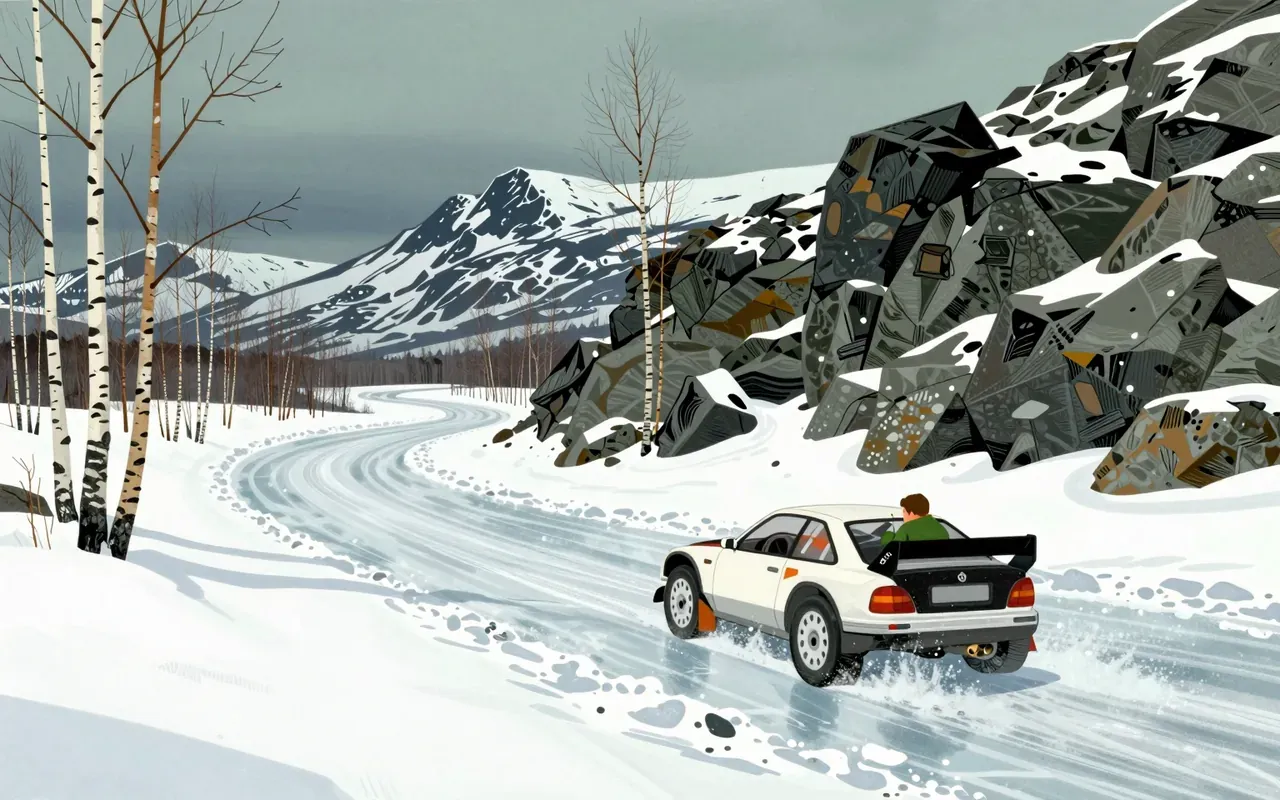
RalliSport Challenge is a 2002 offroad racing game developed by Rainbow Studios. It features four race types—Rally, Hillclimb, Ice Racing, and Rallycross—each defined by distinct terrain-based rules and consequences. Players progress through career mode to unlock cars, choose between Beginner (mid-rally restart) and Normal (full-rally restart) modes, and race either sequentially or against AI. It belongs to the same offroad lineage as Motocross Madness and MX vs. ATV.

9:27

F-Zero GX

Nintendo · 2003

F-Zero GX is a high-speed futuristic racing game built around track memorisation, reflexes, and precise vehicle control. It retains core mechanics from F-Zero X but expands them with customizable machines, energy-based boosting and damage, dynamic track elements (dash/jump plates, obstacles), and advanced cornering techniques like drifting and snaking. Its structure includes Grand Prix, Story, Time Attack, and multiplayer modes, all governed by energy management, vehicle tuning, and escalating difficulty. The game was developed by Amusement Vision and published by Nintendo for the GameCube.

9:27

Radiant Historia

Atlus · 2010

Radiant Historia is a tightly authored, system-led RPG where timeline navigation and grid combat are interlocked — not decorative. Its constraints (DS hardware, reset enemy positions, fixed branches) are visible, consistent, and consequential. It asks for attention to sequence, spatial relationships, and cause-and-effect — not endurance or memorisation.

9:27

The Last Ninja

System 3 · 1987

The Last Ninja is a precise, path-constrained isometric action-adventure that forces players to learn terrain, timing, and ritualised interaction. It works because its systems interlock cleanly—but it refuses flexibility, improvisation, or narrative expansion.

9:27

The Legend of Zelda: Breath of the Wild

Nintendo · 2017

Breath of the Wild replaces authored sequence with systemic consequence. Its design asks you to observe, test, and adapt — then discard your answer when the next object breaks, the next storm hits, or the next slope demands a new use for the same shield.

9:26

Gran Turismo 3: A-Spec

Polyphony Digital · 2001

Gran Turismo 3: A-Spec is a PlayStation 2 racing simulator built around linear, tiered progression, realistic driving physics, and graphical fidelity over breadth.

9:26

Marvel vs. Capcom: Clash of Super Heroes

Capcom · 1998

Marvel vs. Capcom: Clash of Super Heroes is a 1998 2D tag-team fighting game developed by Capcom’s Division 2 for the CP System II arcade system. Players select two fighters, swap between them mid-match, and rely on off-screen regeneration and randomly assigned guest characters with limited uses. It introduces the simultaneous 'Variable Cross' attack and grants unlimited use of the Hyper Combo Gauge. Its 2D animated cartoon-style graphics follow Capcom’s post-Darkstalkers aesthetic.

9:26

Ecco the Dolphin (video game)

Sega · 1992

Ecco the Dolphin is an action-adventure game where the player controls a bottlenose dolphin navigating time-traveling plot-driven levels. Core mechanics include speed-based swimming, singing-based interaction and mapping, glyph-based puzzles, and survival constraints like air depletion and health management.

9:26

Fallout: New Vegas

Obsidian Entertainment · 2010

Fallout: New Vegas is a licensed action role-playing game released in October 2010 by Obsidian Entertainment and published by Bethesda Softworks. It features dual-perspective gameplay, an open-world structure, VATS-based combat, branching dialogue trees, companion recruitment, and deep character customization via SPECIAL attributes and skill allocation—all set in a post-apocalyptic Mojave Desert.

9:25

Joust (video game)

Williams Electronics · 1982

Joust is a Williams Electronics coin-operated arcade game from 1982. It features two-player cooperative or competitive play on a single screen with floating rock platforms above lava. Players control knights on birds — ostrich for Player 1, stork for Player 2 — using horizontal joystick movement and vertical wing-flap timing. Combat resolves via mid-air lance collision based on relative height. Defeated enemies become falling eggs that can be collected for points or left to hatch into new enemies. Three enemy types — Bounder, Hunter, Shadow Lord — differ in colour, AI behaviour, and point value. A pterodactyl appears periodically and must be defeated during a precise animation frame. An indestructible Lava Troll grabs low-flying characters. Lives are lost on collision or lava contact. The game was widely ported to home systems by external developers and publishers.

9:24

Final Fantasy XIV

Square Enix · 2013

Final Fantasy XIV (2013) is a subscription MMORPG rebuilt after failure. It runs on PlayStation 3 and Windows. Players choose a geolocated server and begin only as Disciples of War or Magic. Its UI unifies PC and console inputs. Translation enables basic cross-language communication. Crafting and gathering are locked at launch. The economy runs through market boards, not direct trade. It follows Final Fantasy XI (2002). It was developed by the Final Fantasy XI team using Crystal Tools.

9:24

Fatal Frame (video game)

Tecmo · 2001

Fatal Frame (2001) is a survival horror game developed by Tecmo. It places the player as Miku Hinasaki inside a real-time-rendered Japanese mansion. Navigation uses a semi-fixed camera and flashlight in total darkness. Hostile ghosts are sensed via a 'sixth sense', drain health on contact, and can only be defeated using the Camera Obscura—an antique camera operated in first-person view with dual-stick controls. Damage depends on framing duration and proximity, though ghosts intermittently fade. Film serves as limited, graded ammunition. Progress is gated by puzzles and saved at designated points and chapter ends.

9:24

Lost Ark (video game)

Smilegate · 2018

Lost Ark is a technically competent, gear-obsessed PvE MMO that delivers satisfying combo combat and vast content—but only if you accept its rigid, repetition-first design as a feature, not a flaw.

9:24

Tony Hawk's Pro Skater 2

Neversoft · 2000

Tony Hawk's Pro Skater 2 is a tightly wound trick-chaining machine — built for repetition, reward, and escalating absurdity. Its fixed camera and autonomous skater create a distinct physical language. Its loose physics serve the loop, not realism. It offers no story, no stakes beyond your own score — and that’s exactly why it holds up.

9:23

DayZ (video game)

Bohemia Interactive · 2013

DayZ is a multiplayer online survival game set in fictional plague-ravaged countries where players scavenge, manage health, evade infected, and negotiate threat from other players in a persistent world.

9:23

Metroid (video game)

Nintendo · 1986

Metroid (1986) is a foundational action-adventure game where Samus Aran explores the planet Zebes, acquiring abilities like the Morph Ball and Screw Attack to unlock new areas. It uses nonlinear progression, mandatory boss fights (Kraid and Ridley), and a password save system. It is one of Nintendo’s major franchises and features Samus Aran, a Nintendo character with international recognition.

9:23

Rage 2

Avalanche Studios · 2019

Rage 2 is a first-person shooter co-developed by Avalanche Studios and id Software. Players control Walker — a customisable Ranger — in an apocalyptic open world. Combat blends firearms, the wingstick, Nanotrite powers, and Overdrive, a mode that increases gun damage, heals Walker continuously, and boosts enemy energy drops. Vehicular combat includes trucks, buggies, and gyrocopters — and players may drive any vehicle in the world. The game offers no verified details about platforms, release date beyond 2019, sales, length, frame rate, resolution, player count, or critical reception.

9:22

Arma 3

Bohemia Interactive · 2013

Arma 3 is a military simulation released for PC in September 2013 by Bohemia Interactive. It runs on expansive, photorealistic terrains spanning hundreds of square kilometres. Its realism is systemic: weapons obey ballistics, diving requires dedicated equipment, and electronic warfare or disguise can replace combat entirely. Nearly all gameplay systems—including AI, HUD, and assists—are adjustable via custom difficulty settings. Players pursue fixed mission objectives through self-directed tactics, from solo stealth to squad coordination. It supports extensive modding and user-generated content via the Eden Editor. It is not a narrative-driven shooter. It is a toolset for tactical problem-solving under self-imposed constraints.

9:22

Quake (video game)

id Software · 1996

Quake is id Software’s first true 3D first-person shooter. It launched in 1996. It uses a fully 3D engine. It introduced Internet deathmatch via QuakeWorld. Its single-player campaign has four episodes. Each episode contains seven to eight levels, including one secret level. Episode one’s secret level features very low gravity. Players explore levels, face monsters, and find secret areas before reaching an exit. Switches or keys open doors. Reaching the exit advances the player to the next level. There is no dedicated "use" key — players activate objects by physically pushing against them. The player can wield up to eight weapons but always carries at least an axe and a shotgun. Four separate ammo pools — shells, nails, rockets, and cells — feed specific weapons. Power-ups include Ring of Shadows (invisibility), Pentagram of Protection (invulnerability), and Quad Damage (quadruples weapon damage). Armor has three tiers, each blocking a fixed percentage of damage regardless of durability.

9:22

The Legend of Zelda: Tears of the Kingdom

Nintendo · 2023

Tears of the Kingdom is an expansion of Breath of the Wild’s open-world action-adventure framework, adding verticality through sky islands and the Depths, new traversal and construction mechanics, and four mandatory story dungeons.

9:22

Wreckfest

Bugbear Entertainment · 2018

Wreckfest is a car simulator released on June 14, 2018 by Bugbear Entertainment using their ROMU engine. It features banger racing and demolition derby, with physics-driven soft-body damage that alters vehicle dynamics based on impact location. Players configure assists, buy and upgrade vehicles, and compete in career, multiplayer, and custom events. Its slower, more strategic pacing distinguishes it from faster destruction racers like Burnout.

9:21

Forza Motorsport 4

Turn 10 Studios · 2011

Forza Motorsport 4 is the fourth Forza Motorsport title, developed by Turn 10 Studios for Xbox 360 and published by Microsoft Studios in 2011. It is a racing simulation emphasising realistic car handling and visual fidelity on closed-circuit tracks. It supports dual-input control: traditional controllers or wheels for driving, and Kinect for head-tracking, voice commands, or full-body steering (with auto-acceleration/braking). Its Autovista mode enables detailed exploration of select cars, and its World Tour career adapts AI difficulty based on player performance.

9:21

Madden NFL 24

EA Sports · 2023

Madden NFL 24 improves on-field football with SAPIEN, Fieldsense, and 1,000+ new animations — but fractures its off-field modes across hardware generations and leaves Franchise and Superstar feeling incomplete. It is a technical upgrade with structural debt.

9:21

Hollow Knight

Team Cherry · 2017

Hollow Knight is a 2D side-scrolling Metroidvania. The player controls a silent insectoid warrior exploring the underground fallen kingdom of Hallownest. Core gameplay involves attacking enemies with a sword-like Nail, gaining Soul from combat to fuel abilities like Focus (mask regeneration) and offensive spells, and using Soul for charm-based boosts. Hit points are represented by masks; losing all masks results in death and spawns a Shade at the death location, marked on the map. The game features nonlinear exploration, ability-gated progression, fast travel via Stag Stations, and a charm system that consumes limited charm notches. It was developed and published by Team Cherry, released first on Linux, macOS, and Windows.

9:20

Flashback (1992 video game)

Delphine Software · 1992

Flashback is a cinematic platformer whose gameplay resembles Prince of Persia and Another World. Each level spans many non-scrolling screens, nearly all of which feature multiple levels of altitude. Conrad exhibits realistic human running speed and jumping ability, and realistic weakness. He dies if he falls from a great height. Conrad carries a pistol with unlimited ammunition; a force shield, which absorbs a certain number of shots before needing recharging, acting as Conrad's health; and a portable force field with unlimited use, which can act as a temporary barrier to block enemies' shots. As Conrad progresses through the game's seven levels, he is increasingly presented with spatial puzzles, requiring the player to discover how to guide him toward his destination. Late in the game, Conrad receives a teleportation device, and is able to progress by throwing the device and teleporting into otherwise unreachable areas.

9:20

Kirby 64: The Crystal Shards

Nintendo · 2000

Kirby 64: The Crystal Shards is a 2000 Nintendo 64 platformer developed by HAL Laboratory. It uses 3D rendering but locks movement to a 2D plane. Players collect 98 crystal shards across six worlds using Kirby’s core actions—walk, jump, inhale, fly—and seven copy abilities. Power Combos let players mix two abilities for 28 possible effects. Vehicle-based segments include riding King Dedede’s back, minecarts, and log flumes. Controls use the D-pad exclusively, following usability testing with children. All shards must be collected to reach the final boss and true ending.

9:20

Steep (video game)

Ubisoft · 2016

Steep is a sports video game developed by Ubisoft Annecy and published by Ubisoft. It was released worldwide on 2 December 2016 for PlayStation 4, Windows, and Xbox One. It is an online multiplayer extreme sports game set in a vast open world based on real mountain ranges including the Alps, Alaska Range, and mountains in Japan and Korea. Players explore a freely navigable open world set in the Alps, centered on Mont Blanc. The game can be played from either a first-person or third-person perspective. The game uses GoPro-style camera angles during races. The four main activities are skiing, wingsuit flying, snowboarding, and paragliding. Later DLC added rocket-powered wingsuit flying, sledding, BASE jumping, and speed riding. Players switch between activities using the game's menu wheel.

9:20

Shogun: Total War

Creative Assembly · 2000

Shogun: Total War is a foundational strategy game that fused turn-based empire management with real-time battlefield tactics. Its ambition—to simulate feudal Japanese unification—was matched only by its structural compromises. The campaign map was added late. Systems coexist but rarely converse. Yet its combat loop remains legible, its faction asymmetry functional, and its provincial logic direct. It rewards patience, pattern recognition, and tolerance for abstraction.

9:20

Splatoon 2

Nintendo · 2017

Splatoon 2 is a Nintendo-published third-person shooter built around ink-based terrain control, morphing between humanoid and cephalopodic forms, with structured competitive and co-op modes.

9:20

Final Fantasy VII

Square · 1997

Final Fantasy VII is a foundational 3D JRPG that replaces free movement with narrative-gated spatial modes. Its innovation lies in structural clarity—not immersion.

9:20

Super Smash Bros. Melee

Nintendo · 2001

Super Smash Bros. Melee is a platform fighter where damage is tracked as a percentage that directly governs knockback, not depletion. Players use directional joystick input plus a single button to perform attacks—including special moves mapped to B + direction. Victory comes from knocking opponents off themed stages—not reducing their health to zero. Up to four players compete locally in Stock or Time modes. It is a Nintendo-published title featuring internationally recognised Nintendo characters. It belongs to the Super Smash Bros. franchise, a major Nintendo IP.

9:18

Forza Horizon

Playground Games · 2012

Forza Horizon is a festival-driven open-world racer that swaps lap timing for stunt chaining, uses Colorado’s roads as its track, and runs exclusively on Xbox 360. It works because it makes aggression pay. It falters because it never deepens beyond that loop.

9:18

Mario Kart Wii

Nintendo · 2008

Mario Kart Wii is a 2008 Wii racing game where 24 Mario characters race on 32 themed tracks using items to attack or boost. It supports two- to four-player local split screen and Battle Mode (balloon popping). Motion controls via the bundled Wii Wheel define its feel — intuitive but imprecise. Half the content is locked behind completion objectives. Online play ended in May 2014.

9:18

Return to Castle Wolfenstein

Gray Matter Interactive · 2001

Return to Castle Wolfenstein is a first-person shooter built on id Tech 3, where the player navigates levels and fights enemies including Nazi soldiers, undead, and experimental mutants. In the game's single-player mode, players use combat and stealth to complete objectives across 27 levels in 7 missions. Missions begin with a mission briefing, providing information about objectives, and may include activities such as reaching the end of an area, defeating all the enemies, collecting certain items, eliminating specific enemies, or stealth missions. The player acquires weapons and ammo throughout levels, including for pistols, submachine guns, rifles, grenades, rockets, flamethrowers, and experimental weapons including the Venom, a minigun, and the Tesla Gun, which shoots electricity at enemies. Some weapons have alternate fire modes, such as rifles that have a scope, or shoot projectiles. The player can also engage in melee combat by either kicking or using a knife. Damage is location-specific, with headshots damaging enemies more than other areas. Special items can be collected that increase the player's health, ammo, armor, or stamina.
9:18

Shin Megami Tensei III: Nocturne

Atlus · 2003

Shin Megami Tensei III: Nocturne is a PlayStation 2 RPG developed by Atlus and directed by Katsura Hashino. Released in 2003, it was the first main-series Megami Tensei game released in the United States (2004). Its design centres on a weakness-driven 'Press Turn' battle system, demon negotiation and fusion, and navigation across a symbolic 2D world map and grid-based 3D dungeons with automatic mapping and first-person 'Look' functionality. It sets difficulty at the start (Normal or Hard) and features a silent protagonist named during the opening.

9:18

Galaga '88

Namco · 1988

A fixed shooter where formation, capture, and rescue define every session.

9:18

SimCity 3000

Maxis · 1999

SimCity 3000 refines the city simulation loop with decay, density, and deal-making — but never asks why the city exists, only how to keep its accounts balanced.

9:17

Payday: The Heist

Overkill Software · 2011

Payday: The Heist is a 2011 cooperative FPS by Overkill Software. It establishes the core loop of theft-driven co-op play, hostage-based revival, and civilian protection. Its randomisation adds replayability without altering mechanics. It lacks progression, narrative, or solo support. It runs on PlayStation 3 and Windows.

9:16

Ultima Online

Origin Systems · 1997

Ultima Online is a fantasy massively multiplayer online role-playing game released by Origin Systems on 24 September 1997. It was Origin’s first persistent online game. It was partially designed as a social and economic experiment. Its initial features included persistent player housing, skill-based character progression without levels or classes, a craft-based and player-driven economy, and unrestricted player-versus-player combat. Servers enforced either consensual or non-consensual PVP depending on type — Trammel, Felucca, or Siege — each with distinct rules for combat, travel, and item loss. The release of Trammel led developers to rename the original world Felucca and make its environment more grim. Siege servers restrict players to one character slot and limit travel options. Ultima Online is one of the earliest graphical MMORPGs. Its success was pivotal in EA’s decision to make Origin an online-only company after the completion of Ultima IX: Ascension in 1999.

9:16

EarthBound

Nintendo · 1994

EarthBound is a 1994 Nintendo RPG that rejects the genre’s conventions: no overworld map, no random encounters, no top-down grid. Instead, it builds a seamless, oblique-projection world where enemies are visible NPCs, combat begins with spatial positioning, and progression is deliberately unstable. It asks players to read the environment, not the menu.

9:16

StarCraft (video game)

Blizzard · 1998

StarCraft is a foundational RTS defined by enforced asymmetry across three races—Protoss, Zerg, and Terrans—each with unique units, economies, and strategic identities. Its campaign delivers thirty fixed missions, ten per race, with AI difficulty escalating automatically. It offers no difficulty adjustment, no mission retries, and no explicit pedagogy—only systemic divergence and player-driven translation.

9:16

Tetris

Alexey Pajitnov · 1984

Tetris (1985) is a puzzle game where tetrominoes descend one at a time from the top-centre of a rectangular field; players move and rotate them horizontally until they land, aiming to form complete horizontal lines that vanish and cause blocks above to fall. Line clears grant points and increase descent speed; the game ends when pieces stack to the top ('topping out'). The original version ran on the Elektronika 60 and IBM PC, and its core design remains consistent across versions.

9:15

Ultima III: Exodus

Origin Systems · 1983

A foundational computer RPG that shifted the genre from solo brawling to party-based tactics and puzzle-driven resolution — built on Ultima’s reputation to launch Origin Systems during the 1983 crash.

9:14

Clock Tower (1996 video game)

Human Entertainment · 1996

Clock Tower (1996) is a point-and-click survival horror game with 3D graphics, released by Human Entertainment on Super NES in 1995 and on PlayStation as Clock Tower 2 in 1996. Players navigate using cursor clicks, manage inventory via screen-top access, and survive Scissorman under a dynamic strength system shown by cursor colour. Narrative branches from early choices lead to ten possible endings.

9:14

Shinobi (1987 video game)

Sega · 1987

Shinobi (1987) is a Sega arcade game where Joe Musashi fights Zeed across timed stages using shurikens, melee, and one-per-stage ninjutsu techniques. Movement is precise. Death is absolute. Progression is hostage-driven. It is not about lore, scale, or stamina — it is about reading space, committing to motion, and choosing when to spend your one irreplaceable power.

9:14

Super Smash Bros. (video game)

Nintendo · 1999

Super Smash Bros. (1999) is a Nintendo-published crossover fighting game that discards life bars for percentage-based knockback physics. Players move freely in two dimensions across large, dynamic stages. Damage increases as a percentage, making characters fly farther with each hit. KOs occur when a character is launched off open stage boundaries. Recovery is possible mid-air using jumps. All characters share identical control schemes. The game prioritises aerial mobility and stage awareness over traditional fighting game conventions like blocking or complex inputs.

9:14

The Elder Scrolls V: Skyrim

Bethesda · 2011

Skyrim delivers open-world agency through fast travel, skill-based progression, and unconditional quest deferral — but offers no systemic consequences for how those freedoms are used. Its strength is in repetition, not responsiveness.

9:13

Advance Wars 2: Black Hole Rising

Intelligent Systems · 2003

Advance Wars 2: Black Hole Rising is a Game Boy Advance turn-based strategy game released in 2001 by Intelligent Systems. It refines the Wars series’ core loop with non-linear campaign progression, Super CO Powers, and terrain-specific objectives like capturing Black Cannons. It asks players to sequence actions across turns with precision, not flair. Its rigour is its strength—and its limit.

9:13

Black Desert Online

Pearl Abyss · 2014

Black Desert Online replaces tab-targeting with twitch reflexes — and forces you to feed your horse before it dies in battle.

9:13

Mortal Kombat II

Midway · 1993

Mortal Kombat II is a 1993 arcade fighting game by Midway. It improves on the original with faster pacing, refined movement options, and expanded finishers. It removes bonus games in favour of a win-counter. Finishing moves are disabled against or by boss or secret characters.

9:12

Escape from Monkey Island

LucasArts · 2000

Escape from Monkey Island is the fourth Monkey Island game and LucasArts’ final original adventure title. It is a narrative-driven Caribbean island-hopping game built on dialogue, puzzle-solving, and novel input schemes.

9:11

Dishonored 2

Arkane Studios · 2016

Dishonored 2 is a first-person action-adventure with stealth elements, developed by Arkane Lyon and published by Bethesda Softworks in November 2016. It runs on the proprietary Void Engine. Players choose between Emily Kaldwin or Corvo Attano, each with distinct supernatural abilities — all optional.

9:11

Final Fantasy X

Square · 2001

Final Fantasy X (2001) is a PlayStation 2 RPG by Square that replaces the Active Time Battle system with the Conditional Turn-Based Battle system, abandons traditional leveling for the Sphere Grid, redefines summoning via persistent Aeons, and implements interactive Overdrives. It runs on a continuous 3D world map.

9:10

Super Smash Bros. Ultimate

Nintendo · 2018

Super Smash Bros. Ultimate is a platform fighter for up to eight players. It belongs to Nintendo’s Super Smash Bros. franchise. It uses a percentage-based knockback system, three victory conditions, toggleable Final Smashes, random items including Poké Balls and Assist Trophies, and stage variants with adjustable hazards. Players can save custom rule presets. It includes Spirits and World of Light as core single-player systems.

9:10

Dirt Rally

Codemasters · 2015

Dirt Rally is a focused, unforgiving rally simulation that replaces spectacle with consequence. It demands repetition, observation, and adaptation—not reflexes or narrative. Its strength is in its specificity: real locations, real cars, real weather, real penalties. Its limit is in what it refuses to offer: accessibility, explanation, or compromise.

9:09

PUBG: Battlegrounds

PUBG Corporation · 2017

PUBG: Battlegrounds is a battle royale shooter where up to 100 players parachute onto an island, scavenge for gear, and fight to be the last survivor. The safe zone shrinks over time, forcing players into tighter spaces and more frequent encounters. Players choose solo, duo, or squad (up to four) modes, begin with no functional gear, and must rapidly adapt to dynamic conditions including shifting flight paths, red-zone bombings, and loot-dropping planes. It launched in early access on Windows in March 2017 and later on Xbox One, and was developed by Krafton's PUBG Studios and published by Krafton.

9:09

Mass Effect (video game)

BioWare · 2007

Mass Effect (2007) is a single-player, third-person science fiction RPG developed by BioWare using Unreal Engine 3. Players customise Commander Shepard, choose one of six classes with distinct talents and weapon proficiencies, explore a galaxy map to pursue story and optional quests, and recruit and develop six squad members. Combat is real-time and squad-based, pausable for tactical ability selection, with shield/health mechanics, overheating weapons, and cover. Dialogue uses a radial wheel tied to morality (Paragon/Renegade) that shapes relationships and unlocks narrative options. The game features vehicle-based planetary exploration via the M35 Mako, resource surveying, and talent progression through experience and leveling.

9:09

Front Mission (video game)

Square · 1995

Front Mission is a linear, story-driven tactical RPG where players command modular mecha called wanzers across a point-and-click world map, customising them under strict weight-to-power limits and managing part-specific damage states in mission-based combat.

9:09

Blade & Soul

NCSoft · 2012

Blade & Soul is a Wuxia-themed MMORPG developed and published by NCSoft. Launched in June 2012, it was NCSoft’s first MMORPG since Aion in 2008. It features open-world exploration, real-time combo-based combat, four folklore-inspired races, and extensive character customisation.

9:09

Counter-Strike 2

Valve · 2023

Counter-Strike 2 refines rather than reimagines. Its strength lies in constraint: fixed teams, no respawns, round-based economy, and mechanical precision. It asks for commitment to a narrow, high-stakes loop — and gives nothing back to players who stray from it.

9:08

Bulletstorm

People Can Fly · 2011

Bulletstorm is a first-person shooter built around one idea: make killing absurdly creative, then reward it instantly. Its design forces constant verticality, slow-motion decision-making, and weapon-specific improvisation. It has no narrative weight, no competitive layer, and no ambition beyond its loop. It succeeds precisely where it narrows its focus—and fails where it tries to widen it.

9:08

Torchlight II

Runic Games · 2012

Torchlight II refines the ARPG loop with class-driven builds, overland pacing, and co-op—but ships with brittle networking and zero narrative weight. It works because it knows its limits.

9:08

Spy Hunter

Midway · 1983

Spy Hunter is a 1983 Midway arcade game. It is a vertical scrolling, top-down vehicular combat game where the player drives the G-6155 Interceptor sports car as a spy. The player uses a yoke, pedal, and gearshift to steer and control speed. The car has a machine gun with unlimited ammunition fired by pressing and holding a yoke button. Enemy vehicles—including a bomb-dropping helicopter—try to destroy the player's car or force it off the road. A score counter increments while the car is moving and on the road. Additional points are earned by destroying enemy vehicles using weapons or forcing them off the road.

9:07

Plants vs. Zombies 2

PopCap Games · 2013

Plants vs. Zombies 2 tightens the original’s loop into a five-row, sun-gated, one-mistake-per-lane test—but adds time travel without mechanical consequence, and free-to-play friction without structural reinvention.

9:06

Monkey Island 2: LeChuck's Revenge

LucasArts · 1991

Monkey Island 2: LeChuck's Revenge is a 1991 LucasArts SCUMM-based point-and-click adventure game that introduced iMUSE, used Puzzle Dependency Charts, and offered dual puzzle-difficulty modes.

9:06

Donkey Kong Country

Rare · 1994

Donkey Kong Country is a side-scrolling platform game where players control Donkey and Diddy Kong across 40 levels accessed via a world map. Gameplay involves jumping between platforms, avoiding obstacles, swapping between characters with distinct abilities (Donkey: stronger, terrain-slap; Diddy: faster, more agile), defeating enemies through jumping, rolling, or throwing barrels, and completing boss fights at the end of each area. The game features collectibles, animal buddies with special abilities, bonus stages, and multiplayer modes.
9:06

Splatoon 3

Nintendo · 2022

Splatoon 3 refines Nintendo's ink-based shooter without altering its foundational logic. It delivers tight, readable combat where weapon choice directly shapes movement, coverage, and team function. Its strength lies in consistency—not expansion.

9:06

Sonic Adventure

Sega · 1998

Sonic Adventure is the first main Sonic game built for 3D — and the Dreamcast’s launch title.

9:05

EverQuest II

Sony Online Entertainment · 2004

EverQuest II is a 3D fantasy MMORPG for Windows PCs, released by Sony Online Entertainment on November 9, 2004. It is a sequel set hundreds of years after the original EverQuest, following the same strategy: persistent world, experience-based leveling, guild-driven advancement, and a robust tradeskill system that lets players craft spells, potions, armor, and more. It shifted to free-to-play on December 6, 2011, with optional subscriptions. Its core loop demands sustained group coordination, gear acquisition, and long-term social investment—making it viable only for players who treat MMOs as infrastructure, not entertainment.

9:05

Quake Champions

id Software · 2018

Quake Champions is a fast-paced arena-based shooter built on a hybrid id Tech and Saber3D Engine. It launched free-to-play with Ranger only, added purchasable characters, and replaced loot boxes with a battle pass model. It omits VR, Vulkan, SnapMaps, and mod support. Hardware limitations prevented console release. Each character has one passive and one active ability. It departs from Quake’s legacy of Internet deathmatch and fully 3D engine innovation.

9:05

Civilization II

Sid Meier · 1996

Civilization II is a foundational turn-based strategy game where players build a civilization from a primitive tribe while competing with computer-controlled rivals on a tile-based map. It offers three victory paths—conquest, space colonisation, or survival to 2020 AD—and lets players choose from 21 historical civilizations or create a custom one. Brian Reynolds was the primary designer; the 'Sid Meier's' prefix functioned as a quality signal. The base game supports only single-player mode. It models historical development through abstraction, not simulation.

9:04

Kangaroo (video game)

Sun Electronics · 1982

Kangaroo is a tightly wound 1982 arcade platformer where vertical movement, joystick-based jumping, and face-to-face punching define every second of play. It delivers immediacy and clarity at the cost of variety and longevity.

9:04

System Shock 2

Looking Glass Studios / Irrational Games · 1999

System Shock 2 is a first-person action role-playing survival horror game set aboard a starship in a cyberpunk 2114. You play as a soldier fighting a genetic infection through combat, exploration, and skill development. Gameplay consists of first-person combat and exploration, with role-playing elements including hacking and psionic abilities. Navigation is first-person with a HUD showing character/weapon info, map, and drag-and-drop inventory. The game fuses FPS immediacy with RPG consequence, demanding patience and attention from the player.

9:03

Session: Skate Sim

crea-ture Studios · 2019

Session: Skate Sim is an open-ended sports video game that simulates skateboarding with strict adherence to physics, presented through a fish-eye lens mimicking mini DV format.

9:02

Guitar Hero (video game)

Harmonix · 2005

Guitar Hero (2005) is a rhythm game where players press coloured fret buttons and strum in time with scrolling notes on screen. Developed by Harmonix and published by RedOctane for the PlayStation 2, it uses a custom guitar-shaped controller with five colour-coded frets and a strum bar. Gameplay draws from Frequency and Amplitude, and supports both left- and right-handed configurations. A Rock Meter fails the song if depleted, and Star Power can be activated via whammy bar or tilt. Players earn points for hitting notes, chords and sustains, and increase a score multiplier through consecutive successful hits. Hammer-on and pull-off techniques allow faster note series without strumming each note. Standard controllers map notes to face buttons.

9:02

Skate 2

EA Black Box · 2009

Skate 2 is a 2009 skateboarding game developed by EA Black Box and published by Electronic Arts. Set in the fictional city of New San Vanelona, the single-player career mode follows a skateboarder released from jail five years after being arrested in the first game, Skate, who is tasked with popularising skateboarding in the city again after devastating earthquakes, avoiding security guards hired by the company 'Mongocorp' who have bought most of the city's property.