gamesbriefs
Shortest first

All briefs

467 briefs · 4633 min · 385–467 on page 5 of 5
10:47

Unreal Tournament

Epic Games · 1999

Unreal Tournament (1999) is a tightly constrained arena shooter built for repeatable, high-skill duels. Its design rejects sprawl, narrative, and persistence in favour of immediate spatial logic, weapon-based physics, and player-defined rulesets. It remains potent not because it aged well—but because it never tried to age at all.

10:48

King's Quest I

Sierra On-Line · 1984

King's Quest I is a foundational graphic adventure that trades player freedom for architectural control — every screen is a stage, every command a test of precise positioning, and every death a reminder that the machine holds all the cards.

10:48

Prey (2017 video game)

Arkane Studios · 2017

Prey (2017) is a first-person immersive sim set aboard the Talos I space station. You play as Morgan Yu, a scientist surviving a Typhon outbreak. You begin with a wrench and gradually unlock weapons, Neuromod abilities, and environmental tools. Talos I opens in stages—from linear missions to free exploration—and supports multiple solutions via systemic interactions: oil spills, turrets, explosive canisters, and the Gloo Cannon. It draws inspiration from System Shock and Arx Fatalis. It shares only its name with Human Head Studios’ earlier Prey series. It was developed by Arkane Austin under Raphaël Colantonio’s leadership.

10:48

Samurai Shodown (1993 video game)

SNK · 1993

Samurai Shodown (1993) is a weapon-based 2D fighting game released by SNK for the Neo Geo arcade system. Set in late-1780s feudal Japan, it replaces hand-to-hand combos with deliberate, high-risk strikes. Slow motion highlights impact. A referee lifts white or red flags to confirm hits. Blood appears on contact. It is SNK’s first arcade fighter built around weapons.

10:48

TrackMania Turbo (2016 video game)

Nadeo · 2016

TrackMania Turbo is a 2016 arcade racing game by Nadeo. It delivers stunt-focused, high-speed racing across four themed locations—Canyon Grand Drift, Valley Down and Dirty, Rollercoaster Lagoon and International Stadium—with over 200 tracks. It includes a single-player campaign, cooperative Double Driver mode, local split-screen for up to four players on PlayStation 4, Xbox One and PC, and a track editor with random generation.

10:48

Squad (video game)

Offworld Industries · 2015

Squad is a realism-based military tactical first-person shooter developed and published by Offworld Industries in 2015. It is exclusively distributed via Steam.

10:48

The Longest Journey (video game)

Funcom · 1999

The Longest Journey is a third-person point-and-click adventure game developed and published by Funcom in 1999. It is structured in chapters where players advance the story by completing tasks like talking to characters and solving puzzles. Dialogue is expansive and mostly non-essential to progression, serving instead to build character, location, and lore. Input differs by platform: PC uses a context-sensitive mouse cursor, iOS uses touch-screen interaction. Interaction is guided by icons: Eye for examine, Mouth for talk/consume, Hand for use/pick up. On PC, the cursor changes colour to signal interactivity: red for exits, light blue for multi-action objects. A map screen enables travel between major locations, with new destinations unlocking as the story progresses. Puzzles rely on subtle environmental and conversational clues. Items are stored in an inventory and flash when usable on a compatible object. The game was very well-received both by critics and users. The game was published in 9 languages: English, Norwegian, French, Dutch, Swedish, Italian, Polish, Russian and Spanish.

10:48

Deathloop

Arkane Studios · 2021

Deathloop is a first-person shooter built around a deterministic time-loop puzzle. Players control Colt Vahn, who must kill eight Visionaries before midnight to break the loop. Time advances only when moving between Blackreef’s four districts. NPC routines and environmental access shift with time-of-day. Actions in one district affect others. There is exactly one valid kill order. Every failure resets progress.

10:51

Gran Turismo (1997 video game)

Polyphony Digital · 1997

Gran Turismo (1997) is a PlayStation sim racing game developed by Polyphony Digital. It emphasises realism through physics-driven handling, two distinct modes—Arcade and Simulation—and a curated roster of 140 cars from Japanese manufacturers. It was the first game to fully support the DualShock controller. It does not feature car damage. Its design prioritises mechanical fidelity over spectacle, progression over immediacy, and menu clarity over visual density.

10:52

Soulcalibur III

Namco · 2005

Soulcalibur III is a tightly wound, offline-only PlayStation 2 fighting game that binds narrative, strategy, and character systems into one progression loop. It demands interplay across modes, rewards precision in timed inputs, and refuses to separate personality from equipment. Its absence of online play is a structural choice—not an omission. It is dense, deliberate, and uninterested in hand-holding.

10:52

Portal 2

Valve · 2011

Portal 2 is a first-person puzzle-platform game developed by Valve and released in 2011. It builds on the original Portal's portal-gun mechanic with new tools—gels, lasers, tractor beams, and launch plates—and introduces cooperative play with two robot characters. All gameplay occurs in discrete test chambers inside the decaying Aperture Science facility.

10:52

Silent Hill 2

Team Silent · 2001

Silent Hill 2 is a 2001 survival horror game developed by Team Silent within Konami Computer Entertainment Tokyo. It uses third-person perspective, no HUD, light-dependent maps, manual annotation, and environmental progression to frame James Sunderland’s search for his deceased wife as an act of psychological excavation.

10:52

Suikoden III

Konami · 2002

Suikoden III is a PlayStation 2 RPG by Konami Computer Entertainment Tokyo. It uses the Trinity Sight System to rotate control among Hugo, Chris, and Geddoe — each representing one side of a three-way conflict between the Grassland tribes, Zexen, and Harmonia. Protagonists are fully voiced. Recruitment of the 108 Stars of Destiny has no time limits. Combat features tandem front/back row action and chant-interruptible rune magic. Army battles use a node-based grid.

10:53

Borderlands 2

Gearbox Software · 2012

Borderlands 2 is a shooter built around loot as feedback, class skills as rhythm, and repetition as reward. Its design commits to systems over spectacle—and it works.

10:53

Fallout 2

Black Isle Studios · 1998

Fallout 2 is a role-playing video game developed by Black Isle Studios in 1998. It is a direct sequel built on the same engine and design philosophy as its predecessor. It is not the origin of the Fallout series — Black Isle did not create the original Fallout, though many of its founding members came from that team.

10:54

Killing Floor (video game)

Tripwire Interactive · 2009

Killing Floor is a co-op first-person shooter where players survive escalating waves of ZEDs using perks, door welding, and a between-wave trader. It launched on Steam on May 14, 2009. It began as a mod for Unreal Tournament 2004. It is Tripwire Interactive’s second game.

10:54

Left 4 Dead

Valve · 2008

Left 4 Dead is a cooperative first-person shooter released in 2008 by Valve. Players control one of four survivors navigating zombie-infested environments to reach safe areas. Its defining feature is the AI Director, which dynamically adjusts enemy spawns and item placements to ensure varied, tension-filled experiences across playthroughs. Cooperation is structurally enforced via mechanics like wall-visible teammate outlines, shared healing, mandatory revival from incapacitation, and lethal consequences for repeated failure to recover. Campaign mode includes safehouse checkpoints, crescendo events, and defensive finales, while multiple modes (Versus, Survival, Single-Player) extend replayability. The game uses the Source engine and emphasizes cinematic, film-inspired presentation and communication systems — including voice callouts and visual cues — to sustain coordinated group action.

10:54

Lode Runner

Brøderbund · 1983

Lode Runner is a tightly wound logic puzzle game built around a single, elegant mechanic: digging temporary holes to trap guards, then walking over them before they fill. It demands precision, foresight, and tolerance for opaque enemy behaviour. Its 150 levels escalate cleanly, and its shipped level editor made player authorship part of the core experience. It belongs to the Apple II era—not just chronologically, but architecturally.

10:55

Mario Kart 64

Nintendo · 1997

Mario Kart 64 is a foundational local multiplayer racing game built around item-driven chaos, weight-class trade-offs, and split-screen immediacy. It asks players to react faster than they think—and to forgive the game when luck overrides skill. Its hardware constraints shaped its clarity: no HUD clutter, no camera tricks, no persistence beyond the next race.

10:55

NBA 2K23

2K Sports · 2022

NBA 2K23 is a historically segmented basketball simulation. It divides the NBA into four playable eras — 1983–84, 1991–92, 2002–03, and 2022–23 — each with distinct arenas, logos, jerseys, rosters, draft classes, broadcast packages, and modifiable rules.

10:56

Carmageddon

Stainless Games · 1997

Carmageddon is a 1997 vehicular combat game developed by Stainless Games. It subverts racing conventions by making wrong-way driving, crashing, and pedestrian killing explicit objectives. The player races a vehicle against computer-controlled competitors in city, mine and industrial areas. Time is limited but extendable by collecting bonuses, damaging opponents’ cars or running over pedestrians. A race ends when the player finishes the course, wrecks all opponent vehicles, or kills all pedestrians on the level. The game features thirty-six racetracks across eleven locations. Its fully featured physics engine — a world-first for video games — makes collisions unpredictable and tactile. Crashing feels consequential because the engine simulates damage, momentum and environmental interaction in real time. Wrong-way driving wasn’t a bug — it was the core design mandate. Pedestrian killing was added to distinguish it from Destruction Derby — and to provoke. It is worth your time if you want to experience how physics-driven chaos reshaped vehicular combat in 1997 — not as nostalgia, but as a working prototype of rule-breaking design.

10:57

SSX Tricky

EA Canada · 2001

SSX Tricky is a 2001 arcade snowboarding game developed by EA Canada for PlayStation 2, GameCube, and Xbox. It builds on SSX with twelve characters, Uber Tricks triggered by adrenaline, a rivalry system activated by knocking down opponents, and progression tied to medals and trick books. Tracks include remixes of Merqury City and Tokyo Megaplex, plus Garibaldi and Alaska.

10:58

Thief: The Dark Project

Looking Glass Studios · 1998

Thief: The Dark Project is a 1998 stealth game by Looking Glass Studios. It uses light and sound as core mechanics. Players assume the role of Garrett in a first-person, unscripted 3D world. Objectives are discrete—like stealing a specific object—and must be completed to advance. A visibility gem on the HUD indicates detectability. NPCs react to environmental cues. Eidos Interactive published it.

10:58

Elden Ring

FromSoftware · 2022

Elden Ring is a third-person open-world action RPG developed by FromSoftware and released in 2022. Players explore six main areas on horseback, engage in melee or ranged combat, use stealth, upgrade attributes at sites of grace using runes, and participate in online co-op or PvP.

10:59

Rock Band (video game)

Harmonix · 2007

Rock Band (2007) is a four-player rhythm game developed by Harmonix. It simulates rock performance using instrument-shaped controllers for lead guitar, bass guitar, drums, and vocals. Scoring depends on timing accuracy for instruments or pitch-matching for vocals. It launched across Xbox 360, PlayStation 3, PlayStation 2, and Wii—with feature parity highest on Xbox 360 and PlayStation 3. Post-launch, Harmonix supported PlayStation 3 and Xbox 360 with weekly downloadable songs.

10:59

Pong

Atari · 1972

Pong is not simple — it is surgically constrained.

11:01

Fortnite Battle Royale

Epic Games · 2017

Fortnite Battle Royale is a free-to-play battle royale released by Epic Games in September 2017. It supports up to 100 players per match in solo or squad formats. Players descend from the Battle Bus onto a large island, gather weapons and resources—including wood, stone, and metal—and build temporary structures for movement, defense, or combat. The game is played in third-person perspective, with a continuously shrinking safe zone forcing encounters. It uses microtransactions and a battle pass system for revenue and supports cross-platform play across PC, console, and mobile.

11:02

Phantasy Star IV

Sega · 1993

Phantasy Star IV is a linear, story-driven RPG on the Sega Genesis. It uses turn-based combat, level-based progression, Technique-based magic, and combination attacks. Its manga-style panels and expanded script distinguish it within the series. Only 14 of 15 combination attacks function. Developed internally by Sega’s Consumer Development division, it belongs to Sega’s multi-million-selling Phantasy Star franchise.

11:03

The Legend of Zelda: Ocarina of Time

Nintendo · 1998

A foundational 3D action-adventure that established targeting, context-sensitivity, and music-as-mechanic—but does so with hardware-imposed friction, not elegance.

11:05

Tales of Phantasia

Namco Tales Studio · 1995

Tales of Phantasia is the foundational title of the Tales series—a technical pivot from turn-based to real-time party combat on the Super Famicom. Its Linear Motion Battle System defines engagement by splitting control: one character in motion, the rest in menus or AI. It delivers a focused revenge arc set in Aselia, where the destruction of Cress’s village serves a larger scheme to free Dhaos. Development was delayed from 1994 to late 1995 due to Namco-mandated changes—including the title—after Telenet contracted Namco following failed talks with Enix. Yoshiharu Gotanda conceived the game at Wolf Team.

11:06

1080° Snowboarding

Nintendo · 1998

1080° Snowboarding is a Nintendo 64 snowboarding game released in 1998. Players control one of five snowboarders in third-person across eight levels. Core gameplay splits between racing (Race, Time Attack, 2 Players, Match Race) and trick-based scoring (Trick Attack, Contest). Tricks — 24 standard and 5 secret — fall into grab or spin categories and require circular stick motions plus R, Z, and B inputs. Scoring rewards complexity, combos, and timing. Characters and boards have distinct stats affecting technique, speed, weight, balance, and edge control. The game emphasises realistic physics and responsive controls.

11:06

Donkey Kong Country 3

Rare · 1996

Donkey Kong Country 3 is a 1996 platform game by Rare where Dixie Kong and Kiddy Kong navigate 48 levels across 8 worlds using dual-character switching, vehicle-based overworld traversal, and direct animal friend control.

11:06

Universe Sandbox

Giant Army · 2008

Universe Sandbox (2008) is a physics simulation tool masquerading as a game. It lets players load real solar system data or invent new stars, planets, and black holes — then adjust mass, density, velocity, and time to watch gravity do its work. There is no score, no story, no failure state — only observation, iteration, and consequence. Its strength is fidelity to astrophysical cause-and-effect; its limit is the absence of any design layer between the user and the equations.

11:08

UFO: Enemy Unknown

Julian Gollop · 2013

UFO: Enemy Unknown is a 1994 strategy game developed by Julian and Nick Gollop under Mythos Games. It divides play between the Geoscape—a global strategic layer beginning 1 January 1999—and the Battlescape—a voxel-based, turn-based tactical layer triggered by alien contact. It establishes the X-COM franchise. It asks players to manage finite resources, absorb permanent loss, and reconcile two deeply asymmetrical systems. It falls short in explanation, feedback, and accessibility—but not in consequence.

11:08

Grim Fandango

LucasArts · 1998

Grim Fandango (1998) is LucasArts’ first 3D adventure game. It replaces UI cues with Manny Calavera’s head-turning and inventory management with coat-jacket animations. Players solve puzzles by collecting and combining objects, talking through dialogue trees, and navigating pre-rendered environments — all without death or unwinnable states. Its strengths are its writing, voice acting, soundtrack, and stylised world. Its weaknesses are stiff movement, fixed-camera disorientation, and repetitive environmental feedback. It rewards patience and attention. It resists speed and muscle memory.

11:08

Path of Exile

Grinding Gear Games · 2013

Path of Exile is a systemic ARPG that trades narrative continuity for procedural depth, instanced purity, and build-driven replayability.

11:09

Sweet Home (video game)

Capcom · 1989

A 1989 Famicom RPG that uses mansion architecture, fixed-character utility, and irreversible consequences to build tension—not through jump scares, but through scarcity and spatial logic.

11:09

Tsukihime

Type-Moon · 2000

Tsukihime is a foundational Japanese visual novel that establishes narrative consequence as core gameplay — through death-triggered tutorials, rigid route architecture, and a completionist epilogue. Its 2000 release at Comiket 59 and immediate patching reflect its origins as an iterative, community-facing object — not a polished product. It asks for patience with prose, tolerance for adult content, and acceptance of its narrow interactivity. It gives back tightly controlled emotional arcs and structural clarity — nothing more.

11:09

Gran Turismo 4

Polyphony Digital · 2004

Gran Turismo 4 is a PlayStation 2 sim racing title by Polyphony Digital. It features A-Spec (first-person racing with experience-based progression), B-Spec (AI-directed crew-chief mode), Driving Missions, Photo Mode, and Nissan collaborations including the Fairlady Z NISMO S-Tune Concept and Z-Tune 350Z. It lacks online play at launch and uses reactive-only damage.

11:10

Persona 4

Atlus · 2008

Persona 4 is a PlayStation 2 RPG by Atlus, set in the fictional Japanese countryside town of Inaba in 2011. It divides gameplay between daily life in Inaba and dungeon exploration in the surreal TV World, accessed through televisions. Players manage segmented days—'After School/Daytime' and 'Evening'—with most actions consuming one segment. Evening options vanish after visiting the TV World. Five attributes (Understanding, Diligence, Courage, Knowledge, Expression) gate activities and dialogue, growing through specific real-world actions. Social Links with characters map to the Major Arcana and enhance combat and Persona fusion. Fog appears after consecutive rainy days; failing to rescue a captive before fog triggers a permanent game over requiring reload or rewind. Developed by P-Studio—established in 2006—and directed by Katsura Hashino, it was published and localised for North America by Atlus USA.

11:11

Shin Megami Tensei: Digital Devil Saga

Atlus · 2004

Digital Devil Saga is a system-first RPG duology that treats combat as arithmetic and progression as inventory management. It runs on the PlayStation 2. It was made by Atlus’s Creative Department 1st Production (Team Maniax). It is a spin-off of the Megami Tensei series. It asks players to master a tight, punishing loop—not to lose themselves in a world.

11:11

Virtua Fighter 2

Sega · 1995

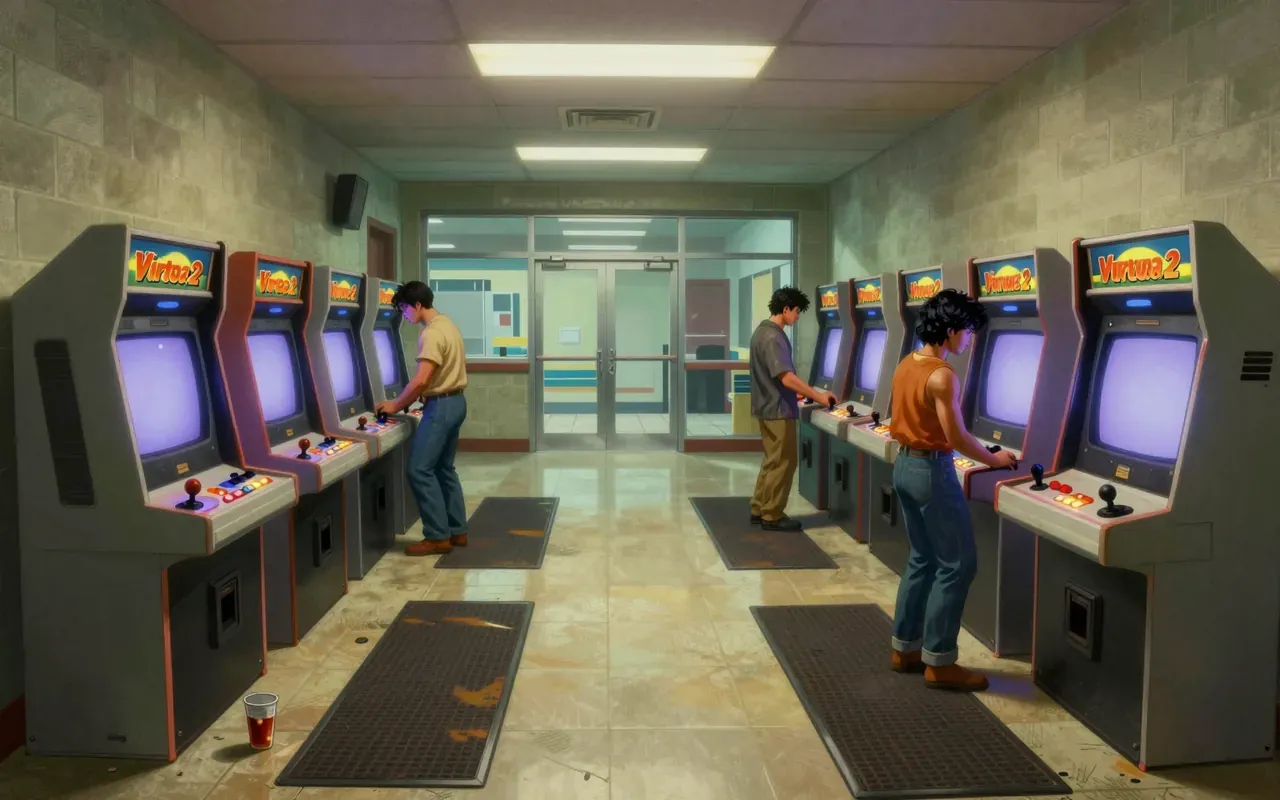
Virtua Fighter 2 is a 3D one-on-one fighting game developed by Sega AM2 for the Sega Model 2 arcade system board. It introduced adjustable arena size and infinite health, enabling sumo-style ring-out play. All characters share core mechanics like universal throws, while differing in style and expanded move sets including counters and throw prevention. It features motion-captured, texture-mapped 3D characters running at 60 FPS. It became Sega's best-selling arcade title of all time.

11:11

Grand Theft Auto: San Andreas

Rockstar Games · 2004

Grand Theft Auto: San Andreas is an action-adventure game published by Rockstar Games in 2004. Players control Carl 'CJ' Johnson in a third-person open world representing a fictionalised California and Nevada. The world comprises three cities—Los Santos, San Fierro, and Las Venturas—connected by rural and desert areas. Cities unlock progressively through the story; airports allow fast travel between them. Players complete linear story missions with fixed objectives, and may freely explore and undertake optional side missions. Navigation includes running, swimming, and vehicle use; combat includes melee, firearms, explosives, dual-wielding, and drive-by shootings. Weapons are acquired via purchase, looting corpses, or finding them scattered across the world. Safehouses—purchasable locations—are used to save progress and store vehicles. The game introduces role-playing elements such as character customisation, skill progression, gang territory control, and relationship management.

11:13

Crysis (video game)

Crytek · 2007

Crysis is a first-person shooter developed by Crytek and published by Electronic Arts. It was released on PC in November 2007. It casts the player as Delta Force soldier Nomad on a hostile tropical island. Its core design premise is 'adaptive tactics'—requiring players to shift between stealth, aggression, lethality and mobility based on terrain, enemy placement and Nanosuit energy state.

11:14

Spore (2008 video game)

Maxis · 2008

Spore is a Maxis-developed simulation game released in 2008 where players guide a species from single-cell origins through five evolutionary phases toward spacefaring capability, with defined goals including spaceship construction and reaching the galactic core.

11:14

Metroid Prime

Retro Studios · 2003

Metroid Prime redefined what a 3D adventure could be — not through spectacle, but structure.

11:16

TrackMania

Nadeo · 2003

TrackMania (2003) by Nadeo is a racing game built around player-authored tracks, checkpoint-driven time trials, and non-interactive concurrent multiplayer. It prioritises iterative lap refinement over narrative, shared space over shared stakes, and file-based exchange (.gbx) over centralised distribution. Its design assumes a player who wants to build, break, and rebuild a single corner until it yields perfection—and who finds satisfaction in that loop alone.

11:18

Soulcalibur (video game)

Namco · 1998

Soulcalibur (1999, Dreamcast) is Namco’s weapon-based fighting sequel to Soul Edge. It introduces eight-way sustained movement, forgiving input buffering, and expanded Guard Impact mechanics. Its design centres on weapon-driven character styles, tactical movement interacting with ring-out, and diversity in weapon behaviour and clash reactions.

11:22

Heretic (video game)

Raven Software · 1994

Heretic (1994) is a first-person shooter developed by Raven Software. It is the first entry in the Serpent Riders trilogy and is set in the dark fantasy world of Silverspring. The game uses a modified Doom engine to deliver level-based combat, key-driven progression, and fantasy-themed interactivity.

11:23

Red Dead Redemption

Rockstar Games · 2010

Red Dead Redemption is a third-person, open-world action-adventure game developed by Rockstar Games using the Rockstar Advanced Game Engine (RAGE). It is set in fictionalised versions of the Western United States and Northern Mexico—specifically the regions of New Austin, West Elizabeth, and Nuevo Paraíso. Players control John Marston through linear story missions, then his son Jack in the epilogue. Core gameplay revolves around horse travel, Dead Eye–enhanced gunfights, a morality-based Honor/Fame system, dynamic random events, and a bounty mechanic triggered by crimes. An online multiplayer mode supports up to 16 players in cooperative and competitive modes set in a recreation of the single-player world.

11:24

Virtua Fighter (video game)

Sega · 1994

Virtua Fighter (1994) is the first 3D fighting game. It uses wireframe and flat-shaded quad polygons. Movement is restricted to two dimensions within a 3D space. It has eight playable characters, each with distinctive moves. Single-player mode requires fighting all eight in fixed order, then facing boss Dural. Matches are best-of-three, won by knockout, ring-out, or higher health at round end. Controls are limited to a stick and three buttons: punch, kick, guard. A port was bundled with the Sega Saturn at Japanese launch and sold at nearly one-to-one ratio with the console. Virtua Fighter and Virtua Fighter 2 together became Sega's best-selling arcade games of all time.

11:24

The Last of Us Part II

Naughty Dog · 2020

A post-apocalyptic third-person action-adventure game set in a United States overrun by humans infected with a Cordyceps-like disease. It follows the plight of Ellie and Joel—and later Abby—as they navigate trauma, vengeance, and survival.

11:25

Quake 4

Raven Software · 2005

Quake 4 is a movement-first FPS built on Quake’s legacy, not its future.

11:26

Red Dead Redemption 2

Rockstar Games · 2018

Red Dead Redemption 2 is a meticulously simulated Western world built on procedural consequence — not player authorship.

11:28

Halo 3

Bungie · 2007

Halo 3 is a first-person shooter released on September 25, 2007, by Bungie. It is the third mainline Halo title. It features on-foot and vehicular combat, a fixed loadout system, and Forge—a real-time, budget-limited map editor for multiplayer maps.

11:30

Project Gotham Racing 2

Bizarre Creations · 2003

Project Gotham Racing 2 is a tightly wound, mode-structured arcade racer that asks players to master rhythm, timing and spatial awareness — not just acceleration. Its Kudos system creates a distinct performance grammar. Its fidelity is tangible: in polygon count, microphone count, and circuit variety. But it offers no narrative, no online play, and no cross-mode progression. It is a studio-built showcase — not a player-built world.

11:30

Super Mario 64

Nintendo · 1996

Super Mario 64 is a 1996 Nintendo 64 platform game and action-adventure title. It is the first Super Mario game with 3D graphics and a large open world. Bowser invades Princess Peach’s castle, kidnaps her, and hides Power Stars in magical paintings. As Mario, the player traverses levels and collects Power Stars to unlock areas of the castle, reach Bowser and rescue Peach. Mario’s abilities are far more diverse than in previous games. He can walk, run, jump, crouch, crawl, climb, swim, kick, grab objects, and punch using the game controller's analog stick and buttons. He can execute special jumps by combining a regular jump with other actions, including the double and triple jumps, long jump, backflip, and wall jump. The player can adjust the camera—operated by a Lakitu broadcasting Mario—and toggle between first-person and third-person view.
11:32

Zork

Infocom · 1977

Zork is a text adventure game developed by Infocom, released in episodic form starting in 1977, where players explore the abandoned Great Underground Empire by issuing natural-language commands to a sarcastic, conversational parser.
11:34

Hades (video game)

Supergiant Games · 2018

Hades is a tightly wound action roguelike where Zagreus fights through randomized rooms in the Underworld to reach Mount Olympus. Combat relies on five precise inputs — attack, special, dash, magic, summon — with Boons from Olympians reshaping their effects each run. Death is frequent but productive: treasure funds permanent upgrades and narrative advances in the House of Hades between attempts. Rooms draw from pre-set layouts rather than generating freely, so variety emerges from enemy placement and Boon synergies — not spatial novelty. The game demands repetition, rewards pattern mastery, and ties every failure to forward motion. It is not about discovering new spaces, but mastering how known tools behave under shifting divine influence.

11:36

Fatal Frame II: Crimson Butterfly

Tecmo · 2003

Fatal Frame II: Crimson Butterfly is a survival horror game developed and published by Tecmo in 2003. Players control Mio Amakura exploring the haunted Minakami Village, often alongside or searching for her sister Mayu. Exploration uses a fixed third-person camera, shifting to first-person when using the Camera Obscura—the primary tool for solving puzzles (via photographing objects and solving riddles) and fighting ghosts. Ghosts are signaled by coloured filaments (blue for friendly, red for hostile), and combat requires precise framing and timing, including mid-attack shots and the 'Shutter Chance' mechanic. Mayu’s presence aids puzzle-solving but also exposes her to ghost attacks, and both sisters’ health is critical—excessive damage ends the game. The narrative centres on a cursed twin ritual tied to the village’s history, with multiple endings determined by player choices, especially regarding Mayu’s fate.

11:38

The King of Fighters XIV

SNK · 2017

The King of Fighters XIV is a 2016 2D fighting game developed by KOF Studio and published by SNK. It is the fourteenth main installment in The King of Fighters series. It is the first game in the series to be rendered entirely in 3D, although gameplay is restricted to a 2D plane. The game was released worldwide for the PlayStation 4 in August 2016 and ported to Windows and Japanese arcade cabinets in June 2017.

11:39

Borderlands (video game)

Gearbox Software · 2009

Borderlands (2009) is a role-playing shooter developed by Gearbox Software. It combines first-person shooter action with RPG systems—including four distinct Vault Hunters, branching skill trees, mission-driven progression, and a procedural loot engine generating over 15 million weapon and gear variations. Its cell-shaded-like art style gives Pandora a comic-book appearance. Players fight hostile wildlife and human forces on the fictional planet while seeking a fabled Vault.

11:43

Dwarf Fortress

Bay 12 Games · 2006

Dwarf Fortress is a procedural simulation that demands reading over reacting, patience over progress, and interpretation over instruction. Its strength is systemic coherence—not accessibility.

11:44

Tony Hawk's Pro Skater 3

Neversoft · 2001

Tony Hawk's Pro Skater 3 is the pivot point where the series’ combo grammar expanded and online play entered—raw, hardware-bound, and version-dependent.

11:47

Virtua Fighter 5

Sega · 2006

Virtua Fighter 5 is a rigorously tuned, system-first 3D fighter built for deep spatial and temporal literacy. Its design assumes player investment in frame data, ring geometry, and layered defensive logic—not spectacle or hand-holding.

11:50

Castlevania: Symphony of the Night

Konami · 1997

Castlevania: Symphony of the Night restructures the action genre around exploration, transformation, and consequence. It replaces linearity with layered access. It replaces exposition with environmental logic. It replaces certainty with discovery — and demands the player pay attention.

11:52

Tony Hawk's Underground

Neversoft · 2003

Tony Hawk's Underground (2003, Neversoft) shifts the franchise from abstract high-score chasing to a story-anchored, exploration-led skate experience. Its trick system remains tightly tuned — ollies initiate combos, grinds demand stick precision, and the balance meter enforces constant correction. Narrative goals provide structure but little weight. Customisation and level editing add longevity. It rewards spatial fluency and repetition, not cinematic immersion.

11:54

Super Metroid

Nintendo · 1994

Super Metroid is a 2D side-scrolling action-adventure game set on the fictional planet Zebes, where Samus Aran pursues a Metroid stolen by Ridley. Its design revolves around non-linear exploration, directional combat, and progressive ability-gated traversal using power-ups like Morph Ball, Spring Ball, and Speed Booster. Movement mechanics—including wall jumping and Moon Walking—expand spatial agency. Systems like the automap, inventory screen, and save stations structure progression. The game is part of Nintendo's Metroid franchise and was sold as an individual title among more than 5.9 billion Nintendo games sold worldwide.

11:58

Gunpoint (video game)

Tom Francis · 2013

Gunpoint is a stealth-based puzzle-platform game where players control freelance spy Richard Conway to infiltrate buildings, avoid guards, and bypass security using gadgets like the Crosslink tool.

12:00

Super Mario World

Nintendo · 1990

Super Mario World is a 2D side-scrolling platformer for the SNES, built around dual-layer navigation (overworld map + linear side-scrolling levels), expanded movement mechanics (Spin Jump, Cape Feather flight/gliding), and new systems like Yoshi riding, power-up storage, and secret Star Road routes.

12:01

Final Fantasy XIV: Endwalker

Square Enix · 2021

Endwalker delivers narrative closure and mechanical polish—but only to those already inside Final Fantasy XIV’s walls.

12:03

Persona 3

Atlus · 2006

Persona 3 is a PlayStation 2 RPG released by Atlus in 2006. It combines traditional RPG mechanics with simulation elements. The game follows the protagonist, who balances their daily life of going to school and building relationships with others with fighting the monstrous Shadows during the Dark Hour. Each day is divided into daytime and evening segments. Except for scripted events, such as plot progression or special events, the player is free to choose how each day is spent, with most activities causing time to pass. The types of activities and characters that can be interacted with vary depending on the day of the week and time of day. Additionally, some activities are limited by the protagonist's three attributes; Academics, Charm, and Courage, which can be built by performing various activities or making certain correct choices. During the evening, players can choose to visit Tartarus, the game's main dungeon, where they can build their party's experience and gain new items. On the day of the full moon, players will participate in a boss battle to progress the story.

12:05

BeamNG.drive

BeamNG · 2015

BeamNG.drive is a sandbox vehicle simulation game built around soft-body physics. It features career mode, campaigns, time trials, and free roam. Campaigns consist of small scenarios themed around races, chases, and stunts. In time trials, players compete against their own best time using selected vehicles, maps, and routes. In free roam, players can operate, place, and manipulate objects and vehicles within maps. They can also change environmental properties such as time, gravity and wind. Players can utilize various objects ranging from road barriers to weapons such as cannons in order to inflict damage on other vehicles.

12:08

Total War: Shogun 2

Creative Assembly · 2011

Total War: Shogun 2 is a systemic strategy game that demands sustained attention across long sessions. It gives players deep control over settlement, economy, religion, diplomacy, and battlefield tactics—but offers no hand-holding for their interplay. Its strength lies in enforced trade-offs: ashigaru versus samurai, stealth versus siege, faith versus expansion. It assumes competence, not curiosity.

12:10

Just Dance (video game)

Ubisoft · 2009

Just Dance (2009) is a Wii-exclusive rhythm game published by Ubisoft. Players use only the Wii Remote in their right hand to mirror on-screen dancers’ choreography. Moves are scored X, OK, or Great. Shake moves trigger a shake meter for bonus points. Each song has two scoring targets: 10,000 (Standard) and 15,000 (Master). Four modes include Standard, Warm Up, Strike a Pose, and Last One Standing. It is one of Ubisoft’s core, long-running franchises.

12:14

Thief II

Looking Glass Studios · 2000

Thief II is a foundational immersive sim built on light, sound, and consequence. It asks players to move like a thought — unseen, unheard, deliberate. Its design remains coherent decades later. Its pacing and opacity do not.

12:21

The Bard's Tale II: The Destiny Knight

Interplay · 1986

The Bard's Tale II: The Destiny Knight is a 1986 Interplay dungeon crawl that expands the first game’s scope with six cities, an explorable wilderness, banks, casinos, and the Archmage class — but retains its opaque interface and unrefined pacing.

12:27

Uncharted 2: Among Thieves

Naughty Dog · 2009

Uncharted 2: Among Thieves is a third-person action-adventure platformer for PlayStation 3. It is developed by Naughty Dog. It continues the studio’s first approach to realistic worlds and characters. It constrains player action through fixed weapon loadouts, scarce grenades, and environment-locked traversal. It ties puzzle-solving to journal entries. It runs on a proprietary engine built for the PlayStation 3’s Cell architecture.

12:35

Hitman: Codename 47

IO Interactive · 2000

Hitman: Codename 47 is a foundational stealth-action hybrid built on compromise: a forced pivot from MMO to shooter, then reshaped by executive vision into something slower, tenser, and more systemic. It rewards silence with money, punishes civilian deaths with deductions, and forces players to drag bodies to avoid alerts — all while running on a bespoke engine that pioneered ragdoll physics. Its brilliance lies in how it stitches together ideas from Deus Ex and Thief, then bends them around corpse logistics. Its flaw is that it never fully sheds its run-and-gun roots — some levels abandon stealth outright, and movement remains stubbornly unrefined. It is not a polished experience. It is a working blueprint.

12:42

Dark Souls (video game)

FromSoftware · 2011

Dark Souls (2011) is a third-person action role-playing game and the first entry in a trilogy. It defines the Soulslike subgenre through high difficulty, environmental storytelling, and an interconnected world governed by deliberate, iterative gameplay.

12:48

The Secret of Monkey Island

LucasArts · 1990

A foundational point-and-click adventure that prioritised interface clarity and consequence-free exploration over challenge or realism.

12:52

Far Cry 3

Ubisoft Montreal · 2012

Far Cry 3 is a first-person shooter set on a pirate- and mercenary-controlled tropical archipelago. Ubisoft Montreal developed it in 2012 using the Dunia engine, building on its work with Far Cry 2.

13:26

Halo: Combat Evolved

Bungie · 2001

Halo: Combat Evolved is a foundational console FPS that redefined player agency through hardware-aware design — not open-ended freedom, but tightly scoped, controller-optimised loops of movement, shielding, and vehicle-based pacing.